

Below, we show where the rest of that money goes, where to find both numbers in YouTube Analytics, and why, since August 2026, the view count under your video is no longer the number your RPM is based on.
Key takeaways
- CPM shows what the advertiser pays. RPM shows what you receive.
- RPM is usually lower because it counts every engaged view, including views with no ad, and it comes after YouTube's 45% share.
- You manage your income through RPM. The Google Ads auction sets CPM, and you influence it only indirectly.
- To plan income, divide your monthly goal by your RPM and multiply by 1,000: at the $2.30 median RPM in our research of 300 channels, $2,000 a month takes about 870,000 engaged views.
RPM dropped this month?
Start with the real reason your RPM dropped and what you can do about it. If MilX guides help you, add MilX to your preferred sources in Google.
The difference between CPM and RPM on YouTube
CPM vs RPM on YouTube comes down to whose money you count:
- CPM measures advertiser cost,
- RPM measures creator revenue.
It is the same money, seen from opposite ends.
|
Parameter |
CPM |
RPM |
|
Whose number |
The advertiser's |
Yours |
|
Counted per |
1,000 ad impressions |
1,000 engaged views, with or without ads |
|
Before or after revenue share |
Before |
After YouTube's share (55% of long-form ad revenue goes to you) |
|
Revenue it counts |
What advertisers pay for ads |
Ads, YouTube Premium, channel memberships, Super Chat, Super Stickers |
A brand bids in Google Ads, and the winning price becomes your CPM.
YouTube Analytics then takes out YouTube's share, adds your other revenue, and spreads the total over all views.
That result is RPM, and it is what reaches AdSense.
One common mix-up: CPM is not the cost per 1,000 views. It is the cost per 1,000 ad impressions, and one view can carry several ads or none at all.
YouTube calculates RPM per 1,000 engaged views, so the public counter under your video can be higher than the views your revenue is spread over.
Since August 24, 2026, YouTube counts a view as soon as a video starts to play. The stricter count, where the viewer clicked to watch or kept watching past the first few seconds, is now called an engaged view, and YouTube's ad revenue analytics guide uses it for RPM.
On two kids' channels in the AIR Media-Tech network, only 56% of public Shorts views were engaged views after the channels launched Shorts in 2025.
Not every engaged view earns from ads, either. Across the 300 channels in our research, the median channel showed an ad on 53% of its views.
To estimate income, multiply engaged views from YouTube Analytics by your RPM, not the public view count.
🎯 Practical tip: compare your top five videos by CPM with your top five by RPM. High CPM with low RPM points to too few monetized playbacks.
Where to find CPM and RPM in YouTube Analytics
Both live in YouTube Studio under Analytics → Revenue: RPM on the Revenue tab, and CPM, playback-based CPM, ad impressions, and monetized playbacks one click deeper in Advanced mode ("See more").
|
Metric |
Where in YouTube Analytics |
What it affects |
How to improve it |
|
RPM |
Revenue tab |
Your income per 1,000 views |
Raise the monetized playback rate, add non-ad revenue |
|
CPM |
Advanced mode |
Advertiser price per 1,000 impressions |
High-CPM geographies, advertiser-friendly videos |
|
Playback-based CPM |
Advanced mode |
Earnings per monetized playback |
8+ minute videos with mid-rolls |
|
Estimated monetized playbacks |
Advanced mode |
Monetized playback rate (fill rate) |
Fix limited-ads icons, set the audience correctly |
|
Ad impressions |
Advanced mode |
Ads served |
Mid-rolls at natural breaks |
|
Revenue sources |
Revenue tab |
Mix of ads, Premium, memberships, Supers |
Memberships, live Supers |
|
Revenue by geography |
Advanced mode, Geography |
Countries that fund your RPM |
Translated metadata |
🎯 Practical tip: build one Advanced mode table with views, monetized playbacks, CPM, playback-based CPM and RPM per video, and check it every Monday. The videos with the lowest monetized playback rate are your quickest wins.
How to calculate CPM, RPM, and playback-based CPM
Four formulas cover the whole chain, all in one format: amount ÷ units × 1,000.
- CPM = advertiser spend ÷ ad impressions × 1,000;
- Playback-based CPM = advertiser spend ÷ monetized playbacks × 1,000;
- RPM = your total revenue ÷ engaged views × 1,000;
- Monetized playback rate (what ad teams call fill rate) = monetized playbacks ÷ engaged views × 100%.
|
Step |
Number |
Calculation |
|
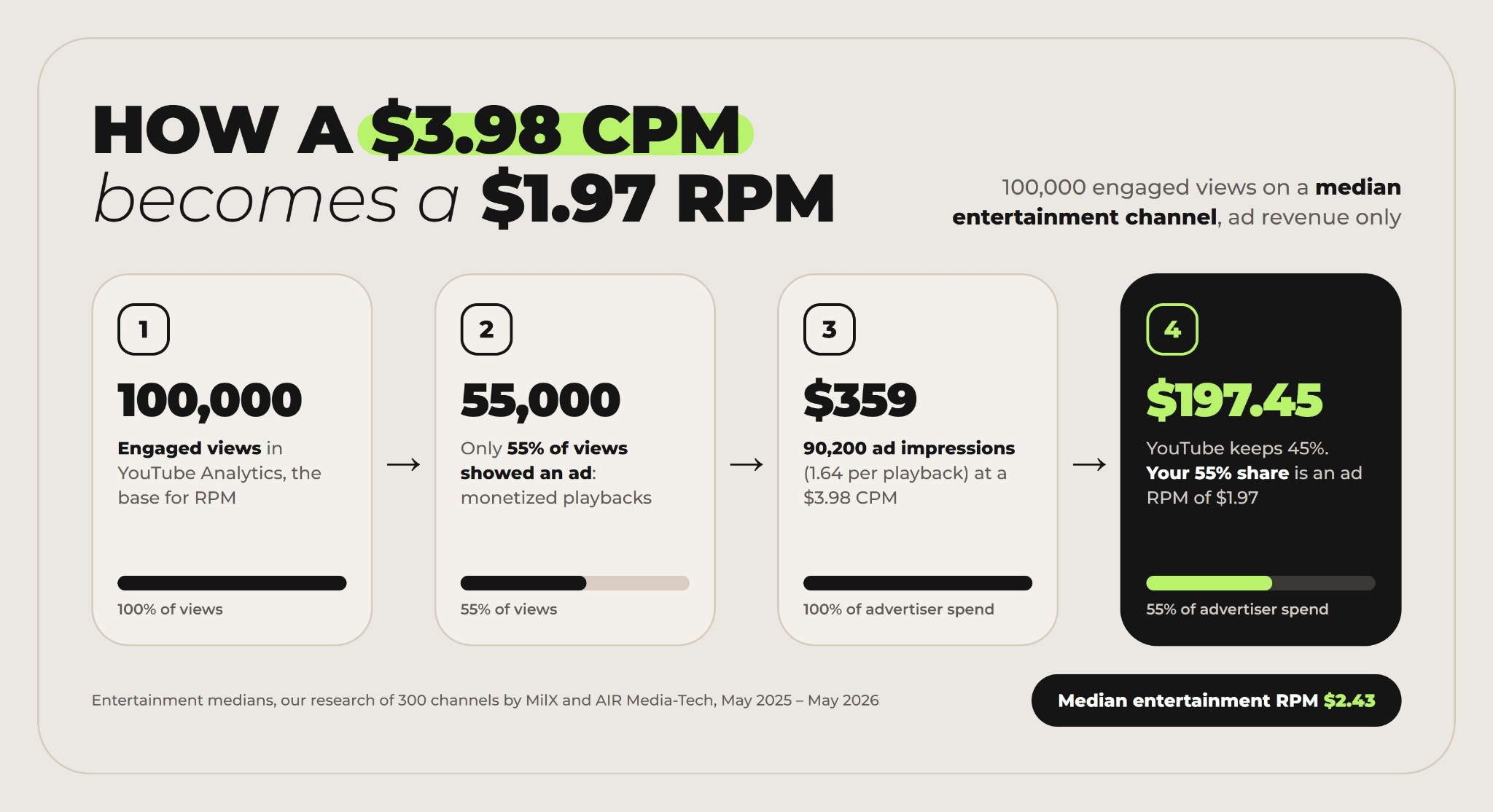
1. Engaged views |
100,000 |
From YouTube Analytics |
|
2. Monetized playbacks |
55,000 |
55% of views showed at least one ad |
|
3. Ad impressions |
90,200 |
1.64 ads per monetized playback |
|
4. Advertiser spend |
$359 |
90,200 impressions at a $3.98 CPM |
|
5. Playback-based CPM |
$6.53 |
$359 ÷ 55,000 × 1,000 |
|
6. Your ad revenue |
$197.45 |
55% of $359 |
|
7. Ad RPM |
$1.97 |
$197.45 ÷ 100,000 × 1,000 |
Every input is a median for entertainment channels in our research of 300 channels (May 2025 to May 2026).
The shortcut that ties it together:
RPM ≈ playback-based CPM × monetized playback rate × 0.55 + other revenue per 1,000 views.
In the example, a $6.53 playback-based CPM × 55% of views with ads × 55% creator share = $1.97 from ads alone. The median entertainment channel in the same research had a $2.43 RPM, because RPM also counts YouTube Premium, memberships and Supers, and medians of separate metrics never multiply exactly.
Each part of the formula is a separate lever: price per playback, share of views with ads, and income that doesn't depend on ads.
To turn RPM into a monthly view target, divide your income goal by your RPM and multiply by 1,000. We worked it through for $1,000 to $10,000 a month in how much YouTube pays per view.
Playback-based CPM and why it's higher than CPM
Take a 20-minute video with three mid-rolls and a 6-minute video with one pre-roll. They can share a $10 CPM and still earn very different amounts per viewer, because CPM prices each ad, not each viewer.
Playback-based CPM is what advertisers pay per 1,000 playbacks that showed at least one ad, so it captures how many ads each viewer actually saw.
YouTube's ad revenue analytics guide lists both metrics side by side, so creators often read the bigger number as their CPM and then wonder why the payout looks small.
How big is the difference in practice? YouTube's own example in the ad revenue analytics guide gives a $3.50 CPM and a $4.67 playback-based CPM for the same video. In our research of 300 channels, a monetized playback carried 1.55 ads at the median, which is why playback-based CPM is the better number for comparing formats.
🎯 Practical tip: divide playback-based CPM by CPM. A result near 1.0 means one ad per viewer, usually because your videos run under 8 minutes.
Why your RPM is usually lower than your CPM
YouTube names two reasons: RPM comes after the revenue share, and it includes views with no ads.
- Revenue share is 55%. On long-form videos, YouTube pays creators 55% of net ad revenue. On Shorts, creators receive 45% of the revenue allocated to them, based on view share.
- Unmonetized views. Ad blockers, markets with no advertiser demand, limited-ads videos, and made-for-kids restrictions all create views with no ads. Each one lowers RPM and leaves CPM untouched.
Kids content shows the widest gap: in our research of 300 channels, kids channels showed an ad on only 32% of their views. That gap comes from COPPA ad restrictions on content made for kids.
So "RPM is always lower" is close, but not quite right. RPM can beat CPM when memberships, Supers, and YouTube Premium bring a large share of revenue, because that money counts in RPM and never passes through the ad auction.
A Ukrainian-language entertainment channel in the AIR Media-Tech network earns 60% of its revenue from memberships, money its CPM never shows.
RPM also leaves some of your income out. YouTube's ad revenue analytics guide says it doesn't include merch shelf sales, brand deals and sponsorships (other than YouTube Creator Partnerships), or money YouTube brings you indirectly, such as consulting.
What affects CPM and RPM in 2026
Some of these factors you can change, and some you can only plan around. Here's how each one shows up in our research of 300 channels (May 2025 to May 2026).
- Season. The median RPM peaked at $2.35 in November and fell to $1.56 in January, about 34% lower. The Q4 lift depends on the niche: about +60% in business and finance, though that niche had only three channels.
- Audience country. MilX data on YouTube CPM by country puts US viewers at about $14.67 per 1,000 ad impressions and Indian viewers at about $0.74, a 20x gap on the same content.
- Share of views with ads. Education channels showed an ad on 77% of their views, gadgets and tech channels on 34%, kids channels on 32%. That's how a $5.73 tech CPM turns into a $2.33 RPM.
- Ads per view. A monetized view carried 1.55 ads at the median. Videos of 8 minutes or longer can run mid-roll ads, which raises this number.
- Channel size, barely. Small channels (10K–100K subscribers) had a $2.14 median RPM, and medium ones (100K–10M) had $2.04. More subscribers bring more views, not a higher rate.
How your RPM compares with your niche
A good RPM depends on your niche first. Benchmark against medians from real YouTube Studio dashboards, not advertiser estimates: in our research of 300 channels (May 2025 to May 2026), the median RPM across 13 niches was $2.30.
|
Niche |
Median RPM |
Middle 50% of channels (RPM) |
Median CPM in YouTube Studio |
|
Education & Science |
$10.22 |
$2.31 – $19.50 |
$5.91 |
|
Lifestyle |
$2.98 |
$1.77 – $5.24 |
$5.32 |
|
Entertainment |
$2.43 |
$0.88 – $5.02 |
$3.98 |
|
Gadgets & Tech |
$2.33 |
$0.70 – $3.71 |
$5.73 |
|
Gaming |
$2.05 |
$0.70 – $3.62 |
$4.05 |
|
Business & Finance* |
$2.01 |
$0.73 – $5.17 |
$4.84 |
*Fewer than ten channels in the sample, so treat this row as directional.
Compare yourself with the middle range of your own niche. Inside one niche, the top quarter of channels earns 3 to 8 times what the bottom quarter does, so a gaming channel at a $3.70 RPM is already in its top quarter.
Kids content sits far lower, at a $0.33 median, and Shorts RPM stays between $0.07 and $0.20 in most niches, according to our research of 274 channels (by MilX and AIR Media-Tech).
For rates by country and by month, see MilX's 2026 CPM and RPM rates.
🎯 Practical tip: benchmark against your niche first, then against your own 12-month median. A gaming RPM next to a finance RPM tells you nothing useful.
You know your RPM. When does the money arrive?
Your June views earn in June, and AdSense pays for them in late July. MilX Advance Funds lets you reach up to 2 months of revenue your channel has already earned, up to 50 days before AdSense pays, for a one-time 4.3% fee.
See how Advance Funds works →How to increase RPM in 2026: one lever for each part of the formula
The formula above has three parts, and each one is a separate lever: how much advertisers pay per playback, how many views carry an ad, and how much you earn without ads.
More views alone won't do it: pranks, reactions, and meme compilations draw views advertisers pay little for, which is why some viral videos bring zero money.
For quick metadata and suitability fixes, see MilX's five RPM tweaks that work in 2026.
Longer videos with mid-rolls (more ads per playback)
YouTube allows mid-roll ads on videos of 8 minutes or longer, and since May 12, 2025, it adds automatic mid-rolls at natural breaks, including on older videos, unless you turn them off.
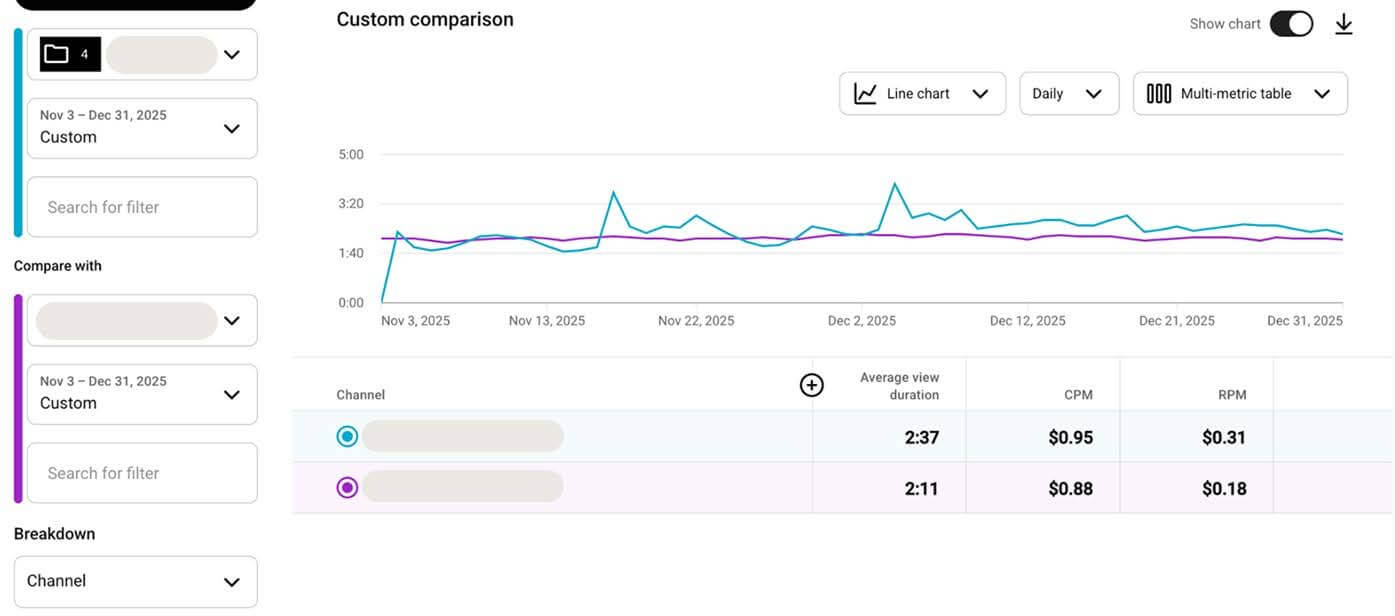
On one kids channel in the AIR Media-Tech network, the new 10-minute compilations earned a $0.31 RPM from November 3 to December 31, 2025, against $0.18 for the channel as a whole, where most videos run 2–3 minutes. CPM barely moved, $0.95 against $0.88, so the gap came from how many views carried ads and how many ads each one carried.
A Japanese-language hobby channel lengthened episodes from 20–25 to 25–30+ minutes, and revenue grew 20% while views fell 9%. About half of that came from a seasonal Q4 rise in CPM, and the rest from longer watch time.
More views with ads (a higher monetized playback rate)
Every yellow limited-ads icon cuts monetized playbacks. Appeal flagged videos that fit YouTube's advertiser-friendly content guidelines.
Set the audience correctly on every upload: content made for kids gets limited ads by design, and labeling it otherwise breaks YouTube's rules under COPPA, so the fix there is the format, not the label.
Higher-paying audiences (a higher price per playback)
Translated titles and descriptions reach viewers in new languages. Switzerland and Germany are both in the top ten of MilX's CPM by country list, and one German translation reaches Germany, Austria, and Switzerland.
Income outside the ad auction
Memberships, Supers and YouTube Premium count in RPM and don't depend on ad rates, so they lift RPM even in low-CPM niches.
A deliberate Shorts mix
In one portfolio of channels in the AIR Media-Tech network, views grew 24.2% from Q2 to Q3 2025 while revenue grew 13.7%, partly because Shorts drove much of the new traffic.
With Shorts RPM at $0.07 to $0.20 in most niches, a growing Shorts share pulls your blended RPM down.
Live streams with mid-rolls
A Korean-language kids channel in the AIR Media-Tech network added 4K live streams with live mid-rolls. Live revenue grew 77%, and total revenue rose 22% while total views fell 23%.
Losing part of every payout to your bank's exchange rate?
With MilX, your channel's earnings land on a balance you own, credited daily from the day you connect. Move them when you need them, in the currency that fits.
- Bank transfers in 54 currencies and 30+ payout methods, including BTC, USDT and USDC, on any day
- Instant Payments in under 5 minutes for 1% (minimum $1)
- Instant P2P transfers to your team on MilX, plus contracts, acts and invoices for your accountant
- Advance Funds: up to 2 months of earned revenue for a one-time 4.3%. If your channel qualifies, Active Funds adds up to 4 months of future revenue
$500M+ paid out to creators across 3,100+ connected channels, rated 4.6 out of 5 on Trustpilot. No subscription, no revenue share. MilX works with revenue earned after you connect.
Download the MilX app →