


We went through YouTube’s and the FTC’s current rules and put together what a kids creator needs: what the label switches off, why the RPM stays low, and where kids channels make their money.
Key takeaways
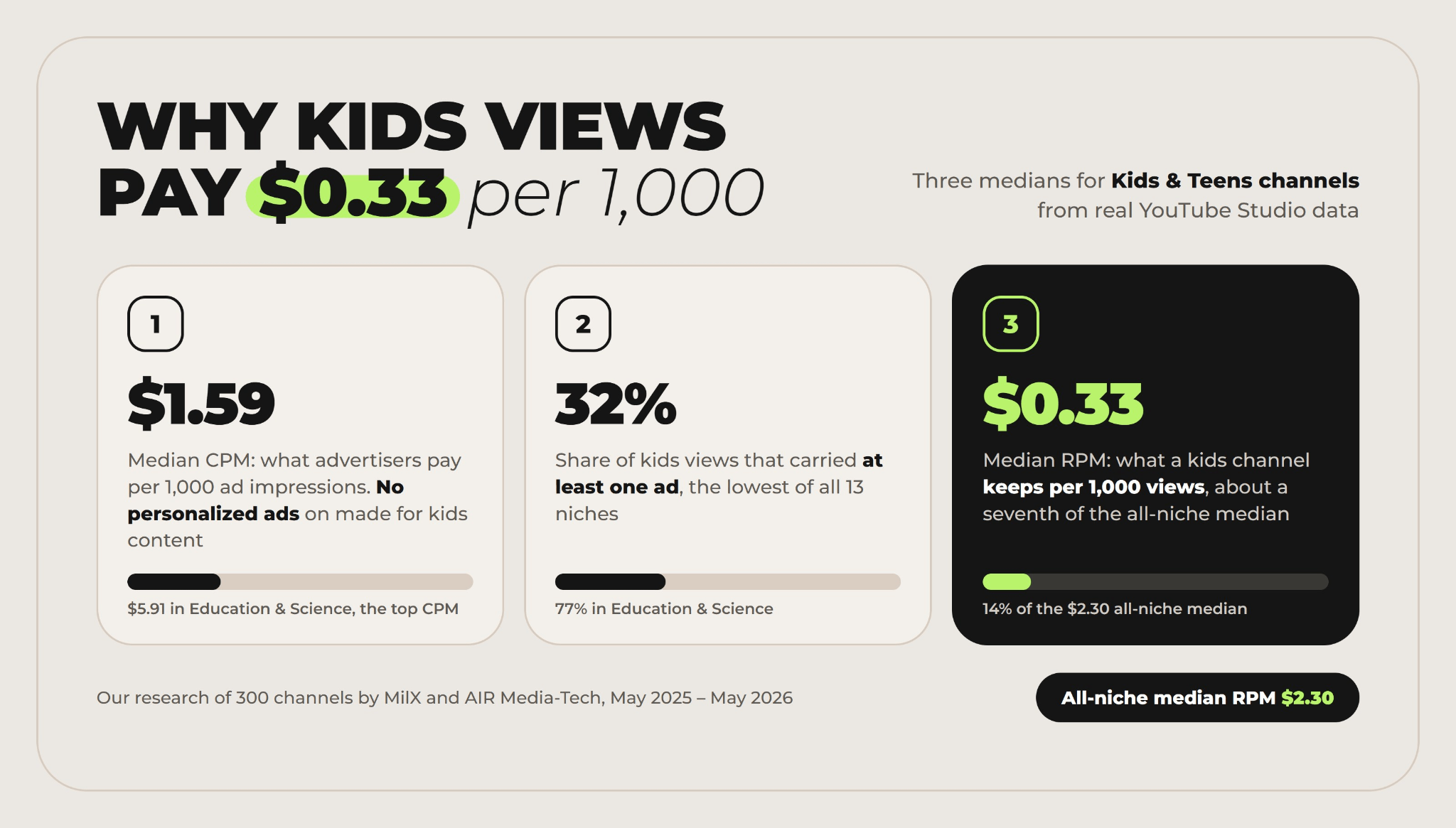
- The made for kids label lowers RPM by design, not because of a settings mistake. Kids & Teens channels had a $0.33 median RPM in our research of 300 channels (May 2025 – May 2026), against $2.30 across all 13 niches.
- Most of the gap comes from cheaper ads: without personalized ads, the kids CPM in YouTube Studio was $1.59, the lowest in the study, and only 32% of kids' views carried an ad.
- Kids channels make their real money from licensing, merch, and brand partnerships, and from huge view counts, not from the AdSense rate.
- A COPPA violation can cost up to $53,088 per violation, far more than a wrong label could ever bring in ads.
Lots of views, little money?
Kids content isn't the only category that pulls RPM down. See which content types earn next to nothing per view, and why.
See which content kills RPM →Want our updates first in Google? Add MilX to your preferred sources.
Want our updates first in Google? Add MilX to your preferred sources.
What made for kids switches off: 14 features, personalized ads included
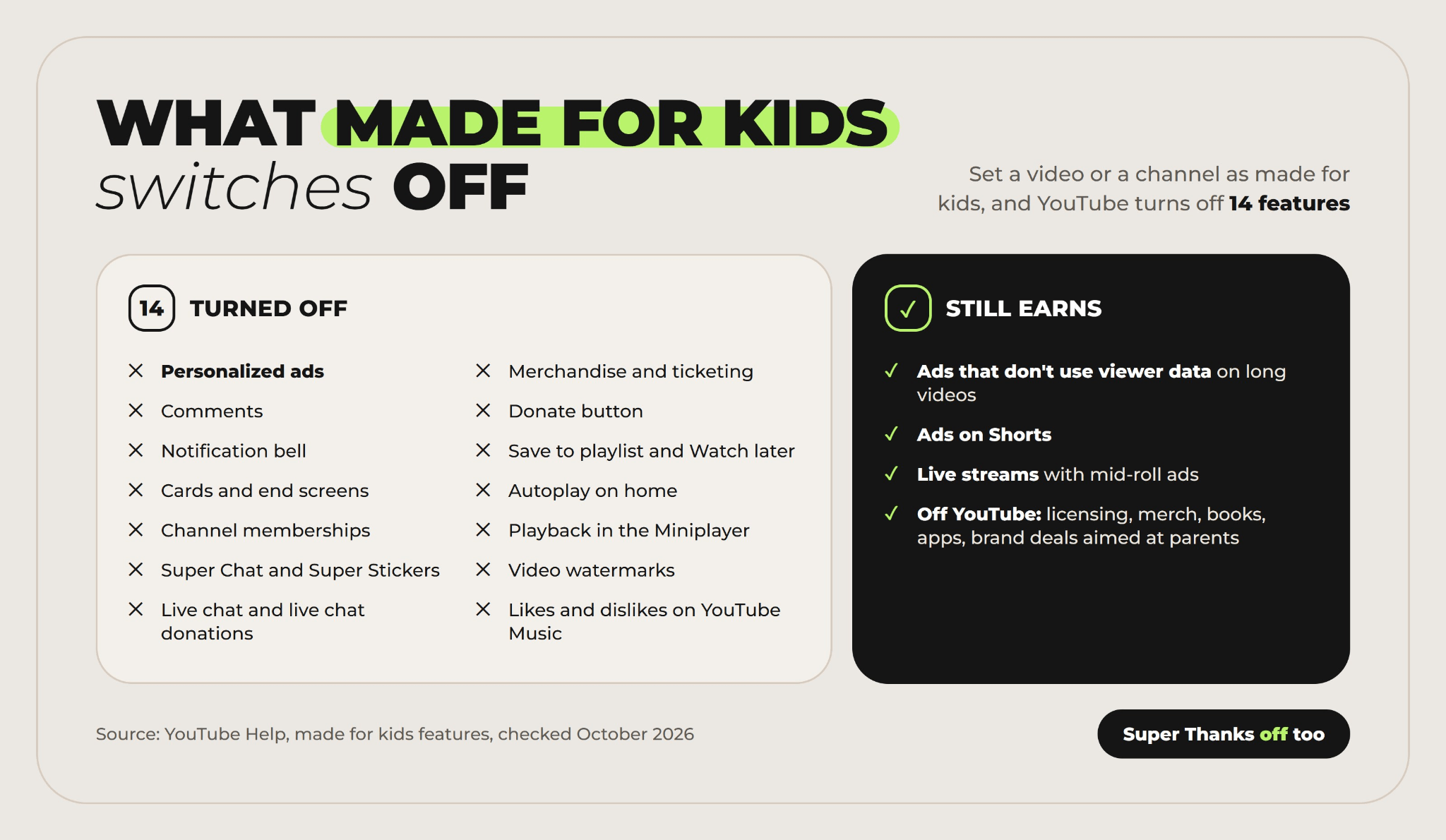
When you set a video or a whole channel as made for kids, YouTube turns off a fixed list of features. That's the COPPA rule at work: YouTube can't collect data from viewers under 13, so anything that relies on that data goes.
Here’s what changes for made for kids monetization, per YouTube Help as of October 2026:
|
Feature |
On made for kids content |
What it means for income |
|---|---|---|
|
Personalized ads |
Off |
Only contextual ads run, matched to the video instead of the viewer, so advertisers pay less per impression |
|
Ads on long videos and Shorts |
On |
Still your main income from YouTube |
|
Live streams |
On, live chat off |
Ads can run in streams, but there are no live chat donations |
|
Channel memberships |
Off |
No monthly income from fans |
|
Super Chat, Super Stickers, Super Thanks |
Off |
No tips from viewers |
|
Merchandise and ticketing |
Off |
Merch has to sell outside YouTube |
|
Donate button |
Off |
No fundraising on the video page |
|
Comments |
Off |
No comment-driven community around the channel |
|
Notification bell |
Off |
Subscribers don't get alerts about new videos |
|
Cards and end screens |
Off |
You can't send viewers to your next video from inside the video |
|
Save to playlist and Watch later |
Off |
Fewer repeat views from saved lists |
|
Autoplay on home, Miniplayer |
Off |
Fewer passive views |
The full list also includes video watermarks and likes and dislikes on YouTube Music. A channel set as made for kids also loses Posts and Ask Studio, and Super Thanks isn't available on made for kids videos or Shorts.
The YouTube Kids app, built for a younger audience, has stricter ad rules of its own: YouTube allows only in-stream video ads there, with no interest-based ads, no food or drink ads, and no clickable links.
Can you leave the made for kids label off?
Only if your videos really aren't made for kids. COPPA requires you to tell YouTube who your content is for, and YouTube's guide to setting your audience lists what makes a video made for kids: the subject, the characters, toys and games, the songs and stories, the language. Content made for parents, even about kids, is a different case.
A wrong label is a legal risk. YouTube warns that if you set your audience wrong, you may face compliance issues with the FTC and action on your YouTube account.
Why kids niche RPM is so low: $0.33 against $2.30
Kids & Teens channels had a median RPM of $0.33 in our research of 300 channels by MilX and AIR Media-Tech (May 2025 – May 2026), the lowest of 13 niches. The middle half of kids channels earned between $0.16 and $0.88 per 1,000 views.
Median RPM, May 2025 – May 2026, 300 channels
Kids & Teens channels
$0.33
per 1,000 views
All 13 niches
$2.30
per 1,000 views
That's about 7 times less per 1,000 views, from the same YouTube ad system.
Three numbers from the same research explain the gap:
- Cheaper ads. Without personalized ads, the median CPM in YouTube Studio was $1.59 for kids channels, the lowest in the study.
- Fewer views with ads. Only 32% of kids views carried an ad, against 77% for education channels. Every view without an ad still counts in RPM and earns nothing.
- Fewer ads per view. A monetized kids view carried 1.29 ads at the median, the fewest of any niche, partly because kids videos are short.
The $1–3 per 1,000 views you see in many guides is an estimate. Our numbers come from real YouTube Studio data, and they sit closer to what kids creators report themselves: on Reddit, kids channel owners compare RPMs of around $0.15.
The rate is low, but kids channels have three ways to make up for it:
- Q4. Kids RPM rose about 22% in Q4 in our research, when advertisers spend the most before the holidays.
- Shorts. In a small video-level sample from our Shorts research, with three kids channels per format, 45.7% of Shorts views carried an ad, against 12.1% of long-form views, so treat it as a direction. Among large kids channels with 10 to 50 million views a month that post 21 or more Shorts a month, Shorts brought 41% of revenue.
- Scale. Kids rewatch favorite videos, so view counts can grow faster than in most niches.
If you're weighing whether to stay in a low-RPM niche at all, here's how creators pivot an undermonetized niche without starting over.
Content rules that keep ads on kids' videos
YouTube judges kids content by its quality principles for kids and family content. A channel with a strong focus on low-quality made for kids content can be suspended from the YouTube Partner Program, and a single video that breaks the principles can get limited or no ads.
Your own characters, not the same video on repeat
Using AI is allowed on kids channels. Mass-producing videos is what costs monetization. On July 15, 2025, YouTube renamed its repetitious content policy to inauthentic content and made clear it covers repetitive and mass-produced videos. Its examples read like a description of low-effort kids animation: AI-generated content made with generic templates, templated storylines, and characters put in the same situation over and over again.
Use AI for drafts, translations, and metadata. Keep the story, the voice work, and the pacing human, and vary episodes for real. Borrowed characters like Elsa or Spider-Man bring copyright claims, while your own characters are what toy brands and streaming services later pay to license.
Calm, safe and honest
YouTube's quality principles reward videos that teach, spark curiosity, and show positive behavior. They flag content that encourages dangerous activities, wastefulness or bullying. So skip pranks, jump scares, and stunts kids could copy, and tone down flashing transitions and nonstop noise. Parents should be able to leave your video on while they cook dinner.
Keep titles and thumbnails true to the video. "Learn ABCs with Dinosaurs" tells a searching parent what they get. "Best Kids Video Ever!!!" tells them nothing, and fake "official" titles can get the video flagged.
Sell to parents, outside the video
Heavily promotional videos, such as unboxings built around products, count as low quality under the same principles. If a brand pays for a placement, turn on the paid promotion disclosure. Merch shelves are off on made for kids content, so send parents to your store outside YouTube.
Age restriction is the opposite problem: a video judged too mature loses most of its ads. If your content sits near that line, here's how to monetize sensitive topics without getting age-restricted.
Ads cover the views. What covers the rest?
Full-time creators stack several income streams on top of AdSense. See the seven that work, and which ones fit a channel like yours.
See 7 revenue streams →How kids channels make money beyond AdSense
For most kids channels, YouTube ads pay for the views, and the business is built on what the characters do outside YouTube. Here's what works with the made for kids label on:
|
Revenue stream |
Works with made for kids content? |
Who pays |
|---|---|---|
|
Ads on videos and Shorts |
Yes, without personalized ads |
Advertisers, through YouTube |
|
Live streams with mid-roll ads |
Yes, live chat off |
Advertisers, through YouTube |
|
Licensing to streaming services and TV |
Yes, outside YouTube |
Platforms and broadcasters |
|
Merch, toys, books |
Yes, sold outside YouTube |
Parents |
|
Apps and games |
Yes, outside YouTube |
Parents |
|
Brand partnerships |
Yes, with paid promotion disclosure and no hard selling to kids |
Brands |
|
Memberships, Super Chat, Super Thanks |
No |
Not available |
- Licensing. Streaming services and TV channels buy kids' libraries they can't produce themselves. This only works with characters you own.
- Merch and books. Plush toys, coloring books, and printables sell to parents through your own store. Here's how small creators turn fans into buyers with merch.
- Brand partnerships. Toy makers, children's publishers, and learning apps pay for safe, story-led placements. Talk to the parents in the description and keep the pitch out of the story.
- Apps and games. A character kids already know gives an app a head start in the store.
A kids channel where live streams brought 85% of revenue
A Korean-language kids channel in the AIR Media-Tech network, with 13 to 17 million views a quarter, switched its live streams to 4K and turned on live mid-rolls in Q4 2025. It also uploaded 35% fewer videos that quarter, so total views fell 23%. Revenue still grew 22%, because live streams went from 58% to 85% of the channel's revenue:
|
Kids channel revenue |
Jul–Sep 2025 |
Oct–Dec 2025 |
Change |
|---|---|---|---|
|
Live stream revenue |
$4,088 |
$7,247 |
+77% |
|
Revenue from other videos |
$2,931 |
$1,323 |
-55% |
|
Total revenue |
$7,019 |
$8,570 |
+22% |
|
Live share of revenue |
58% |
85% |
+27 points |
|
Live stream views |
3.66M |
5.70M |
+56% |
|
Total views |
17.24M |
13.20M |
-23% |
What to try
Stream your best episodes in 4K with live mid-rolls turned on. After a month, compare live RPM with video RPM in YouTube Studio, Analytics → Revenue.
COPPA YouTube rules in 2026: what creators are responsible for
COPPA, the Children's Online Privacy Protection Act, is a US law that limits how online services collect data from children under 13. It reached YouTube creators in 2019, when Google and YouTube agreed to pay a record $170 million to settle FTC claims, which led YouTube to introduce the made for kids setting.
- You are responsible too. The FTC says that if your content is directed to kids and personal data is collected on your behalf, for example, to serve targeted ads, you count as an operator who has to comply with COPPA.
- The fine is per violation. A court can order civil penalties of up to $53,088 per violation, according to the same FTC FAQ.
- The rule was updated. The FTC finalized changes to the COPPA Rule that limit how companies can make money from kids' data. They took effect on June 23, 2025, and companies had until April 22, 2026, to comply.
For a creator, the practical rule stays the same: set the audience correctly on every upload and every channel. YouTube then switches off the data-based features for you.
Waiting 50 days for money your views already earned?
With MilX, your channel's revenue lands on a balance you own every day from the day you connect. Advance Funds lets you reach what you've already earned up to 50 days before AdSense pays.
- Earned revenue up to 2 months early, for a one-time 4.3% on the amount you take
- Pay animators, voice actors and editors instantly with no transfer fee when they're on MilX
- Withdraw any day in 54 currencies through 30+ payout methods
- $500M+ paid out to 1,500+ creators