
Key takeaways
- Structured shows kept growing in 2026. Microdramas passed 6.5 billion views on YouTube in the first half of 2026, and their views on TV grew more than 90% year over year, according to YouTube.
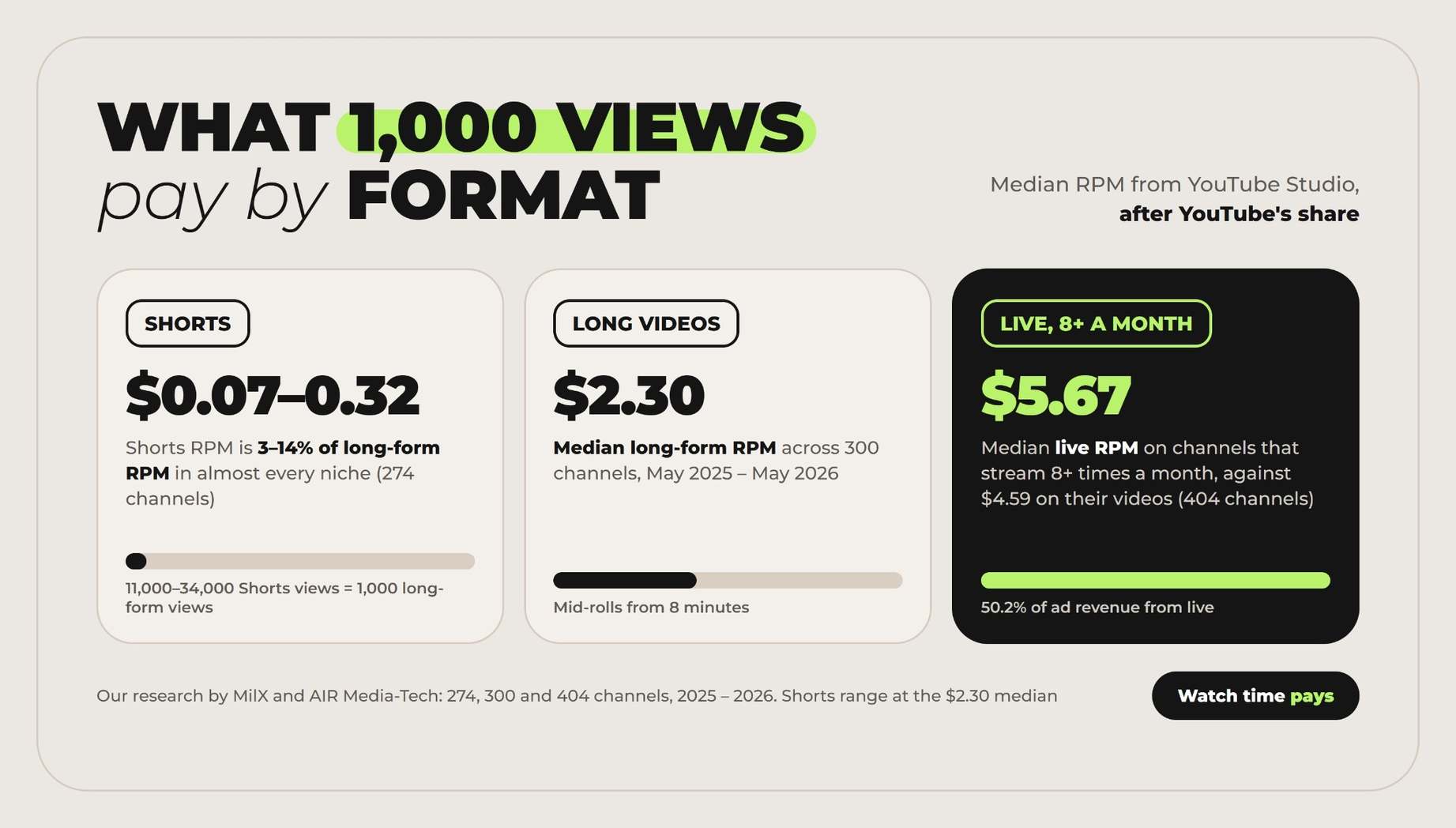
- Not every trend pays. In our research of 274 channels (by MilX and AIR Media-Tech), Shorts RPM was 3–14% of long-form RPM in almost every niche, so most channels needed 11,000–34,000 Shorts views to earn what 1,000 long-form views paid.
- Long videos win on TV. YouTube held 13.4% of all US TV viewing in April 2026, the largest share of any media company, according to Nielsen. Videos of 8 minutes or more can carry mid-roll ads.
- Live pays once it becomes a habit. In our research of 404 channels, channels that streamed 8 or more times a month earned a median 50.2% of their ad revenue from live, against 4.4% at one stream a month.
- Dubbing opens new countries at their own ad rates. More than 6 million viewers a day watched at least 10 minutes of auto-dubbed content in December 2025, and a dubbed view pays at the rate of the viewer's country.
New Formats, New Stars
What do a boxer, a comedian mom, and a 3D-printing scavenger hunt have in common?
They all drove massive growth through unexpected content formats.
- IShowSpeed turned sports chaos into a structured show, Speed Goes Pro.
- Quenlin Blackwell fed celebrities on camera, but made it comedy first.
- SleepyCrafter used hide-and-seek with handmade objects to build a cult fanbase.
YouTube's 2025 Culture & Trends report picked these channels as examples of structured, recurring shows, and the format kept growing in 2026. Microdramas passed 6.5 billion views in the first half of 2026, their watch time grew more than 50% year over year, and YouTube started rolling out Shorts series that play in order on web, mobile and TV (YouTube, September 2026). Let's see more examples.
Druski’s creator-led reality franchise:
- Started with Coulda Been House, a Big Brother-style format that reimagines reality TV inside YouTube.
- Followed up with a dating spin-off: Coulda Been Love.
- Each series lasted under 10 episodes, enough for binge appeal without viewer fatigue.
Why it worked: Familiar structure, but flipped with creator chaos. Druski’s raw improv energy kept viewers hooked, and the limited series format made it digestible.
Glitch Direct – animation with a twist:
- Glitch, known for The Amazing Digital Circus, launched Glitch Direct, a behind-the-scenes format where founders preview upcoming series in a transparent, casual vlog style.
- It blurred the line between creator and studio, pulling fans into the production pipeline.
Why it worked: Fans feel included. Instead of being passive viewers, they become part of the content development conversation.
Technoblade's posthumous rise:
- Though Technoblade passed away in 2022, his channel passed 20 million subscribers in 2025.
- His community hosted a “substravaganza” livestream and a special 20M subscriber event, keeping his legacy alive.
Why it worked: Emotional connection plus clear milestones created a viral loop of tribute and re-engagement.
Remember that advertisers love predictability. Structured formats offer exactly that.
A series still pays at the rate of its format. A long-form series earns long-form ad rates, while a Shorts series earns Shorts rates, however loyal its viewers are.
Know the trends, but not what to change on your channel?
Our 2026 trends plan turns them into steps for your format mix, packaging and revenue streams. Then add MilX to your preferred sources to see new creator data from us first in Google.
Read the 2026 trends plan →The Rise of Local Universes
Top creators in 2025 built ecosystems.
Their channels became hubs for storylines, in-jokes, side quests, and real-world interaction.
YouTube's 2026 research explains why this works. In its In Search of Mainstream report from September 2026, 69% of US viewers aged 14–29 said they had watched content from a community they consider niche, and 73% of the people surveyed called YouTube the best place to explore their interests in depth.
Germany: Community as Content
Creators in Germany are turning local spaces into shared experiences.
- Delay Sports Berlin, founded by YouTubers, built a semi-pro football club with full YouTube integration from training to game day.
- HandOfBlood hosted a costume flea market in his Berlin neighborhood, blending creator merch with offline community moments.
They’re rituals. And they keep fans coming back online and off. These shifts also reflect broader creator economy trends, where monetization, community ownership, and tool-enabled agility define the next phase of growth.
Brazil: Life as a Sitcom
Brazilian creators blurred genres so well that fans forgot where fiction ends.
- Natan por Aí turned travel into a survival game.
- Enaldinho’s shared creator house is more interactive drama than a vlog.
- Emilly Vick’s videos often reveal plot twists like discovering her sister is pregnant, triggering huge speculation in the comments.
France: Endurance as Entertainment
In France, creators proved that low-fi can still be high-impact.
- Byilhan and Nico Là live-streamed a 900 km walk from Montpellier to Paris, gaining millions of views and real-time meetups along the way.
- AnymeTV evolved from gaming to a variety-show livestream packed with comedy, chaos, and shareable bits that dominated Shorts.
Every moment became clip-worthy. Every clip became culture.

When Memes Go Global
Memes aren't noise, they’re strategy.
In 2025, the most monetizable formats weren’t planned. They were remixed.
Creators took viral sounds, AI characters, or modded games and turned them into entire content engines.
From AI Joke to Global Meme
The breakout meme of the year?
“Tung tung tung sahur,” a Ramadan-themed AI character inspired by Indonesian culture and Brainrot aesthetics.
- Over 445,000 uploads used the phrase in their titles, and 79% of them came from outside Indonesia, according to YouTube's 2025 Culture & Trends report.
- It showed up in Shorts, animations, guessing challenges, and even Roblox mods.
Smart creators adapted it to their own formats, and that’s where the views snowballed.
Labubu. Brainrot. Steal a Garden
They’re viral story ingredients.
- Labubu, a surreal toy-turned-icon, trended across France, MENA, and Brazil.
- Brainrot, with its absurdist visual style, became a universal YouTube language seen in everything from Roblox UGC to music videos.
- Roblox games like Grow a Garden and Dandy's World turned into whole content genres for gaming creators.
Meme culture went global, but the real win came from local remixing.
India’s Meme Remix Economy
In India, creators turned memes into monetizable formats:
- Horror satire + Minecraft + meme characters = sticky, rewatchable content.
- Carry Depie, Ayush More, and Wanderers Hub inserted viral moments into scripted plots, blending pop culture with game lore.
- Results: more Shorts views, watch time, and creative monetization options.
Monetization Insight
Memes, when strategically used, drive:
- Fast trend adoption → more Shorts views, though Shorts RPM was 3–14% of long-form RPM in our research of 274 channels.
- Shareable formats → perfect for building playlists and rewatch sessions.
- Local adaptation → better for engagement and brand-safe ads.
A video went viral, and the money arrives 50 days later?
With Advance Funds, MilX lets you reach revenue your channel has already earned up to 2 months early, for a one-time 4.3% on the amount you take. Put it into the next video while the trend still runs.
See how Advance Funds work →Short Form? Yes. Long Form? Still Winning
Shorts may spark discovery, but long-form builds loyalty, trust, and higher RPM.
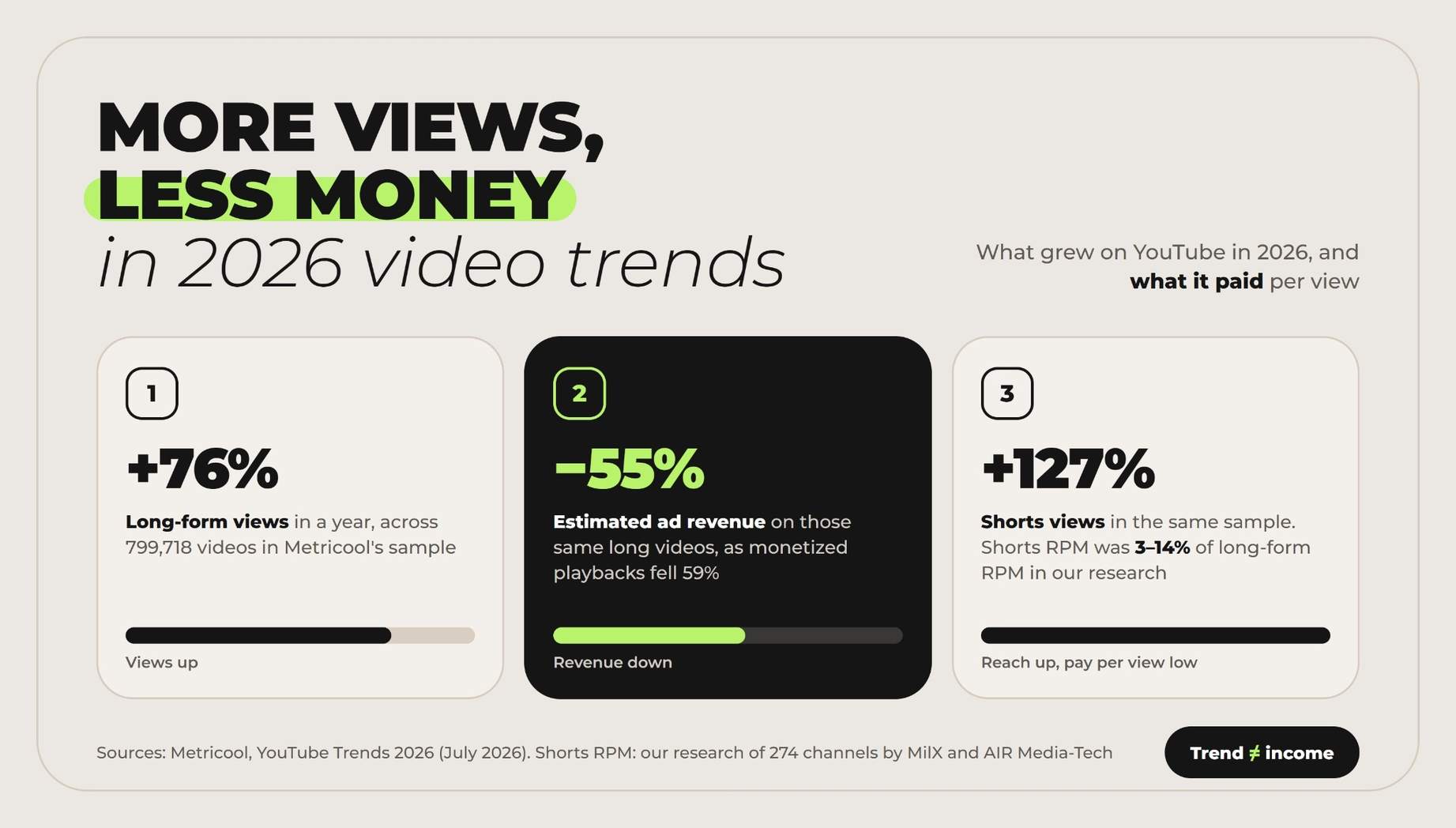
The 2026 numbers back this up. Shorts now average 200 billion daily views, Neal Mohan wrote in January 2026. In Metricool's study of 799,718 YouTube videos, published in July 2026, average views per Short grew 127% in a year and per long video almost 76%, while estimated ad revenue per long video fell 55%. In our research of 300 monetized channels (by MilX and AIR Media-Tech), the median long-form RPM was $2.30 per 1,000 views from May 2025 to May 2026, and Shorts RPM was 3–14% of that in almost every niche (the full study).
👉Learn more about the YouTube Shorts monetization.
Depth Still Delivers
- Madeline Argy built a Gen Z following with raw, 40+ minute reflections on feminism, imposter syndrome, and toxic relationships.
- Gary’s Economics explained inflation, inequality, and political shifts in 30-minute explainers with stripped-down visuals, no gimmicks.
This content didn't chase trends. It grew because it was focused, and audiences showed up to listen. In our research of 4,538,463 videos from 18,080 channels (by MilX and AIR Media-Tech), most creators published in the 5–10 minute range, and in no niche was that range where engagement peaked (the study).
Monetization Impact
Long-form is a monetization engine. Structured formats and emotionally resonant stories are now key drivers of YouTube creator monetization, especially when paired with consistent watch time and community involvement.
- More watch time = higher RPM and Premium revenue.
- Mid-roll ads fit in naturally, and YouTube lets you turn them on in monetized videos of 8 minutes or longer (YouTube Help).
-
More opportunity for creators to plug products, sponsorships, and affiliate links without feeling forced.
Shorts are great for reach. But long-form gives creators room to monetize meaningfully.
TV is where long videos get watched. YouTube held 13.4% of all US TV viewing in April 2026, the largest share of any media company in Nielsen's Gauge. Phones still bring more than 60% of views across 3,000+ channels in AIR Media-Tech's analytics, so the TV shift shows up in watch time first.
Smart Creators Mix Formats
The best creators in 2025 didn’t choose between short and long. They blended both:
- Argy uses Shorts as lead-ins to deeper videos.
- Niko Omilana, another Gen Z creator, built hour-long content on immigration and inflation, packaged with levity and social commentary.
This dual-format strategy helps maximize both discoverability and depth and supports creators looking to boost revenue per minute, not just views.
Our data puts a number on the mix. In our research of 274 channels, the strongest subscriber and revenue results came at roughly one Short for every two or three long uploads. From February 1, 2027, a channel will also need 10 million qualified Shorts views over the last 90 days to share in Shorts ad revenue, as our Shorts monetization guide explains.
For creators, this is a reminder that a smart social media content strategy now blends Shorts, long-form, and livestreams into a single storytelling system.
Music Is the Message
The most viral tracks this year weren’t pushed by industry campaigns; they were born on Shorts, spread by fans, and monetized by creators.
👉 Discover the top royalty-free music libraries.
Indonesia: From Local Sound to Global Trend
- Hiphop + dangdut = hipdut, a Gen Z music mashup that didn’t wait for radio.
- Artists like Tenxi and Naykilla built momentum through Shorts, not streaming platforms.
-
Their independent label antinrml pulled over 235 million views in 2025 thanks to dance trends and lip-sync loops, according to YouTube's 2025 Culture & Trends report.
Korea: Storytelling Still Wins
- AI characters like Hamzzi the Hamster may look synthetic, but success came from relatable narration.
- The human voice behind the character made fans connect even when the visuals were digital. The same pattern shows up in the money when AI voiceovers go up against a human voice.
- Emotion still drives repeat plays. And repeat plays = higher YouTube music revenue.
Even in AI-driven formats, creators who inject narrative win both views and loyalty.
Global: Loop-First, Lyric-Less
Creators around the world leaned into music built for the platform:
- Non-verbal tracks (like “Passo Bem Solto”) dominated global Shorts charts.
- Sounds became challenges. Challenges became formats.
- Danceable, loop-ready audio turned 15-second uploads into revenue-generating tools for both musicians and creators.
Music is also where Shorts pay closest to long videos. In our research of 274 channels, music Shorts earned 41–60% of long-form RPM, while most other niches stayed at 3–14%, because Content ID closes most of the gap for music.
Music on YouTube is now decentralized, audience-driven, and monetized through participation, not playlist placement.
From Online Broadcast to IRL Presence
The leap from screen to stadium got shorter. More creators hosted real-world events, pop-ups, and meetups not as side gigs, but as content engines. These activations weren’t one-offs. They were broadcast loops.
A livestreamed 5-a-side tournament? That’s content for Shorts, a merch drop, a sponsorship deck, and a brand collab waiting to happen. Fans showed up physically because they already felt like part of the show.
Live is now big enough to plan a channel around. More than 600 million logged-in viewers watched live content on YouTube each day in August 2026, and more than 40% of live watch time came from outside a creator's home country, YouTube said at Made on YouTube 2026. In our research of 404 channels (by MilX and AIR Media-Tech), channels that streamed 8 or more times a month earned a median 50.2% of their ad revenue from live, and their live RPM was $5.67 against $4.59 on their videos.
Direct-to-Fan Approaches That Strengthen Community
In both cases, authentic or performative, the bridge was a direct interaction.
Creators who opened DMs, hosted comment Q&As, or involved fans in polls, edits, and decisions outperformed those who only broadcast.
In 2026, that participation pays in more ways. More than 500,000 creators are already in YouTube Shopping, Neal Mohan wrote in January 2026, and in supported countries memberships, Super Chat and Super Thanks open at the first YouTube Partner Program tier, from 500 subscribers with recent uploads and watch time (YouTube Help). Fans feel part of it, too. In YouTube's September 2026 research, 60% of fans said they feel proud of the success of what they're a fan of, because they believe they helped build it.
Dubbed Content Reaches Pan-Regional Audiences
Creators in 2025 went global without changing their filming setup.
Auto-dubbed videos in Spanish, Hindi, Arabic, and Portuguese reached millions of new viewers. What mattered wasn’t perfection, but understandability and relatability.
The numbers back it up. MrBeast, who often dubbed his videos into seven Indian languages, gained more than 47 million subscribers from India in 2025, according to YouTube's 2025 Culture & Trends report. In December 2025, more than 6 million viewers a day watched at least 10 minutes of auto-dubbed content, Neal Mohan wrote.
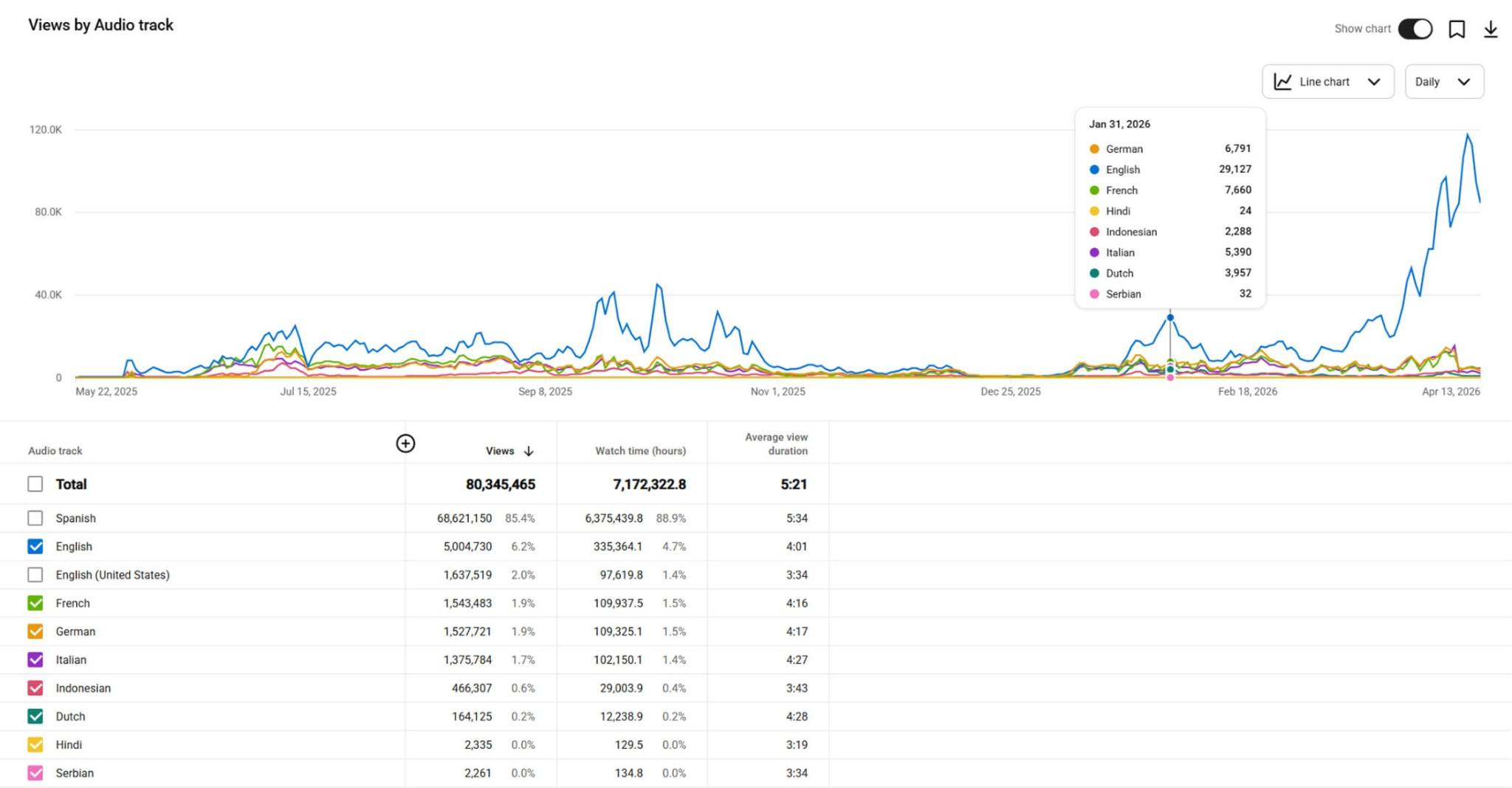
A Spanish-language channel AIR Media-Tech works with collected 80.3 million views between May 2025 and April 2026. Its AI-dubbed English, French, German and Italian tracks held viewers for 4:01 to 4:27 on average, against 5:34 on the Spanish original.
A dubbed view is paid at the rate of the viewer's country. In AIR Media-Tech's network data, an ad impression cost about $5.61 in Spain against $1.82 in Mexico (AIR's breakdown), so check Top geographies in YouTube Studio before you pick a language, and see our comparison of AI voiceovers and human voice for what each option costs.
Non-Verbal Shorts for Global Discovery
Formats like "pass-the-dance", reaction chains, or visual-only challenges dominated YouTube Shorts. No translation needed, just rhythm, emotion, or absurdity.
This non-verbal format offered zero-barrier discovery, especially in countries with low-English proficiency, creating global virality without localization budgets.
YouTube's 2025 report points to India, where KL BRO Biju Rithvik built a family channel of more than 79 million subscribers with no dialogue, and to Japan, where office workers post about their jobs without using their voices. These Shorts still pay at Shorts rates, so the reach matters most when it leads viewers to your long videos.
How to Prepare Your Content Strategy for 2026
You’ve seen the trends. Here’s how to make them actionable:
- Mix formats intentionally: Ladder your content, Shorts as hooks, 10-minute explainers for depth, live streams for interactivity.
- Use every project across outputs: Record once, remix for vertical, horizontal, and playlist formats.
- Prioritize fandom over virality: Focus on a niche, a storyworld, or a meme you can own and evolve with your audience.
- Keep your stack simple: Tools like browser-based editors, subtitle generators, and auto-dubbers mean anyone can publish at speed.
- Design for the TV screen. Make your main videos 8 minutes or longer when the topic allows, so mid-roll ads can run, and check that text and thumbnails read well from a couch.
- Stream on a schedule. In our research of 404 channels, one stream a month brought 4.4% of ad revenue, while 8 or more brought half.
- Use AI inside YouTube's rules. Since July 15, 2025, YouTube calls template-made videos inauthentic content (YouTube Help), and on July 16, 2026, it clarified that AI personas discussing finance, legal or health topics can cost a channel its monetization (TechCrunch).
- Pick formats your niche pays for. Format sets how many ads a view can carry, and niche sets how much advertisers pay for them, so check which niches pay the most before you plan a series.
- Plan for the payout gap. AdSense pays a month's earnings between the 21st and the 26th of the following month (AdSense Help), so money from a trend you catch in March arrives in late April.
These evolving video format trends highlight that success in 2026 won’t come from one style but from knowing how to remix formats across fan journeys.
Every payout lands once a month, in one currency, to one account?
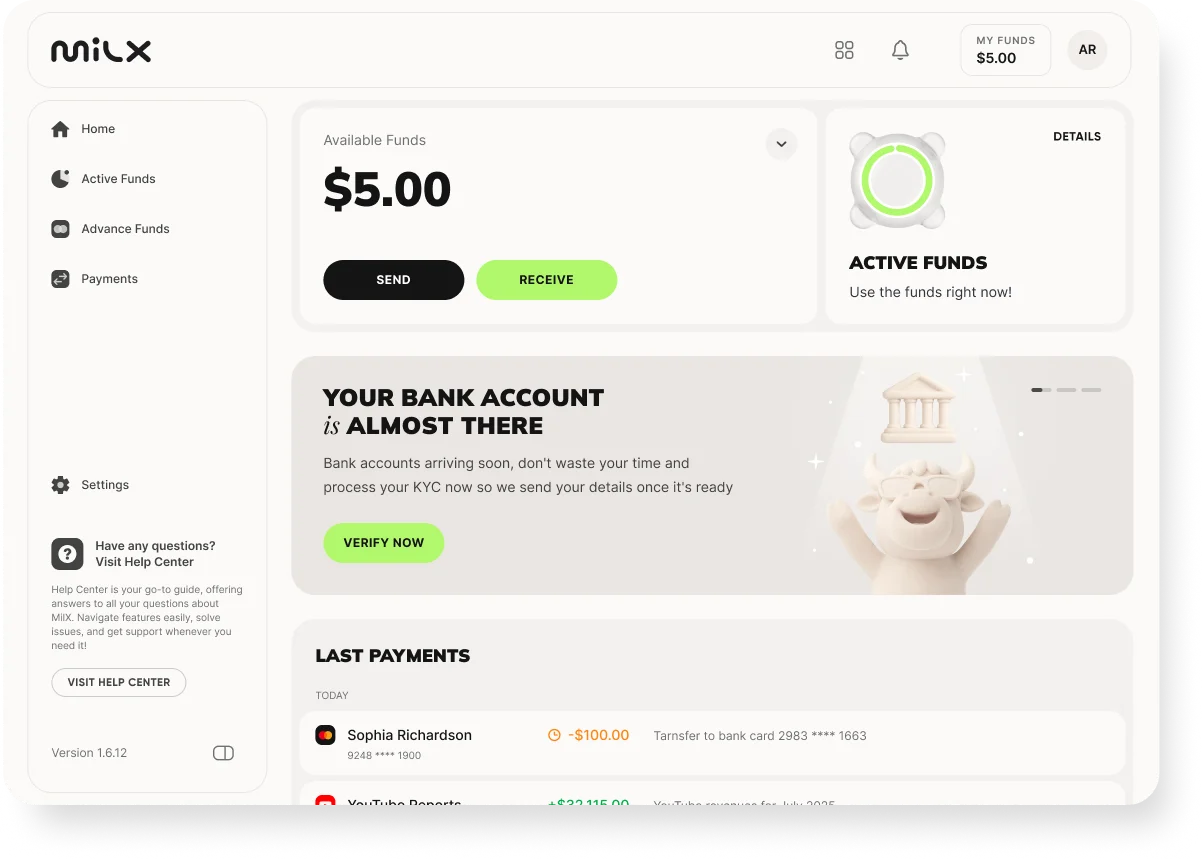
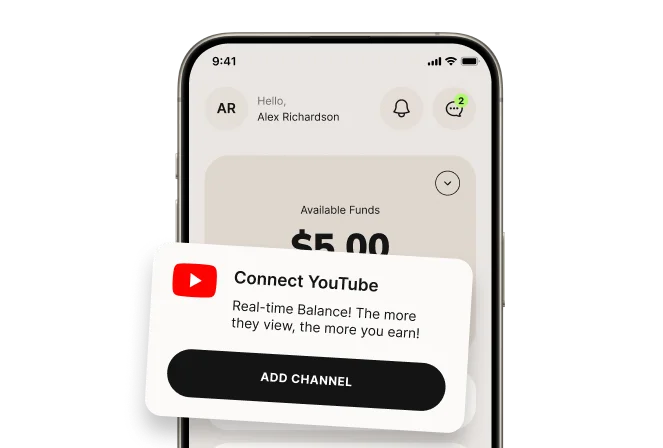
MilX gives your channel a balance you own. Revenue is credited every day from the day you connect, and you move it when you want.
- Withdraw any day in 54 currencies through 30+ payout methods, including BTC, USDT and USDC
- Pay your editor or designer instantly with no fee when they're on MilX
- Get contracts, acts and invoices for your payments, ready for your bank or accountant
- Reach earned revenue up to 2 months early with Advance Funds, and check if your channel qualifies for Active Funds
- No subscription and no cut of your revenue. 3,100+ channels connected, $500M+ paid out