We went through YouTube Help and the YouTube Blog and put together what YouTube itself says: the rules in its own words, how they changed since 2023, and what they mean for your revenue.
Key takeaways
- YouTube doesn't ban AI. It stops paying for mass-produced, template-based videos with no added value, under the inauthentic content policy, renamed on July 15, 2025, and clarified on July 16, 2026.
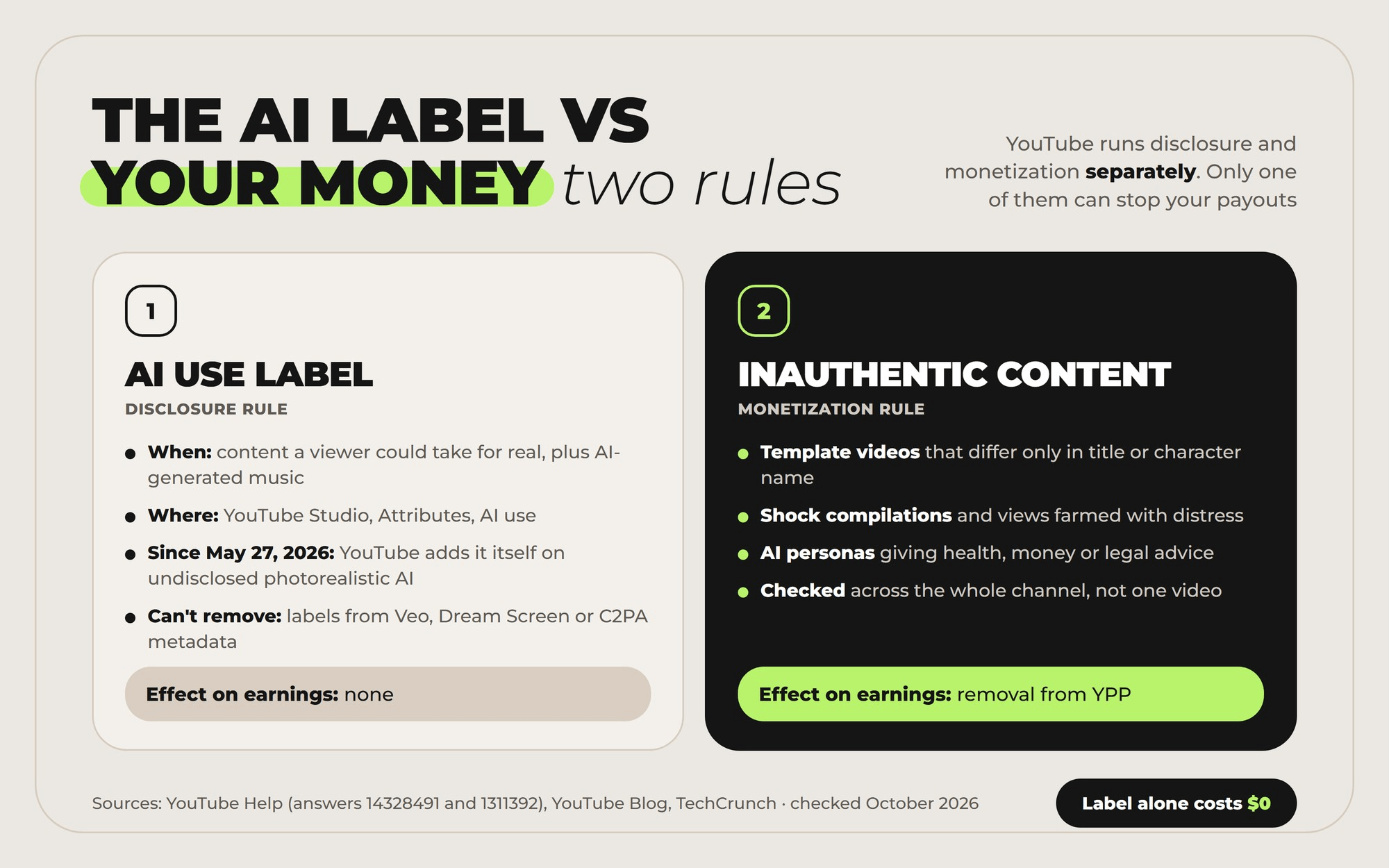
- Realistic AI content needs a label, and the label doesn't affect earnings. Since May 27, 2026, YouTube adds the label itself when it detects undisclosed photorealistic AI.
- Monetized channels already use AI. In the AIR Media-Tech network, which MilX is part of, 116 channels published AI-generated visuals and 110 narrated with AI voices as of September 30, 2026.
- The rules change several times a year. YouTube has made eight official changes to its AI rules since November 2023, so check YouTube Help before you launch a new AI format.
What YouTube officially says about AI and monetization in 2026
YouTube's monetization policy never names a tool. It asks whether the finished video is original and gives viewers something.
"If you use automated tools or templates to help create your content, the final product must still demonstrate your creative vision and provide educational or entertainment value," says YouTube's channel monetization policy.
Here's what the same page allows and rules out for AI content, as of October 2026:
|
What YouTube's policy says |
Monetized? |
What it means for an AI channel |
|---|---|---|
|
"Using AI to visualize a unique character and narrative you invented" |
Yes |
AI visuals are fine when the story and characters are yours |
|
"A series following a set of characters across episodes", each with a distinct storyline |
Yes |
Recurring formats work if every episode has its own idea |
|
"AI-generated content made with generic or unoriginal templates giving the impression of mass production" |
No |
The same prompt and assets across dozens of uploads put the whole channel at risk |
|
"Image slideshows, templated storylines, or scrolling text with minimal or no narrative, commentary, or educational value" |
No |
AI images under a voiceover need real commentary |
|
"Videos that stitch together unrelated or inconsistent AI clips to surprise or shock viewers" |
No |
Shock compilations lose ads whether or not AI made them |
|
"AI-generated podcast hosts offering financial guidance" and an AI "doctor" giving health advice |
No |
AI personas can't present as experts on health, money or law |
Source: YouTube Help, channel monetization policies, checked October 2026.
The policy looks at the whole channel. In the AIR Media-Tech network, which MilX is part of, 116 channels published AI-generated visuals and 110 narrated with AI voices as of September 30, 2026. What YouTube looks at is whether one video can be told apart from the next.
Using AI on your channel already?
This article covers what YouTube says. Our practical guide checks each part of an AI workflow, from scripts to voiceovers, against what keeps a channel monetized.
See which AI parts are safe →Want our updates first in Google? Add MilX to your preferred sources.
YouTube AI policy in 2026: every official change since 2023
YouTube has adjusted its AI rules almost every quarter since late 2023. Here's each change from YouTube's own announcements, with its status in October 2026:
|
Date |
What YouTube did |
Status in October 2026 |
|---|---|---|
|
Nov 14, 2023 |
Announced that creators must disclose realistic altered or synthetic content, and that people can ask to remove AI content that simulates them |
Live as the disclosure rule and the privacy removal process |
|
Mar 18, 2024 |
Launched the disclosure tool in YouTube Studio |
Live, now called "AI use" |
|
Dec 2024 |
Started a likeness detection pilot with talent represented by Creative Artists Agency |
Grew into likeness detection |
|
Mar 10, 2025 |
Added human review to monetization checks, so a decision can take up to 24 hours |
Live |
|
Apr 9, 2025 |
A 2026 version of the bill (S.4591) was reported to the Senate on June 24, 2026, and isn’t law |
|
|
Jul 15, 2025 |
Live |
|
|
Jan 21, 2026 |
CEO Neal Mohan named reducing low-quality AI content a priority |
Enforcement ongoing |
|
May 2026 |
Opened likeness detection to all creators 18+, after a pilot with top creators and Partner Program members |
Live, rolling out in phases |
|
May 27, 2026 |
Started labeling undisclosed photorealistic AI on its own and moved the label below the player |
Live |
|
Jul 16, 2026 |
Clarified three kinds of inauthentic content that can't be monetized |
Live |
|
Sep 23, 2026 |
Announced speaking-voice detection to work alongside face matching |
Expected later in 2026 |
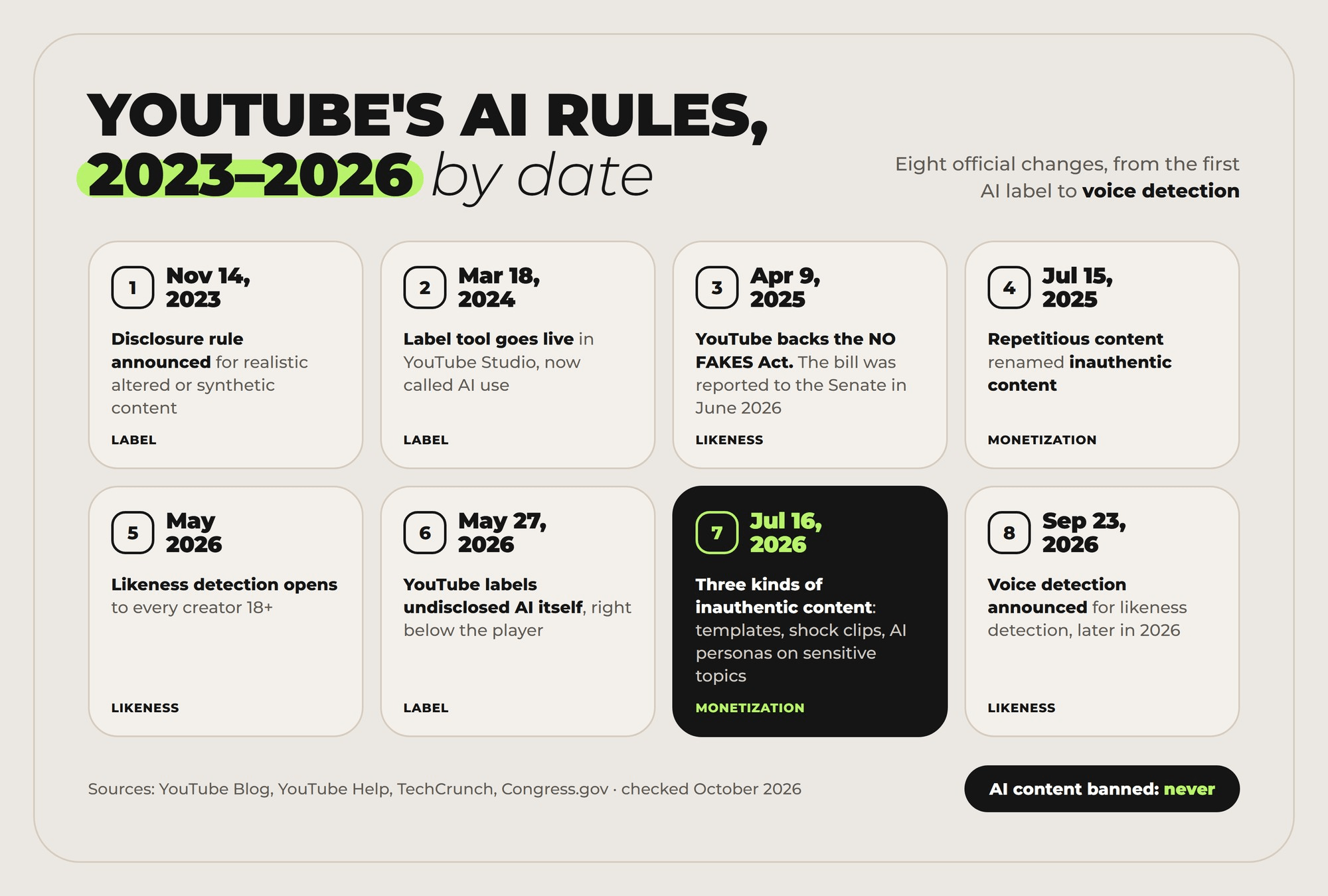
Across three years of changes, YouTube never banned AI content. Each update either added a label or narrowed what counts as mass production.
YouTube's inauthentic content policy after the July 2026 update
The inauthentic content policy is the rule that decides whether an AI channel earns. On July 15, 2025, YouTube renamed its "repetitious content" policy and said it covers "content that is repetitive or mass-produced". A year later, on July 16, 2026, YouTube spelled out three kinds of content that can't be monetized, as TechCrunch reported:
- Generic, repetitive or template-based content: near-identical videos, slideshows and templated storylines.
- Off-putting or distressing content: clips stitched together to shock, and repetitive scenarios built to farm views, such as animals in exaggerated danger. This applies with or without AI.
- AI personas on sensitive topics: AI hosts or "experts" giving medical, financial or legal advice.
YouTube's trust and safety chief Matt Halprin explained the reason in the same report:
“AI can actually allow people to make a lot of videos,” and he added that sometimes those videos are great. A channel with too much content from any of the three groups can be removed from the YouTube Partner Program.
Two things stayed the same. When YouTube renamed the policy in July 2025, it said the reused content policy, which covers commentary, clips, compilations, and reactions, wasn’t changing. And the review still looks at the whole channel: its main theme, most-viewed and newest videos, and metadata.
Faceless channels still earn when every video is different
Faceless channels aren't a policy category. YouTube's examples never mention a face on camera. The risk comes from sameness: one voice, one thumbnail layout, and one script shape across 30 uploads read as mass production, whoever made them. A faceless history channel where each episode has its own research and story fits the "series following a set of characters" example YouTube allows.
Thousands of AI channels lost monetization. What did they have in common?
See the patterns behind the 2026 suspensions and the steps that help a flagged channel get back into the Partner Program.
See why AI channels got suspended →AI disclosure on YouTube: when the AI use label is required
The second rule is about transparency, or synthetic media disclosure. YouTube asks you to disclose content a viewer could take for real. You do it in YouTube Studio, in the Attributes section, by answering the "AI use" question. Older guides call it "altered content".
Per YouTube Help, as of October 2026:
|
Needs the AI use label |
Doesn't need it |
|---|---|
|
A real person shown saying or doing something they didn't |
AI help with scripts, titles, thumbnails or ideas |
|
Altered footage of a real event or place |
Beauty filters, color correction, upscaling |
|
A realistic scene that never happened |
Captions and audio repair |
|
AI-generated music |
Cloning your own voice for voiceovers or dubs |
|
A real person shown as arrested or imprisoned |
Clearly unrealistic or animated content |
YouTube is direct about the money side: "Disclosing AI content won't limit a video's audience or impact its eligibility to earn money."
Skipping the label is the risk. Creators who consistently don't disclose may get a label applied by YouTube or face penalties that include removal of content or suspension from the Partner Program. YouTube's Help page doesn't list a strike for missing labels.
Since May 27, 2026, YouTube adds the label on its own
When YouTube's systems detect significant photorealistic AI in a video you didn't label, YouTube now applies the label itself. On long videos, the label sits directly below the player, above the description. On Shorts, it appears over the video. That's also how viewers can tell a video uses realistic AI.
Most labels can be changed. A few can't:
|
How the label got there |
Can you change it? |
|---|---|
|
You answered "AI use" at upload |
Yes, in Studio |
|
YouTube's detection flagged AI you didn't use |
Yes, update the disclosure status in Studio |
|
The video was made with YouTube's own AI tools, such as Veo or Dream Screen |
No |
|
The file has C2PA metadata marking it fully AI-generated |
No |
|
The label was added after a manual review |
No |
YouTube's blog repeats the key point: "a disclosure label alone does not change how a video is recommended or whether it's eligible to earn money."
Likeness detection and the NO FAKES Act: what protects your face and voice
Likeness detection is YouTube's tool against deepfakes of you. It works like Content ID, except the reference is your face rather than a song or a film. It scans new uploads for your face and puts matches in the Likeness tab of YouTube Studio. From there, you can request removal under the privacy rules, file a copyright request, or archive the match. YouTube decides on removal, and parody or satire can stay up.
- Who can use it: Since May 2026, anyone 18+ with a Channel Owner or Manager role, after verifying with an ID and a selfie video. Membership in the Partner Program is no longer required, and it isn’t available in some countries yet.
- What it finds: faces only, per YouTube Help. On September 23, 2026, YouTube announced it will add speaking-voice detection to face matching later in 2026.
- What it means for money: if you publish realistic AI videos of a real person without permission, that person can find them and ask YouTube to remove them, and the AI label doesn't protect you.
The NO FAKES Act would turn a removal request into a legal right. The bill creates a federal right over your voice and visual likeness, a notice-and-takedown process for unauthorized digital replicas, and exemptions for news, sports broadcasts, and satire.
YouTube has backed the bill since its 2025 version. As of October 2026, the 2026 version, S.4591, was reported to the Senate on June 24, 2026, and hasn’t become law. For step-by-step setup, see our guide to how likeness detection and the NO FAKES Act protect creators.
What YouTube's AI rules mean for your revenue
The label costs nothing, and the inauthentic content policy can cost everything. Here’s how YouTube’s AI content monetization rules reach your income:
- The AI label does not affect ads or recommendations, per YouTube's own Help page and blog.
- The inauthentic content policy works at the channel level. A removed channel stops earning ad revenue on every video, including the ones that were fine.
- AI personas on health, finance, and law are now a named exclusion, which hits high-paying niches hardest.
- Weak AI loses money through watch time, before any policy kicks in. In AIR Media-Tech's dubbing tests, an AI-only English track on a wildlife channel held viewers for 1:22 on average, against 3:40 to 5:19 for professionally dubbed tracks on the same videos. Fewer minutes watched means fewer ads shown. Details are in AIR's AI dubbing research. For what that gap means in dollars, see whether an AI voiceover or a human voice earns more.
Average view duration on the same videos, wildlife channel, AIR Media-Tech dubbing tests
AI-only English track
1:22
minutes
Professionally dubbed tracks
3:40–5:19
minutes
Viewers stayed 2.7 to 3.9 times longer with a human dub, and every extra minute is room for another ad.
YouTube publishes no separate RPM for AI content. AI videos earn by the same CPM and RPM rules as any other video and follow the same advertiser-friendly content guidelines. One more change is coming that has nothing to do with AI: from February 1, 2027, new Partner Program applicants will need 8,000 watch hours in 12 months or 20 million Shorts views in 90 days. Channels already in the program aren’t affected by the new entry thresholds. To see which other formats are close to the line, check which channels have a high risk of demonetization in 2026 and the monetization policy changes creators can expect in 2026.
Staying on the safe side usually means paying people: an editor, a scriptwriter, a voice actor. AdSense pays for last month's views between the 21st and 26th of the next month, so those bills often come first.
Need to pay your editor before YouTube pays you?
With MilX, your channel's revenue lands on a balance you own every day from the day you connect. Advance Funds lets you reach what you've already earned up to 50 days before AdSense pays.
- Earned revenue up to 2 months early, for a one-time 4.3% on the amount you take
- Pay editors, scriptwriters and voice actors instantly with no transfer fee when they're on MilX
- Withdraw any day in 54 currencies through 30+ payout methods
- $500M+ paid out to 1,500+ creators