


This piece explains which channels are at the highest risk, what usually triggers the platform, and what creators can do before a policy issue turns into a revenue crisis.
How YouTube Evaluates Channels for Monetization
When YouTube reviews a channel, its reviewers may look at:
- the main theme of the channel;
- the most-viewed videos;
- the newest videos;
- the content driving the biggest share of watch time;
- metadata such as titles, thumbnails, and descriptions;
- the About section.
YouTube also says channels are reviewed continuously after acceptance into YPP, not just once at the start.
The key YouTube monetization policy update happened on July 15, 2025. The platform renamed its old “repetitious content” rule to inauthentic content and clarified that this includes content that is repetitive or mass-produced. YouTube was explicit that this was not a brand-new ban on AI; it was a clearer way of enforcing an existing rule against spammy, low-effort production.
It also separately confirmed that channels using AI can still monetize if they follow policy and add original value.
Since March 2025, ad suitability checks can also include an extra human review, and some decisions can take up to 24 hours.
In practice, that means the YouTube inauthentic content policy works at two levels:
- Reused content is about repurposing existing material without enough transformation.
- Inauthentic content is about pattern-level sameness: videos built from a repeatable template with little variation, little judgment, and little reason for a viewer to pick one over the next. A channel can be risky even when each individual video looks technically “fine.”
There is also a second AI-related layer in 2026: disclosure.
Creators must disclose realistically altered or synthetic content, such as a fake version of a real person, altered footage of a real event, or a realistic scene that never happened. YouTube labels content made with its own AI tools automatically, but disclosure does not rescue low-value content.
It solves a transparency issue, not a quality issue.
Types of Content With High Demonetization Risk
So, what actually puts a channel in the danger zone? Usually, it is not one small mistake. Let’s look closer at some YouTube demonetization triggers:
Massively AI-Generated Content and “AI Slop”
This is the clearest danger zone in 2026. YouTube now openly says it is building on its anti-spam and anti-clickbait systems to reduce the spread of “low quality AI content” and “low quality, repetitive content.” In Neal Mohan’s recent interview, he framed AI as a creative tool, but also made “managing AI slop” a stated platform priority:
“We want to make sure that our recommendation systems can deal with AI slop. And we're going to treat it based on our track record of being able to do that around things like clickbait, low-quality, repetitive content. You should expect to see a lot more investment from YouTube, building on what we've been doing over the last couple of years, going into 2026.”
So, here is what usually falls into this bucket:
- AI voice reading a generic script over stock clips or still images
- near-identical explainers where only the topic name changes
- slideshow videos with scrolling text and little or no narration
- AI-generated news recaps built from web text
- fake trailers, fake interviews, fake celebrity clips, fake public-event footage
- AI music dumps with the same visual loop and no curation or commentary
YouTube’s own examples are blunt: content that reads material from websites or news feeds, repetitive low-value videos with minimal variation, mass-produced template content, and image slideshows with little or no narrative or educational value can all violate YouTube revenue policy in 2026.
And it is no longer theoretical. In 2025, YouTube demonetized and later terminated channels Screen Culture and KH Studio after a scandal over AI-generated movie trailers. By the time of their termination, the two channels had more than 2 million subscribers combined and over 1 billion views, which makes the lesson clear: scale does not protect a channel if the format itself is deceptive or duplicative.
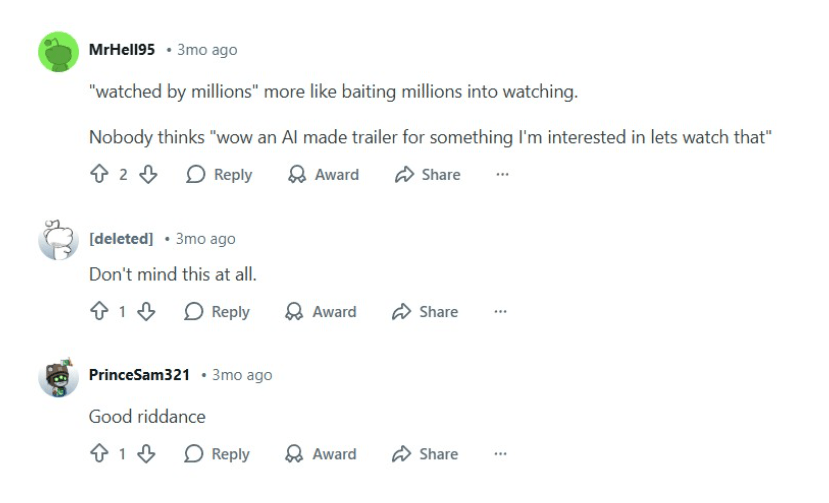
And it seems like a lot of people rejoiced at the sight of this. Here’s what Reddit users said:
At the same time, AI use on YouTube is mainstream. YouTube says more than 1 million channels used its AI creation tools daily in December 2025.
That is exactly why the platform’s position matters: AI assistance is normal, but AI authorship without visible human input is where risk rises fast.
Reused Content With Minimal Transformation
This is still one of the easiest ways to lose monetization. YouTube allows commentary, reaction, criticism, and edited remixes, but only where viewers can clearly tell what the creator added. Permission alone is not enough. A channel can avoid copyright trouble and still fail YouTube’s reused-content test.
High-risk content on YouTube includes:
- compilations of TV, sports, or social clips with little narration
- Reddit/story channels that mostly read material written elsewhere
- “top moments” edits with almost no analysis
- movie or show recap channels that swap clips but keep the same formula
- music collections and reposted tracks, even with permission
- non-verbal reactions, where the creator adds almost nothing beyond facial expressions
For creators, the uncomfortable truth is this: “We edited it ourselves” is not a strong defense if the final value still comes mostly from someone else’s material.
At the same time, if you comment, react, and transform the source material vigorously enough, like The Media Knights, for example, you can even show a huge amount of clips from the latest blockbuster and still earn from it:
Clickbait and Misleading Thumbnails or Titles
Misleading packaging is not just a CTR issue anymore. YouTube states that reviewers may inspect titles, thumbnails, and descriptions as part of channel review, and the platform’s spam and deceptive-practices policies prohibit content designed to trick or mislead users.
High-risk factors here include:
- presenting fan fiction as real news
- implying a celebrity endorsement that never happened
- editing synthetic footage to look like a real event
- using “official trailer,” “breaking,” or “confirmed” when the video is speculative or fabricated
- repeating the same emotional bait across dozens of videos
For AI-heavy channels, this is where many teams get trapped. The video might be synthetic, but the policy problem is often the promise being made to the viewer.
But as one Redditor said: “Clickbait isn't inherently bad, if done correctly and without misleading the audience.”
This ethical clickbait is sometimes called “legitbait.” The term is created by YouTuber Brady Haran, who runs channels like Numberphile, Periodic Videos, Hello Internet, and many more.
The principles of legitbaiting:
- Tell the truth. Use curiosity in the title, but never fabricate events, endorsements, or facts.
- Create a curiosity gap. Reveal just enough to make viewers want the answer inside the video.
- Deliver on the promise. The thumbnail and title should accurately represent what the viewer will actually see.
- Be specific, not vague. Numbers, clear claims, and concrete outcomes make titles more compelling and trustworthy.
- Test what works. Compare titles, thumbnails, and formats to see what attracts clicks without misleading viewers.
- Optimize for retention, not just CTR. A strong title gets the click, but real value keeps people watching.
- Respect the viewer’s time. Get to the point quickly and make sure the content rewards the click.
Don’t Let Delays Stall Growth
Claims, reviews, and payout holds can throw off even a healthy channel’s finances. Try MilX for free and get more control over earnings, withdrawals, and day-to-day cash flow.
Adult, Violent, or Sensitive Content
The obvious one.
YouTube’s advertiser-friendly guidelines can reduce or remove ads on videos focused on graphic violence, highly sexualized material, hateful content, dangerous acts, or sensitive events, especially when those elements appear in the title or thumbnail or are the focal point of the video. Repeated serious violations can result in the channel's deletion.
For creators in commentary, true crime, war coverage, bodycam, or celebrity-drama niches, the point is simple: some channels are not at high risk of removal, but they are at high risk of yellow icons, limited ads, and unstable RPM.
YouTube updated these guidelines again in 2026: in January, it loosened monetization for some non-graphic controversial content, but content focused on child abuse or eating disorders remains ineligible for full monetization. In March, it also clarified that shocking content featuring subjects who appear young in distress is not eligible for ad revenue. Age-restricted videos may still run ads, but often with limited demand and lower yield.
YouTube also updated adult-content guidance in late 2024 to restrict ad revenue on content that promotes or explains how to create synthetic sexually explicit content or nude imagery.
That means a channel may remain in YPP yet still experience revenue instability because too many uploads fall into the limited-ad territory.
Channels With Inconsistent Ad-friendly Compliance
A yellow icon is not the same as full demonetization, but repeated limited-ad decisions are still a business risk.
YouTube says advertiser-friendly monetization reviews cover the video itself, plus the title, thumbnail, description, and tags. It also recommends uploading as private or unlisted early so checks can finish before a public launch. Channels that routinely trigger manual review are harder to forecast, harder to sell to sponsors, and more likely to drag finance teams into constant exception handling.
Channel Factors That Increase Risk
Some warning signs are official policy triggers. Others are softer signals that usually show up on risky channels before the policy email does.
#1. Low Audience Retention or High Bounce Rate
So, one example is low retention across videos. Of course, low retention by itself is not a stated monetization violation.
But it often shows up beside the real problems: templated scripting, weak intros, no editorial value, or misleading thumbnails. For creators, that makes poor retention a useful early warning sign, not a formal policy strike. The bigger issue is that YouTube may review the videos that drive the largest share of watch time, so if your highest-watch-time content is also your weakest creatively, that is where risk compounds.
#2. Irregular Upload Schedule or Sudden Spikes in Activity
Another one is unusual production spikes. Uploading more often is not a violation by itself. But a sudden activity jump can look suspicious.
YouTube’s fake engagement policy prohibits artificial inflation of views, subscribers, watch time, likes, and ad impressions. So, if a sudden spike comes from bought traffic or engagement manipulation, the risk jumps fast.
Here’s how invalid traffic impacts your earnings:
- YouTube may adjust Analytics to remove revenue linked to invalid traffic.
- Ad serving can be temporarily limited until YouTube sees the risk as reduced, which can cut revenue even if view counts look stable.
- If invalid traffic is identified after earnings were calculated or paid, that amount can be deducted from current or future AdSense for YouTube balances.
- Payouts may be delayed for up to 90 days while YouTube investigates traffic quality and verifies whether those earnings were valid.
#3. High Ratio of Monetization Warnings
A third is a growing stack of warnings, yellow icons, and manual checks. A single yellow icon is normal. A recurring pattern across the library is not. If a team keeps pushing borderline topics, ignoring self-certification accuracy, or repeatedly testing policy edges, that becomes a forecasting issue. Revenue becomes harder to model, and brand deals become harder to defend internally.
For example, one of MilX users saw a 32% revenue increase after manually reviewing and appealing 53 yellow tags (41 were restored to full monetization), and then launching a 24/7 live-stream.
#4. Use of Copyright-Restricted Music or Video
Then there is copyright-restricted music or video.
Content ID can block a video, track it, or monetize it on behalf of the rights owner. YouTube also says estimated revenue can be adjusted for invalid traffic and Content ID disputes, and policy enforcement can delay payments by up to 90 days while issues are investigated.
And when YouTube revenue gets delayed by claims or disputes, services like MilX help creators keep cash flow moving with faster access to earnings and more flexible payouts.
Why creators love MilX:
- No credit score needed. No banks, no traditional lending hoops.
- Simple auto-repayment. Just 5% is repaid automatically from future income.
- 40+ payout currencies. Withdraw to card, wallet, or crypto.
- Free P2P transfers. Send money to your team without extra transfer fees.
That means you can pay editors, contractors, or ad costs always on schedule.
Channel Risk Factors to Watch Closely: A Quick Cheatsheet
|
Risk factor |
Why it matters |
What creators should do |
|
Same format at scale |
Looks mass-produced |
Break the template: new structure, new pacing, real commentary |
|
Looks scraped or reused |
Show visible authorship: analysis, voice, story, edits |
|
|
Signals spam or deception |
Match the promise to the actual video. Use legitbaiting |
|
|
Can mislead viewers |
Disclose realistic synthetic content and avoid deceptive framing |
|
|
Risky back catalog |
Old videos can still dominate watch time |
Audit the library, not just the next upload |
|
Repeated ad-suitability problems |
Damages advertiser trust |
Separate risky topics from monetized core content |
Case Examples of High-Risk Channels
#1. AI explainer and narration farms.
On Reddit and creator forums, recent complaints increasingly come from channels using AI voiceovers, stock or static visuals, and repeatable scripts. One creator with roughly 50k subscribers said they were demonetized for “mass-produced” content despite uploading only twice a month, which suggests upload volume alone is not the deciding factor; sameness of format matters more.
That may sound funny, but it aligns with YouTube’s written policy. The reason the "mass-produced" flag is about how YouTube classifies the content, not the upload frequency.
#2. Back catalogs are getting unstable.
In another Reddit thread, a creator described older videos getting yellow icons months after publication, even after successful appeals. That does not prove a new universal rule, but it does show how unstable a channel can become once it sits near policy boundaries for a long time.
#3. AI content that looks too clean, too fast, too similar.
A creator who appealed a monetization rejection said their videos were edited manually and took hours to produce. Even so, YouTube support pointed to the usual red flags: synthetic voice, low variation, repetitive structure, mass-produced feel, and slideshow-style delivery. That is the core issue in 2026. YouTube is not only judging the effort behind the scenes. It is judging whether the channel looks original at scale.
The broader pattern across creator complaints is not just “AI got me demonetized.” It is usually one of these combinations:
- AI narration + third-party source material;
- AI visuals + static or weak editing;
- AI music + no human framing;
- repeated format + bulk publishing cadence.
Now, on YouTube, “made by hand” is no longer enough if the final result still looks low effort.
How You Can Assess Your Own Risk
A useful internal audit starts with one question:
If your channel name disappeared, would a reviewer still be able to tell these videos were made by the same creator because of judgment, structure, taste, and insight?
If the answer is no, your channel may already be drifting into the territory of the YouTube demonetization risk of 2026.
A practical risk audit should check:
- your 10 most-viewed videos;
- your 10 newest videos;
- the videos driving the most watch time;
- recurring thumbnail patterns;
- repeated hooks, scripts, and pacing;
- how often the same voice model, same template, or same visual structure shows up;
- whether realistic AI content is properly disclosed.
If too much of the content can be generated from one prompt template, your channel is at risk of demonetization.
Strategies to Reduce Demonetization Risk: Step-by-Step
Here is the short list that matters most:
- Fix the channel pattern, not just one video. If the overall catalog feels templated, changing one upload will not solve the problem. Review your top performers and your newest uploads first, because those are the areas YouTube says reviewers may focus on.
- Add authorship everywhere. Rewrite AI-assisted scripts, add stronger commentary, change pacing, and make your point of view obvious. AI can support production; it cannot replace editorial judgment without increasing risk.
- Stop relying on static visuals. Slideshows, looping backgrounds, and generic footage are one of the easiest ways to make a channel look low-effort at scale. Use motion, structure, cutaways, overlays, or on-screen explanation.
- Clean up titles and thumbnails. Remove bait, fake urgency, and misleading framing. Deceptive packaging does not help a weak channel survive longer; it usually makes the risk profile worse.
- Use disclosure correctly. As we already mentioned, YouTube requires disclosure for realistic, altered, or synthetic content. But disclosure does not make low-value content monetizable by itself.
- Build an internal review step before publishing. For channels with sponsors or teams, pre-publish review should check: reuse risk, AI disclosure, ad suitability, copyrighted assets, and whether the video actually adds something new.
- Handle appeals like a business process. If YPP access is suspended and an appeal fails, YouTube’s updated process says creators may need to wait 90 days before reapplying. That is a long time to discover your channel had no revenue cushion.
When You're Clear, Time to Fund Your Growth
Fixing your channel's risk profile is step one. The next is consistent cash flow. AdSense pays on a 30-day delay. Brand deals come in waves. Content ID disputes can hold earnings for up to 90 days.
MilX is built exactly for that gap.
It's a banking app for creators.
- Already earned it but haven't been paid yet? Access it now.
- Need capital to hire, upgrade, or scale fast? Unlock up to 6 months of future AdSense revenue upfront. No credit checks, just your analytics doing the talking.
- Pay your editors for free via P2P transfers.
- Withdraw in 40+ currencies, 10+ ways: card, PayPal, crypto. Most transfers land in under five minutes.
You fixed the floor. MilX helps you build on it.
Try the free MilX app and manage your earnings on your terms.