

Below is what YouTube pays per view in 2026 by niche, country, and format, why earnings calculators overshoot, and how to read and raise your own RPM.
Key takeaways
- No single pay-per-view rate exists. Among MilX users in our research, median long-form RPM ran from $0.33 per 1,000 views in Kids & Teens to $10.22 in Education & Science, although most RPM lists put finance first.
- Not every view is monetized. The median channel in our research monetized 53% of its views, and you earn only on those, after YouTube's share.
- Your own RPM beats any average. Pull it from YouTube Analytics, as shown below.
- Shorts pay a fraction of long-form. In our data from 274 channels, Shorts RPM ran 3–14% of long-form RPM in almost every niche.
New to the terms? Start with CPM vs RPM, the key metrics for YouTube monetization. If MilX guides help you, add the MilX blog to your preferred sources in Google to catch the next data update.
What YouTube really pays per view
Your YouTube earnings per view come to about $0.0023 at the median among MilX users in our research, or $2.30 per 1,000 views, and they depend first on whether an ad ran. A view with no ad earns $0 from advertising, so the useful unit is RPM, revenue per 1,000 views: total revenue ÷ all views × 1,000. Four terms explain why views and pay drift apart:
- Monetized playbacks. YouTube defines these as the number of times your video was watched with ads. Views from ad-blocker users and many views on kids or limited-ads videos run without an ad.
- Ad impressions. One monetized playback can carry several ads. YouTube's own example shows 2.
- Fill rate. The share of ad slots that advertisers buy. When ad budgets reset in early January, fewer brands bid and more slots stay empty.
- Invalid traffic. Views from bots or paid view services. YouTube says earnings from invalid traffic may be withheld, changed, or offset, and payments can be delayed up to 90 days while it checks.

Below is what YouTube pays per view in 2026 by niche, country, and format, why earnings calculators overshoot, and how to read and raise your own RPM.
Key takeaways
- No single pay-per-view rate exists. Among MilX users in our research, median long-form RPM ran from $0.33 per 1,000 views in Kids & Teens to $10.22 in Education & Science, although most RPM lists put finance first.
- Not every view is monetized. The median channel in our research monetized 53% of its views, and you earn only on those, after YouTube's share.
- Your own RPM beats any average. Pull it from YouTube Analytics, as shown below.
- Shorts pay a fraction of long-form. In our data from 274 channels, Shorts RPM ran 3–14% of long-form RPM in almost every niche.
Same views, different paycheck?
Two channels can post the same view count and still earn several times apart. The difference sits in format, audience and ad setup, and each one is fixable. See why two channels with identical views earn differently
What YouTube really pays per view
Your YouTube earnings per view come to about $0.0023 at the median among MilX users in our research, or $2.30 per 1,000 views, and they depend first on whether an ad ran. A view with no ad earns $0 from advertising, so the useful unit is RPM, revenue per 1,000 views: total revenue ÷ all views × 1,000. Four terms explain why views and pay drift apart:
- Monetized playbacks. YouTube defines these as the number of times your video was watched with ads. Views from ad-blocker users and many views on kids or limited-ads videos run without an ad.
- Ad impressions. One monetized playback can carry several ads. YouTube's own example shows 2.
- Fill rate. The share of ad slots that advertisers buy. When ad budgets reset in early January, fewer brands bid and more slots stay empty.
- Invalid traffic. Views from bots or paid view services. YouTube says earnings from invalid traffic may be withheld, changed, or offset, and payments can be delayed up to 90 days while it checks.

YouTube pay per view by country
Viewers in the United States bring the highest pay: a $14.67 CPM and an estimated $5.13–$8.07 RPM, about 20x India's $0.74 CPM. Advertisers bid by country, so the same video enters different auctions in Toronto and in Mumbai.
|
Country |
Long-form CPM |
Estimated long-form RPM |
Shorts RPM |
|
United States |
$14.67 |
$5.13–$8.07 |
$0.33 |
|
Australia |
$13.30 |
$4.66–$7.32 |
$0.19 |
|
Switzerland |
$12.98 |
$4.54–$7.14 |
$0.21 |
|
Norway |
$11.21 |
$3.92–$6.17 |
n/a |
|
New Zealand |
$10.21 |
$3.57–$5.62 |
n/a |
|
Canada |
$9.93 |
$3.48–$5.46 |
$0.17 |
|
Germany |
$9.79 |
$3.43–$5.38 |
$0.16 |
|
United Kingdom |
$8.91 |
$3.12–$4.90 |
$0.17 |
|
South Korea |
$5.73 |
$2.01–$3.15 |
$0.19 |
|
Japan |
$5.68 |
$1.99–$3.12 |
$0.14 |
|
Mexico |
$1.82 |
$0.64–$1.00 |
n/a |
|
Brazil |
$1.64 |
$0.57–$0.90 |
n/a |
|
India |
$0.74 |
$0.26–$0.41 |
n/a |
Source: our data on 3,000+ channels (by MilX and AIR Media-Tech), average CPM by country over the 365 days to May 1, 2026. Estimated RPM applies the 35–55% CPM-to-RPM range from our research. All values are per 1,000 views.
👉 See the full top-20 list of countries with the highest YouTube CPM.
🎯 Practical tip: in YouTube Analytics → Revenue, list your top five countries by views and by revenue. If the two lists differ, translate titles and subtitles for your best-paying country first.
Same views, different paycheck?
Two channels can post the same view count and still earn several times apart. The difference sits in format, audience and ad setup, and each one is fixable. See why two channels with identical views earn differently
YouTube Shorts pay per view in 2026
Shorts earn a small fraction of long-form per view. In our data from 274 channels, Shorts RPM ran $0.07 to $0.20 per 1,000 views in most niches, and about $0.33 for a US-heavy audience. So 1 million Shorts views usually brings $70–$200, and up to about $330 with mostly US viewers.
The model is different, too. YouTube pools Shorts Feed ad revenue each month, sets part aside for music licensing, splits the Creator Pool by engaged views, and pays you 45% of your allocation.
- Views to match. Most channels need 11,000–34,000 Shorts views to earn what 1,000 long-form views bring.
- Music is the exception. Music channels earn 41–60% of their long-form RPM on Shorts, thanks to Content ID.
- Kids content flips the ratio. In a small sample from our research, 45.7% of kids Shorts views carried an ad, against 12.1% on kids long-form.
- Heavy Shorts months carry a risk. Among MilX users in our research, Entertainment channels earned $4.58 long-form RPM in months without Shorts and $1.84 in months with them. It is a correlation, so track it in your own Analytics.
The 2027 rule changes. YouTube has announced that from February 1, 2027, channels will need 10 million qualified Shorts views in the last 90 days to earn from Shorts ads and Premium. Channels below that line stay in the YouTube Partner Program and keep their long-form earnings. New creators will also face a higher entry bar: 8,000 qualified watch hours in 365 days or 20 million qualified Shorts views. Current partners are not affected. For the current entry rules, see YouTube monetization requirements for 2026.
|
Criterion |
Long-form |
Shorts |
|
How you're paid |
Ads on your own video |
Share of a monthly Creator Pool |
|
Revenue share |
55% |
45% of your allocation |
|
Typical RPM (our data) |
$1.23–$10.22 niche medians |
$0.07–$0.20 in most niches |
|
Mid-roll ads |
Yes, from 8 minutes |
No |
|
Views for $100 at typical RPM |
About 40,000 at $2.50 |
About 670,000 at $0.15 |
|
Earning rule from Feb 1, 2027 |
Unchanged for current partners |
10M qualified Shorts views in 90 days |
|
Best use |
Your main income |
Discovery that feeds long-form |
🎯 Practical tip: keep Shorts at 1–5 per month next to your long-form schedule, and point every Short to a related long video. In our data, that range showed the smallest hit to long-form RPM.
How many YouTube views do you need to make $1,000 to $10,000 a month?
At the niche medians in our research, $1,000 a month takes about 98,000 long-form views in Education & Science and about 3 million in Kids & Teens. Divide your target by your RPM and multiply by 1,000.
|
Niche (median long-form RPM) |
$1,000 a month |
$2,000 a month |
$3,000 a month |
$10,000 a month |
|
Education & Science ($10.22) |
98,000 |
196,000 |
294,000 |
978,000 |
|
Lifestyle ($2.98) |
336,000 |
671,000 |
1.01 million |
3.36 million |
|
Entertainment ($2.43) |
412,000 |
823,000 |
1.23 million |
4.12 million |
|
Gaming ($2.05) |
488,000 |
976,000 |
1.46 million |
4.88 million |
|
Health & Sport ($1.23) |
813,000 |
1.63 million |
2.44 million |
8.13 million |
|
Kids & Teens ($0.33) |
3.03 million |
6.06 million |
9.09 million |
30.3 million |
|
Shorts, most niches ($0.15) |
6.67 million |
13.3 million |
20 million |
66.7 million |
Calculated from the niche medians above. Values are rounded, and your own RPM will move them.
These are median-month numbers. Among MilX users, January pays 30–50% less than December for the same views, so plan with your weakest month.
For how many months it takes a new channel to reach its first $100 and first payment, see how long it takes to start making money on YouTube.
👉 For bigger numbers, see how much money you get for a million views on YouTube.
Why you earn less than YouTube earnings calculators show
Most calculators multiply views by an advertiser CPM and skip five deductions:
- Unmonetized views. Only part of your views carry an ad.
- YouTube's share. You keep 55% of watch-page ad revenue.
- Invalid traffic. Filtered views never reach your balance.
- Season. Among MilX users, January pays 30–50% less than December for the same views.
- US tax withholding. If you live outside the US, Google withholds 0–30% of your earnings from US viewers, depending on your country's tax treaty, and up to 24% of all earnings if your tax info is missing. It comes out of your AdSense payment, not the Analytics figure.
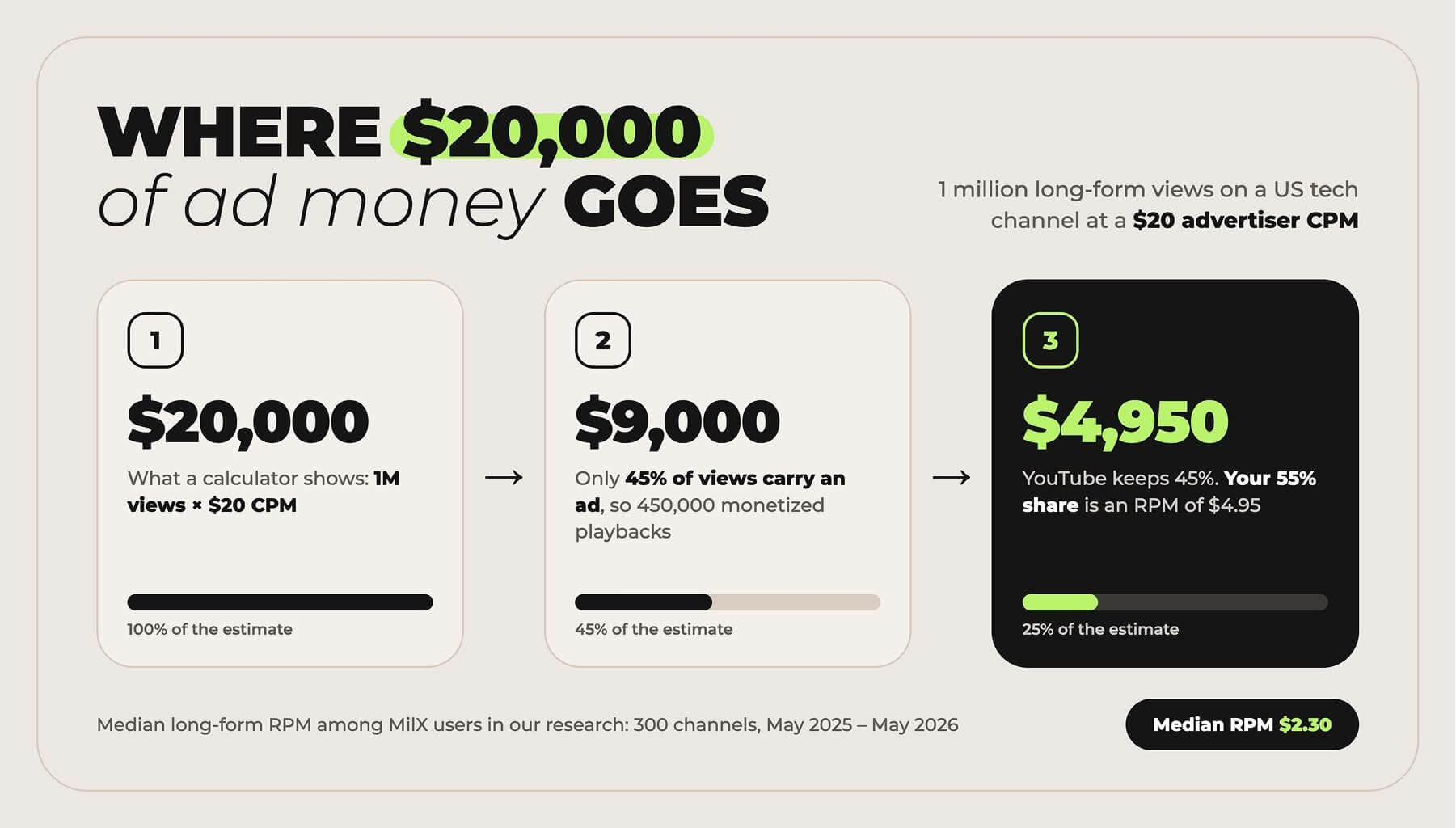
Take a US tech channel with 1 million long-form views and a $20 CPM. With 45% of views monetized, 450,000 playbacks bring $9,000 gross, and your 55% is $4,950, an RPM of $4.95. The calculator shows $20,000. Treat any calculator figure as a ceiling, not a forecast.
👉 Learn why a 1M-view video can earn less than a 100K-view one.
How to find your RPM in YouTube Analytics
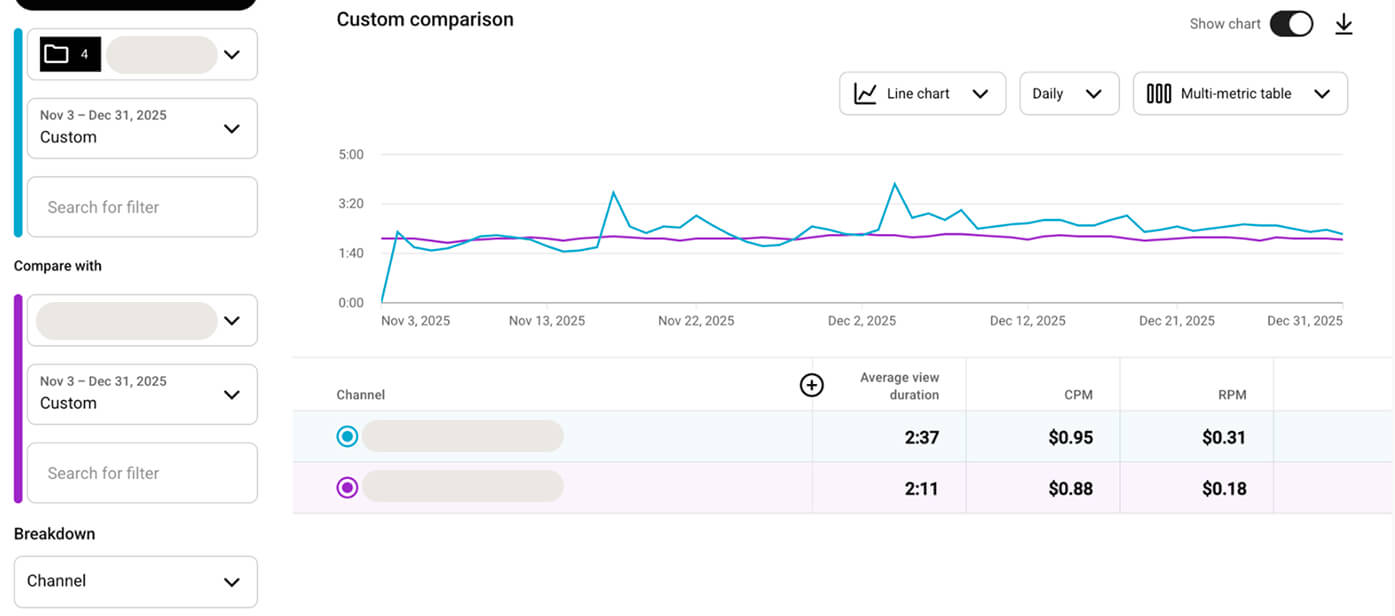
Your RPM sits on the Revenue tab in YouTube Analytics. Here is how to calculate it for a channel with 100,000 monthly views:
- Open YouTube Studio → Analytics → Revenue for the last 28 days. Note the estimated revenue, say $150.
- Divide by views and multiply by 1,000. $150 ÷ 100,000 × 1,000 = $1.50 RPM.
- Open Advanced mode and add Estimated monetized playbacks and Playback-based CPM. Say 42,000 playbacks at a $6.00 CPM: $252 gross, and your 55% is $138.60. The other $11.40 comes from YouTube Premium and memberships.
- Check your monetized share. 42,000 ÷ 100,000 = 42%. Lifting that share from 45% to 60% raises ad revenue by a third on the same views. Start with yellow-icon videos, short runtimes, and kids settings.
Keep long-form RPM and Shorts RPM on separate budget lines. They move for different reasons.
The money itself arrives later. Once your balance passes the payment threshold ($100 for US-dollar accounts), AdSense issues payments between the 21st and the 26th of the month after you earn it, so revenue from early in a month can take 50 days or more to reach you.
How to earn more per view on YouTube
A kids channel that added 10-minute compilations to its 2–3 minute clips earned a 72% higher RPM on the compilations, while CPM was only 9% higher. Longer sessions raise RPM fastest, because videos of 8 minutes or longer can carry mid-roll ads. Three more channels show how much each fix moved revenue:
- Add minutes where viewers stay. A hobby channel went from 20–25 to 25–30+ minute videos. Views fell 9%, and revenue grew 20%.
- Turn on live mid-rolls. 4K streams with mid-rolls grew one kids channel's live revenue by 77% on 56% more live views.
- Fix packaging. New titles and thumbnails cost a rural-life channel 3% of views and added 23% to revenue.
Clear limited ads as well. A yellow icon means brands can opt out of that video, so fix or appeal those first.
Longer videos, compilations, and 4K streams all cost time or money to make, so budget for a month or two before the higher RPM pays back.
What to take from this
YouTube doesn't pay a rate per view. It pays per monetized playback, and the only number you can plan a month on is your own RPM, read in your weakest month. Niche sets the ceiling, country and format decide how close you get to it, and the calendar decides when the money arrives.
Waiting 50 days for money your views already earned?
AdSense pays once a month, between the 21st and the 26th. With MilX, your earnings land on your own balance every day from the day you connect, and Advance Funds lets you take up to 2 months of what you've already earned for a one-time 4.3%.
- Move money on any day in 54 currencies, plus Bitcoin, USDT and USDC, through 30+ payout methods. Instant Payment arrives in under 5 minutes for 1% (min $1).
- Pay your editor or designer instantly. Transfers between MilX users carry no fee.
- Get contracts, acts and invoices for your payments, and clean records for your accountant.
$500M+ paid out · 1,500+ creators paid · 3,100+ channels connected
Download the MilX app →