
Key takeaways
- On a regular upload schedule, the path to YPP usually takes 6 to 18 months. Treat anything shorter as an outlier.
- After approval, reaching the $100 AdSense threshold takes 1 to 3 months at 15,000 to 45,000 views a month, then payment lands between the 21st and 26th. Right at the 4,000-hour bar, about 5,000 views a month, it takes about 9 months at the $2.30 median RPM.
- In our research of 300 channels (by MilX and AIR Media-Tech), the median RPM from May 2025 to May 2026 was $2.30, so the first $100 takes about 43,500 views and $1,000 a month takes about 435,000.
- Getting approved and getting paid are two different clocks. Approval alone puts nothing in your bank account.
- The fastest early income comes from affiliate links, direct sales, and the 500-subscriber fan funding tier, not from ads.
- Public long videos keep adding qualified watch hours after you stop publishing. Shorts watch time and live streams you don't archive never count toward the 4,000 hours.
- YouTube has announced that from February 1, 2027, new applicants will need 8,000 watch hours or 20 million Shorts views, and Shorts revenue sharing will require 10 million Shorts views in 90 days for every channel.
Not sure which YPP tier you can reach this year?
Our guide to YouTube monetization requirements lays out both tiers, what counts toward them, and how to track your progress in YouTube Studio. If our guides help you, add MilX to your preferred sources on Google.
See the 2026 requirements →How long it takes to make money on YouTube, from first upload to first payment
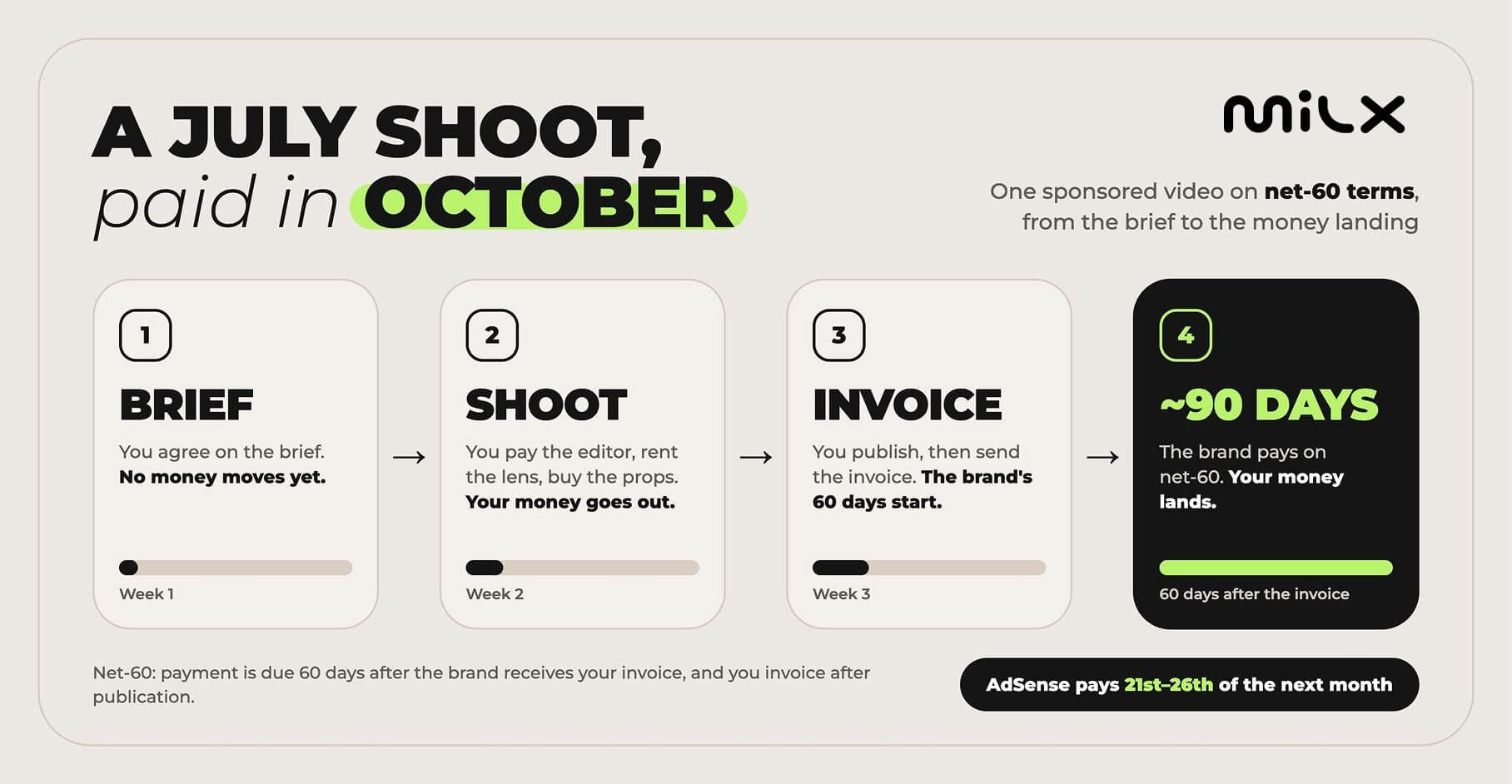
The time to monetize a YouTube channel splits into two waits, and most creators only plan for the first one:
- Time to access: 6 to 18 months to clear the Partner Program requirements.
- Time to money: about a month of review, then 1 to 3 months to reach the $100 AdSense threshold at 15,000 to 45,000 views a month, or about 9 months right at the 4,000-hour bar.
YouTube says more than 3 million creators are in the Partner Program, in its August 2026 announcement. It doesn't publish how many channels applied and never qualified, so any "X% of channels get monetized" figure you see online is an estimate.
Add the two waits together, and a channel starting from zero should plan for its first payment 8 to 22 months out. Planning for 3 months is how creators end up quitting in month four.
YouTube monetization requirements in 2026
The Partner Program has two entry points, and only the second one pays for ads:
|
YPP tier |
What your channel needs |
What it pays |
|
Fan funding |
500 subscribers, 3 public uploads in the last 90 days, and 3,000 watch hours in 12 months or 3 million Shorts views in 90 days |
Memberships, Super Chat, Super Thanks, Shopping. No ad revenue |
|
Ad revenue |
1,000 subscribers, and 4,000 watch hours in 12 months or 10 million Shorts views in 90 days |
Ad and Premium revenue sharing |
Both tiers are set out in YouTube's overview of the expanded Partner Program and its eligibility page.
We break each requirement down in our guide to YouTube monetization requirements for 2026.
Two details cost beginners months. First, only qualified watch hours count: hours from public long videos, podcasts, and archived livestreams. Shorts, unlisted or private videos, views from ads, and live streams you don't archive add nothing, per YouTube's explanation of qualified watch hours. So splitting effort evenly between Shorts and long videos feeds two counters at half speed. Second, the 12-month window rolls: hours earned 13 months ago drop off. A channel that stalls for a quarter can slide backwards on a threshold it was close to clearing.
What YouTube announced for February 1, 2027
YouTube has announced that from February 1, 2027, new applicants will need 8,000 qualified watch hours in the last 365 days or 20 million Shorts views in the last 90 days.
The same date brings a second change that affects everyone: Shorts ads and subscription revenue sharing will only go to channels with 10 million Shorts views in the last 90 days, including channels already in the program. Channels below that line stay in YPP and keep earning on long-form.
Fan funding thresholds don't change. All of this is in YouTube's August 2026 announcement.
Staying in the program gets its own bar from the same date. A channel counts as active with 1,000 qualified watch hours in the past 365 days, 1 million qualified Shorts views in the last 90 days, or 2 long videos or 5 Shorts every 90 days. A channel that drops below gets 90 days to get back to 1,000 watch hours or 1 million Shorts views, per YouTube's page on changes to the Partner Program.
For a creator starting in autumn 2026, this works like a deadline: if you're anywhere near 4,000 hours now, treat the application as urgent.
How long it takes to get monetized on YouTube, stage by stage
The journey has seven stages, and five of them respond to what you do.
|
Monetization stage |
What has to be true |
Planning range |
What moves it fastest |
|
Fan funding tier |
500 subs + 3 uploads in 90 days + 3,000 watch hours or 3M Shorts views |
3 to 8 months |
A niche with existing search demand |
|
First 1,000 subscribers |
1,000 subs |
4 to 12 months |
Titles and thumbnails, not upload count |
|
YPP ad revenue |
1,000 subs + 4,000 watch hours in 12 months, or 10M Shorts views in 90 days |
6 to 18 months |
Video length and watch-hour accumulation |
|
YPP review |
Application sent, AdSense for YouTube linked |
About 1 month, YouTube's own estimate |
A clean policy record: a rejection adds a 30- or 90-day wait |
|
First $100 in AdSense |
$100 balance reached |
1 to 3 months at 15,000–45,000 views a month; about 9 months at 5,000 |
Niche RPM and monthly views |
|
First payout in your bank |
Threshold met, address PIN verified, then the payout cycle runs |
Up to 6 weeks after the earning month ends |
Nothing: it follows the calendar |
|
Stable $1,000 per month |
About 435,000 views a month at the $2.30 median RPM (about 98,000 in Education & Science) |
No reliable public range |
Library depth and high-RPM markets |
Planning ranges built from the threshold arithmetic in this article and in line with vidIQ's 2026 monetization guide, which puts a typical channel at 6 to 12 months to reach 1,000 subscribers and 4,000 watch hours, and some at 12 to 18. YouTube doesn't publish a median time to monetization.
How long to reach 1,000 subscribers
For most channels, it takes four to twelve months, and the spread depends mostly on whether anyone is searching for what you make. (If you're wondering what those subscribers are worth once ads switch on, we broke it down in how much money 1,000 subscribers is worth on YouTube in 2026.)
Run the watch-hour maths alongside it, because both thresholds have to be met together, and hours are usually the harder one. 4,000 hours is 240,000 minutes. At an average view duration of 4 minutes, that's 60,000 views across the year, or about 5,000 views and 333 watch hours a month.
Publishing 2 to 5 videos a month gives you 24 to 60 videos to spread that across, so each one needs roughly 1,000 to 2,500 views.
You can check this against reality in month three. If your videos average 200 views, 4,000 hours is years away. Fix titles and thumbnails before you add more uploads.
Track minutes rather than views: a 12-minute video at 800 views beats a 3-minute video at 2,000 views on the counter that decides your timeline.
Watch hours and accumulation
Every public long video keeps adding watch hours for as long as people find it. A library of 60 videos keeps collecting hours between uploads, while a library of 6 depends on whatever you posted last.
An existing catalogue can keep pulling an audience on its own. An English-learning channel for Spanish speakers that we work with ran 24/7 live streams built from its old videos while it wasn't producing anything new. From June 22, 2025, those streams brought 53,843 views, 669 new subscribers and $321.79 in revenue, with an average view of 10 minutes 20 seconds. That channel was already monetized. On a channel that isn't yet monetized, the new subscribers would count toward 1,000, but the stream hours count toward 4,000 only if the stream is archived.
If you have 20+ videos and growth has flattened, re-title and re-thumbnail the five oldest videos with the most impressions before shooting anything new.
The first YouTube payout timeline
Four steps stand between your application and the first payment, and only one of them depends on your channel.
- YouTube reviews your channel. Once you accept the Partner Program terms and link an AdSense for YouTube account, the channel joins a review queue, and YouTube says a decision typically takes about 1 month, per its Partner Program eligibility page. After a first rejection, you can reapply in 30 days. After a second, the wait is 90 days.
- Your AdSense balance reaches $100. That's the US payment threshold. Below it, earnings roll into next month, per Google's AdSense payment threshold documentation.
- You verify your address. When your balance passes a small verification threshold, Google mails you a PIN, which usually takes about 3 weeks to arrive, per AdSense's address verification guide. You need it entered to get paid.
- YouTube pays. Finalized earnings post to your balance between the 7th and the 12th of the following month and pay out between the 21st and the 26th, as described in YouTube's guide to getting paid.
Step 2 is the one that depends on your channel. Here's how long it takes at the $2.30 median RPM among MilX users in our research:
|
Views a month after approval |
Earnings a month at $2.30 RPM |
Month you cross $100 |
First payment |
|
5,000 (about the 4,000-hour bar at a 4-minute average view) |
~$11.50 |
Month 9 |
21st–26th of month 10 |
|
20,000 |
~$46 |
Month 3 |
21st–26th of month 4 |
|
45,000 |
~$103.50 |
Month 1 |
21st–26th of month 2 |
So a channel that only just clears the bar can wait most of a year for its first payment, even after approval.
Set up and verify your AdSense payment method the week you're approved, not the week you hit $100. An unverified address or a failed identity check costs you a full cycle.
Past the first $100, the views you need depend on your niche. At the $2.30 median RPM in our research of 300 channels (by MilX and AIR Media-Tech), $1,000 a month takes about 435,000 views, and our breakdown of how much YouTube pays per view shows the numbers by niche, up to $10,000 a month.
How long until your channel makes $1,000 a month?
We looked at how creators among MilX users got to their first $1,000 a month and which income streams got them there faster than ads alone.
See how creators got to $1,000 →What speeds up the monetization timeline
Four choices shape both waits: your niche, your upload pace, video length, and the language market you publish in.
Niche and monetization speed
Your niche moves both waits at once. On the first, niches with steady search demand (tutorials, reviews, how-tos) keep pulling views into old videos, so watch hours pile up faster.
On the second wait, RPM decides how fast you reach $100. Among MilX users in our research, Education & Science channels needed about 9,800 views for their first $100, and Gaming channels about 48,800. The gap grows with every goal: at $1,000 a month it's about 98,000 views in Education & Science against about 488,000 in Gaming.
Upload frequency and growth
YouTube sets no upload count beyond 3 public uploads in 90 days for fan funding. Our posting-frequency research of 18,000 English-language channels (by MilX and AIR Media-Tech), focused on channels with 100,000 to 1 million monthly views, found that 7 of 11 niches grow most at 2 to 5 videos a month, according to the full study. Gaming and kids' channels peak at 20 to 40 a month, beauty and business at 10 to 20, and food at 5 to 10.
Rhythm counted more than volume. Channels that posted on a predictable schedule outperformed channels posting the same number of videos on random days, and channels that went quiet for 14 days or more, three or more times a year, got fewer views per video. From February 1, 2027, uploads also count toward staying active in the Partner Program: 2 long videos or 5 Shorts every 90 days is one of the ways to qualify.
Video length and language market
Videos under 8 minutes can't carry mid-roll ads, per YouTube's mid-roll documentation. A 16-minute video can hold several mid-roll slots, while a 2-minute video earns one pre-roll impression.
If your videos sit at 6 or 7 minutes, restructuring them to clear 8 is the cheapest RPM increase a small channel has. It usually costs one extra segment per script.
Language is the second structural lever. English accounts for 40.9% of all YouTube channels, according to AIR Media-Tech research across 60 million channels, so that's also where the competition is. A channel in a less crowded language market can reach the same view counts with fewer competitors for each search.

Long-form or Shorts: which route to YPP is faster
It depends on the daily views your Shorts already get. 10 million Shorts views in 90 days works out to roughly 111,000 views a day, every day, for three months. If your Shorts already pull six figures daily, that route is faster. If not, the 4,000-hour route is the realistic one, and from February 1, 2027, both bars double for new applicants.
Shorts still help on the long-form route while they stay a share of your uploads. Our research of 18,000 English-language channels (by MilX and AIR Media-Tech), March 2025 to March 2026, found the strongest results when Shorts made up 25% to 40% of uploads, according to the full Shorts study. Above roughly 55%, long-form audiences thinned out in every niche, and 1,247 channels that shifted their format mix by 30 percentage points or more within six months underperformed both steady groups. Fitness, food, business, and education channels gained most from mixing. Gaming, entertainment, science, and beauty did better staying long-form.
When the fit is right, the upside comes fast. A Hindi-language kids channel we work with started publishing Shorts on May 29, 2025, and by September 30, its revenue had nearly doubled. For how Shorts pay once you're in, see our YouTube Shorts monetization guide.
How to earn on YouTube before YPP
Ad revenue is the slowest income a creator can choose, and the only one behind a 1,000-subscriber gate. These four start earning much earlier:
- Affiliate revenue. Pays on buyer intent, not audience size, so a small channel with a useful gear or software link can out-earn ads per view.
- Direct sales. A preset pack, a template, a one-hour consultation. If 1% of a 2,000-view video buys a $15 product, that video made $300. The same video on ads at a $2 RPM makes about $4.
- Sponsorships. Brands pay for a specific audience. A 3,000-subscriber woodworking channel is easier to target than a 100,000-subscriber meme channel.
- Fan funding at 500 subscribers. Memberships, Super Thanks, and shopping open a full tier before ad revenue does.
Creators who reach real income before monetization sell something to the audience they already have. We collected numbers from channels that did it well before 10,000 subscribers in this case study of creators who earned before hitting 10,000 subscribers.
A 90-day plan for a new channel
- Days 1–14: validate the niche. Search 10 phrases your viewer would type. If autocomplete doesn't suggest them and top results sit under 5,000 views, demand is thin.
- Days 15–30: publish 3 videos over 8 minutes. This also covers the fan funding rule of 3 uploads in 90 days.
- Days 31–60: fix packaging before adding volume. Any video with impressions CTR under 4% needs a new title and thumbnail. Then add 2 to 4 more videos.
- Days 61–75: turn on one non-ad income stream. One affiliate link, product, or service, mentioned once in the video.
- Days 76–90: add Shorts at about a third of uploads, each ending with a reason to watch the long video.
On day 90, multiply your trailing 30-day watch hours by 12. That's your annual run rate against 4,000 hours. If it lands well under 4,000 and February 2027 is close, the fan funding tier is the more realistic target for this year. For the application itself, including AdSense linking and the checks that hold approvals up, see how to start monetization on YouTube.
Monetized, but still waiting until the 21st to get paid?
MilX works with monetized channels. Your earnings land on your MilX balance daily from the day you connect, and Advance Funds brings up to 2 months of revenue you've already earned forward for a one-time 4.3%.
- Withdraw any day in 54 currencies through 30+ payout methods. Instant Payment lands in under 5 minutes for 1% (minimum $1).
- Pay your editor or designer with free, instant P2P transfers between MilX users.
- Get contracts, acts, and invoices for your payments. YouTube signs nothing.
- If your channel qualifies, Active Funds adds up to 4 months of future revenue.
$500M+ paid out to creators, 3,100+ channels connected, 4.6 out of 5 on Trustpilot. No subscription, no revenue share.
Download MilX for free →