

Guidelines
11 Sep 2026
 How to monetize reaction videos without getting demonetized in 2026
YouTube’s inauthentic content policy states plainly that commentary, clips, compilations, and reaction videos are still allowed, as long as your video keeps “a meaningful difference between the original video and your video.” The threat is not the format. It is a single Content ID claim moving that video’s ad revenue to the rights holder while the video stays online, and you have 5 days to respond before that money is gone for good.
9 Sep 2026
 How much money can you get for 1000 subscribers on YouTube in 2026?
YouTube pays for monetized views, not for subscribers. On their own, 1,000 subscribers are worth $0: they give access to the YouTube Partner Program. A new partner channel with 5,000 to 25,000 monthly long-form views earns roughly $16 to $375, depending on niche RPM. Your first payment arrives only after your AdSense balance passes $100.
26 Aug 2026
 How much can you earn on YouTube streaming in 2026?
Live stream RPM runs between $0.70 and $5.98 per 1,000 stream views across MilX partner channels, so 100,000 stream views pay somewhere between $70 and $600. On top of that, YouTube returns 70% of net revenue from Channel Memberships, Super Chat and Super Stickers, and 55% from ads on the watch page, under the revenue share rates in its partner earnings terms. One MilX partner channel ran 12 streams in a month for 867,317 views and $610.61. A much smaller one pulled 53,843 views and $321.79.
5 Aug 2026
 What Is the Best Payment Method for YouTube Creators in 2026?
The best YouTube payout option in 2026 depends on where you live and how you want to access your earnings. AdSense gives you three payout paths: bank transfer (which Google calls wire, EFT, or SEPA depending on your country — it's one rail with regional names, not three separate methods), a PayPal Hyperwallet account (not your regular PayPal, and only in specific countries), and cheque, which Google is phasing out anywhere EFT is available.
31 Jul 2026
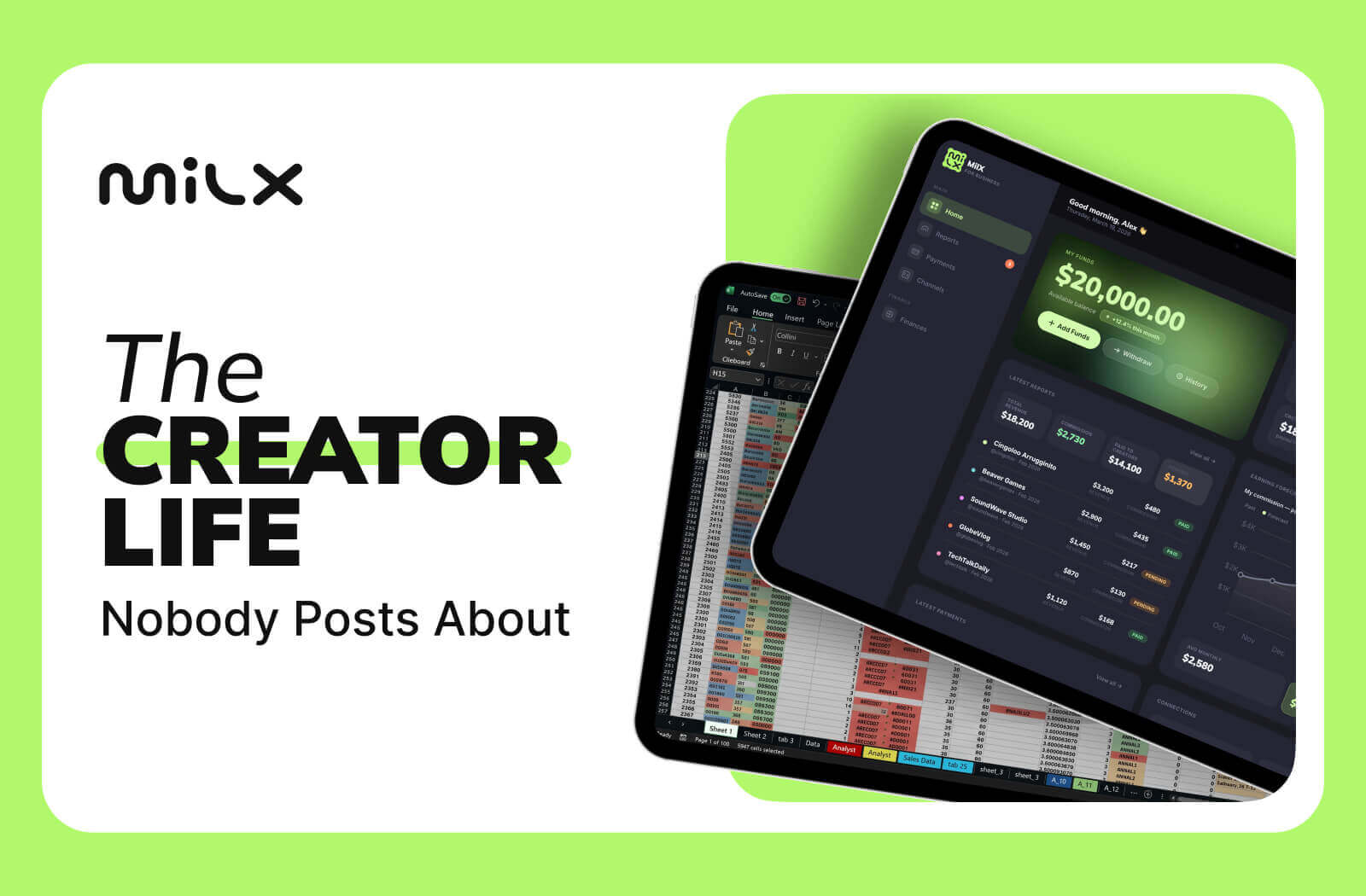 How To Survive the Job as a YouTube Creator?
YouTube creator life runs on unpredictable pay, invisible hours, and solo problem-solving, and the creators who last are the ones who treat it like a business from day one. 71 percent of independent creators make under $30,000 a year, one 10-minute video eats 20 to 40 hours, and ad rates drop 30 to 50 percent every January. None of that is a reason to quit before you start. It is the list of things to prepare for so none of them catch you flat.
28 Jul 2026
 How Long Does It Take to Succeed on YouTube?
Your first two years on YouTube are an investment phase, not a paycheck. Around 97% of channels stay under 10,000 subscribers; most creators need 6 to 18 months of steady posting to get monetized, and first-year ad income for the majority lands in the low thousands. The creators who plan their money for a slow year one are the ones who make it to year two.
24 Jul 2026
 Why Does YouTube Revenue Drop in Q1?
The YouTube Q1 revenue drop is real. Your revenue falls in January even when your views hold steady, because ad CPMs drop 30–50% below December as advertiser budgets reset on January 1. The dip is deepest in the first 2–3 weeks of January and recovers through February and March. The one exception is tax and legal content, where CPM climbs 20–30% during tax season. The drop is predictable, so you can prep for it in Q4.
20 Jul 2026
 Which Niche Should You Switch to If Your CPM is Under $2?
A CPM under $2 puts your 100,000-view month at roughly $90 after YouTube's cut—the same views in a finance or AI tools niche: $720 or more. The most common fix is to start a new channel in a higher-paying niche — a clean slate, the right audience from day one. You keep the old channel running as a passive income source while the new one builds. Pivoting within the same channel is possible but carries real risks: subscriber mismatch, algorithm confusion, and a slow reset period. The right destination is the highest-paying niche your skills and credibility can carry.
17 Jul 2026
 Which YouTube Payout Method Costs You the Most: Wire, PayPal, Payoneer, or Crypto?
Two creators pulled the same $2,000 from YouTube this month. One keeps about $1,960 and has it by the weekend. The other keeps $1,740 and waits three extra weeks to see it. Same views, same revenue, different bank balance. The gap is not in their content. It is the YouTube payout method each one picked, usually once, during AdSense setup, and then never touched again.
13 Jul 2026
 The Difference Between USD, USDC, and USDT in Creator Monetization
USD, USDC, and USDT all carry the same dollar value. What they do not share is speed, flexibility, and reach, and those are the things that decide whether your earned income becomes usable income. Fiat is trusted but slow. USDC is the compliant digital dollar. USDT is the liquidity workhorse with regulatory fine print.