

|
Factor |
What it means |
|
Reaction videos |
Can be monetized in 2026. |
|
Key requirement |
Add meaningful original commentary, modification, or entertainment/educational value |
|
Main risk |
A Content ID claim can redirect ad revenue to the rights holder while the video may remain online. |
|
Critical window |
Dispute within 5 days to have revenue held from the date the claim was made; otherwise, held revenue may be released to the claimant. |
Reaction video demonetization rarely starts in a courtroom. It begins with an automated match, a policy review, or a manual claim you did not open in time.
Below: what YouTube’s systems check, how much of your own work a reaction needs, what a claim does to your payout, and the exact response after a claim or a strike.
👉 Start with the mechanics of the system that will judge your uploads: what Content ID is and how it detects copyright violations on YouTube.
Key takeaways
- Fair use is a defense in court, not permission to upload. No disclaimer, no credit line, and no “for educational purposes” text changes what Content ID does to your video.
- Revenue from a reaction often goes to the rights holder even when the video stays on your channel. A claim redirects money; it does not remove the video.
- A safe reaction is one in which your commentary and edit carry most of the value. Short inserts, constant talk-over, real cuts.
- Claims and strikes cost more than ad revenue. According to the data from MilX users, hidden strikes also suppress recommendations, which is why revenue on one tech channel rose 484% after the strikes were cleared. They also localized metadata and picked better thumbnails after the A/B test to get that result.
What is the difference between a copyright claim and a copyright strike?
A copyright claim is a monetization decision. A copyright strike is a legal removal request that moves your channel one step closer to termination. Two systems, two consequences, and creators who confuse them panic at the wrong moment.
|
Parameters |
Copyright claim (Content ID) |
Copyright strike |
|---|---|---|
|
How it starts |
Automatic match in Content ID, or a manual claim filed by a rights holder with timestamps |
A legal removal request (DMCA) from the copyright owner |
|
What happens to the video |
Stays online; the owner chooses to block, track, or monetize it |
Removed from YouTube |
|
Effect on the channel |
Usually none on channel standing |
Strike lasts 90 days after Copyright School; live streaming limited for 7 days |
|
Effect on your income |
Ad revenue on that video goes to the claimant |
The video and its revenue are gone |
|
Your response |
Dispute, then appeal |
Ask for a retraction, file a counter-notification, or wait it out |
|
Three of them |
Nothing automatic |
Account termination, channels removed, no new channels |
Claims carry no counter toward termination, which is why a channel can run hundreds of claimed videos and stay in good standing.
🎯 Practical tip: check YouTube Studio → Content → Restrictions weekly and sort by “Copyright.” A claim you never opened earns money for someone else while the 5-day revenue-hold window runs out. Full breakdown: copyright strike vs copyright claim on YouTube.

Can you monetize reaction videos on YouTube in 2026?
Yes. YouTube renamed its repetitious content policy to the inauthentic content policy on July 15, 2025. The reused content policy stayed exactly as it was, and YouTube confirmed nothing changed for it concerning commentary, clips, compilations, and reaction videos. What the policy targets is mass-produced or templated uploads and content where, in YouTube’s words, “we cannot tell that the content is yours.”
Two separate systems decide whether ads run:
- Channel-level monetization under the inauthentic content policy. This asks whether your channel adds original value. Failing it can cost you the YouTube Partner Program.
- Video-level ad suitability under the advertiser-friendly guidelines. Profanity throughout the video, graphic clips you are reacting to, or shocking source footage produce the limited-ads icon even when copyright is clean.
Reaction creators blame copyright for the yellow icon when the trigger is often the language in the first 30 seconds. That is fixable without touching the source clip.
🎯 Practical tip: run the Checks step before publishing. YouTube Studio screens the upload for copyright and lets you rate the video against the advertiser-friendly guidelines through Ad suitability, so you fix the issue before the video is public instead of appealing after.
Does fair use protect your reaction video?
Fair use protects a YouTube reaction video in court, not inside Content ID. YouTube says it directly: “courts decide fair use cases according to the facts of each unique case,” and “automated systems like Content ID can’t decide fair use.” Claims land on videos that would win a fair use argument, because the system never runs that argument.
Courts have generally considered four factors, which YouTube lists in its fair use help pages:
- Purpose and character. Commentary, criticism, and education weigh in your favor. Passive rewatching does not.
- Nature of the work. Factual and news material is treated more favorably than fiction and music.
- Amount used. Short excerpts weigh better than long stretches, and the “heart” of a work counts even when it is brief.
- Effect on the market. If a viewer skips the original because your video replaced it, this factor turns against you.
A second exposure sits outside these four factors. In February 2026, a US District Court in Cordova v. Huneault let DMCA circumvention claims proceed against a creator who used a ripping tool to pull YouTube clips for reaction videos. Bypassing YouTube’s download protection is treated as its own alleged violation, decided apart from whether the finished video is fair use. How you obtain the clip now carries risk of its own.
🎯 Practical tip: drop third-party downloaders. Screen-record playback, use the platform’s own clip and embed tools, or ask the creator for the file. Same footage, one fewer legal argument against you.
How much original commentary does a reaction video need?
YouTube publishes no percentage. The policy gives examples instead of a threshold, so the working standard is risk management: the more of the runtime carried by your voice, your edit, and your framing, the less a claim or a policy review can take from you.
- Insert length: keep any uninterrupted stretch of source footage under 30 seconds. Pause, react, continue.
- Share of original material: your own material carries the majority of the runtime. If the source plays untouched for most of the video, you have a reupload with a webcam in the corner.
- Commentary on top: talk during the clip, not only after it. Silence over the source is the weakest position in a dispute.
- Editing: crop, zoom, add text, cut between points. The edit is documentary evidence of transformative use, and Content ID cannot replicate it.
- Added value: answer a question the original never asked. A vocal coach explaining breath support, a lawyer flagging the missed clause, a gamer showing the input that caused the crash.
The passive format is the trap. A video that plays a full track or a whole episode with a face cam reads as redistribution rather than commentary, and it runs into the reposting problem that ends monetization at the channel level, not the video level.
🎯 Practical tip: script your first sentence over every clip before you record. Two or three planned talk-over beats per insert kill the “watch, laugh, say nothing for 90 seconds” pattern that produces weak retention and weak disputes at the same time.
What happens to your money when a Content ID claim hits a reaction video?
The video keeps running ads, and the revenue goes to the rights holder. When Content ID finds a match, the owner picks one of three policies:
- lock
- rack
- or monetize
That third option is the revenue claim most reaction creators live with, and it explains a million-view video that pays almost nothing.
Revenue sharing can also be your own decision. Through Creator Music, eligible creators use a licensed track and split revenue instead of paying a license fee: one revenue-share track cuts the creator share to roughly half of the standard 55%. Same split, agreed before upload instead of imposed after it.
Timing decides how much money is at stake during a dispute. YouTube’s rules on monetization during Content ID disputes are specific: dispute within 5 days of the claim, and all the video’s revenue is held while the claimant reviews. Dispute later, and only the revenue from the dispute date forward is held. Everything earned before that goes to the claimant, even if you win.
🎯 Practical tip: treat the 5-day window as your deadline, not the 30-day one. A claim during the first-week traffic spike is the most expensive claim a reaction video ever gets, and after day 5, the revenue earned before your dispute goes to the claimant, whatever the outcome.
Which actions raise your risk of a claim, a strike, or lost income?
Risk stacks by how you use the source, not by your niche. Common reaction setups against the three outcomes that matter:
|
What you do |
Content ID claim risk |
Copyright strike risk |
Effect on your income |
|---|---|---|---|
|
Play a full song or full music video |
Very high |
Low |
All ad revenue for that video redirected to the rights holder |
|
Movie or TV clip over 30 seconds with no talk-over |
High |
Medium |
Claim, plus blocking in some countries |
|
Trailer or clip with commentary across most of it |
Medium |
Low |
Claim possible, but a dispute has a real basis |
|
Clip obtained with a ripping tool |
High |
Medium, plus DMCA circumvention exposure |
Revenue at risk and a separate legal argument against you |
|
Reupload with a few reactions cut in |
High |
Medium |
Channel-level monetization risk under inauthentic content |
|
News or factual clip, short excerpt, your analysis on top |
Low |
Low |
Usually full monetization |
|
Game footage with face cam and live commentary |
Low |
Low |
Usually full monetization |
|
Licensed track used more times than the license allows |
High |
Low |
Claims across every video with that track |
🎯 Practical tip: read the “per video” line in every music license you buy. A license is a permission with limits, and Content ID enforces the limits, not your intentions.
A Claim Freezes One Video, Not Your Whole Channel
A dispute can hold that video's revenue for up to 30 days. Connect your channel to the MilX app, and everything else it earns keeps landing in your balance every day, claim or not. Withdraw it anytime in 50+ currencies through 30+ payout methods, crypto included. Try MilX
What should you do after a Content ID claim on a reaction video?
Open the claim, read the timestamps, then pick one of four moves. Silence hands the revenue over by default.
- Do nothing on purpose. If the claimed segment is short and the video is not a big earner, leaving the claim in place costs you that video’s revenue and nothing else. No strike, no channel damage.
- Edit the claim away. In YouTube Studio, you can trim out the claimed segment, replace the song, or erase it while keeping the same URL and view count. The claim clears once the claimed content is gone.
- Dispute it. Use this when you hold the rights, the license covers the use, or you have a real transformative use argument. The claimant then has 30 days to respond: release the claim, reinstate it, or escalate to a removal request that becomes a strike. No response in 30 days and the claim expires.
- Appeal after a rejected dispute. The claimant gets 7 days to answer an appeal, and their options narrow to releasing the claim or filing a takedown. This is the step where the risk turns real, so appeal only when your rights argument is solid.
|
Criterion |
Do nothing |
Edit the claim out |
Dispute |
Appeal |
|---|---|---|---|---|
|
Time to resolve |
Immediate |
Hours to a day of processing |
Up to 30 days |
7 days after a rejected dispute |
|
Revenue on that video |
Goes to the claimant |
Returns to you after processing |
Held until resolved |
Held until resolved |
|
Video stays as published |
Yes |
No, the segment is gone for good |
Yes |
Yes |
|
Risk of a copyright strike |
None |
None |
Real, if the claimant escalates |
Higher, the claimant can only release or take down |
|
What it needs from you |
Nothing |
Correct timestamps |
A rights or fair use argument in writing |
The same argument, under more pressure |
|
Recommended for |
Low-traffic videos with a short claimed insert |
Music beds and background tracks you can replace |
Licensed or clearly transformative use, filed within 5 days |
Rejected disputes where you hold documented rights |
Manual claims deserve a closer look than automatic ones. Rights holders must file them with accurate timestamps, and YouTube revokes access for owners who repeatedly submit inaccurate ones. A manual claim stretched over your intro, your outro, and your face cam is worth challenging.
🎯 Practical tip: before disputing, screenshot the claimed timestamps and write your reason in two sentences: what you used, how long, and what you added. One music channel that uses MilX for payouts had monetization blocked across its catalog by pirate Content ID claims; after the claims were removed and monetization restored, quarterly revenue went from about $11.8K to about $115.6K. The money was never missing; it was misrouted. More context here: how a copyright claim works on YouTube and why it’s not always a problem.
What should you do after a copyright strike?
Move fast. A strike is the one thing on this list that ends channels. A strike lasts 90 days once you complete Copyright School; live streaming access (specifically) is limited for 7 days, and a second strike extends that limit to 14 days. At three active strikes, the account and any associated channels are subject to termination, uploaded videos become inaccessible, and new channels are blocked.
Three routes out, in the order worth trying:
- Ask the claimant for a retraction. The fastest path, and the one creators skip. A short, calm message explaining the edit and offering to trim the clip resolves more strikes than any form.
- Wait it out. Complete Copyright School and let the 90 days run. Correct whenever the claim was valid.
- File a counter-notification. Only when you hold the rights or your use is clearly lawful. It is a legal statement with legal consequences.
According to MilX data, direct contact with the claimant breaks the deadlock more often than the forms do. One kids channel carried one blocked-monetization flag and two limited-ads flags on licensed music after its appeals were rejected with no explanation. Tracking down the claimant by email, negotiating removal of the strike, and then requesting a manual channel health review brought back about $5,360 in revenue.
Strikes also do damage nobody bills you for. We watched a network of channels AIR manages run a cleanup — pulling policy-violating uploads and swapping out unsafe thumbnails — and saw views rise 89.7% and revenue rise 30.5% across the portfolio in five weeks. The lift came from fixing existing content, not new uploads: the channels had simply stopped being suppressed.
🎯 Practical tip: if monetization is already gone at channel level, work the checklist in what to do if my channel is demonetized before uploading anything new. New uploads on a suppressed channel bury your best evidence that the cleanup worked.
What does MilX do for reaction channels?
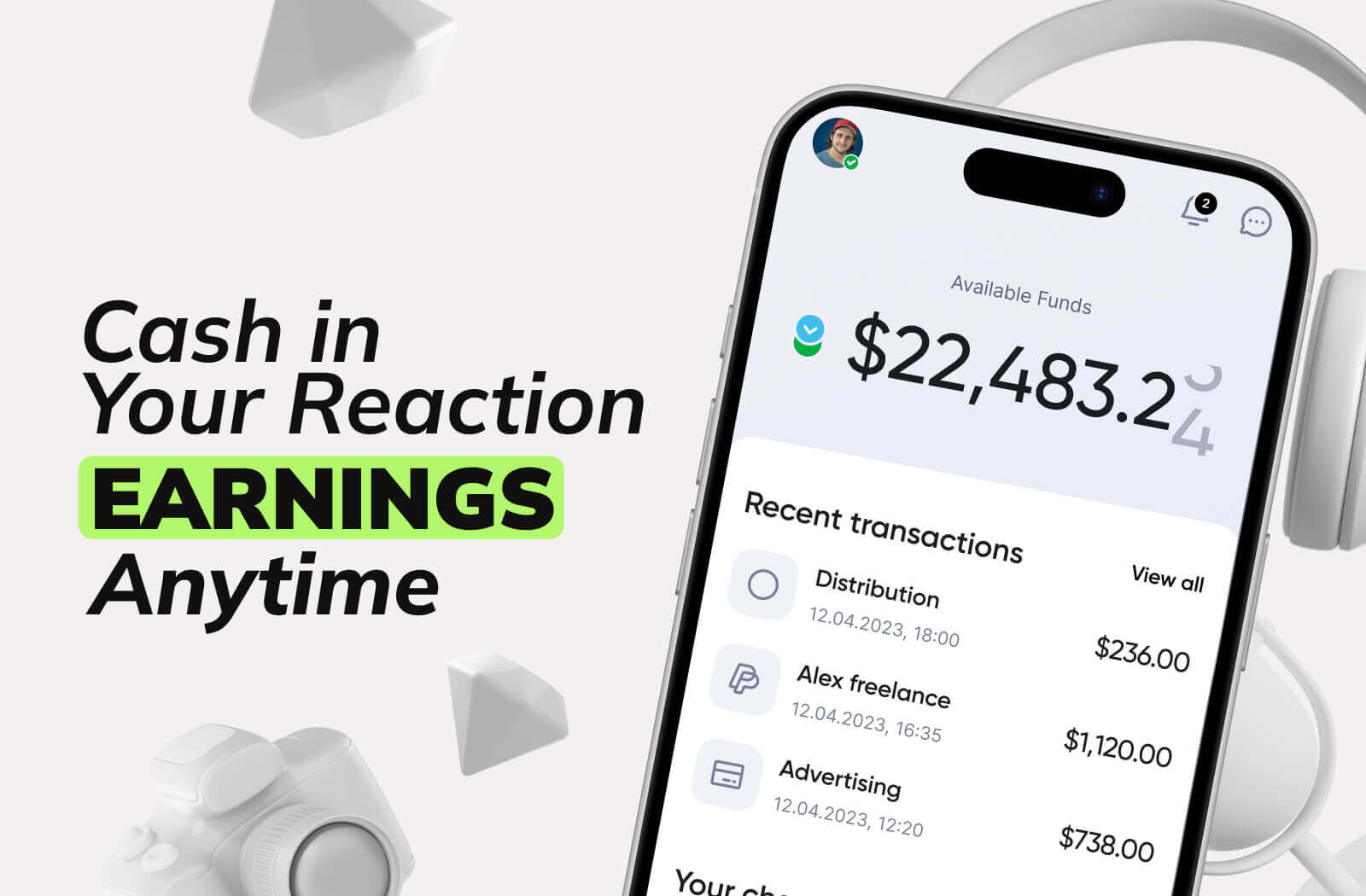
You've earned that money. It's sitting somewhere between the platform and your bank account, and closing that gap is what MilX does for you.
What that looks like in practice:
- Advance Funds gives you access to revenue you have already earned and can see in your analytics, up to 50 days before YouTube pays it, for a 4.3% commission charged once on the amount you use.
- Active Funds covers up to 4 months of future revenue for qualifying channels at 0.33% per day on the outstanding balance, repaid at 5% a month, with no credit check, so a disputed month does not stop the next production. Combined, that is up to six months of revenue upfront.
- Withdrawals run through 30+ payout methods in 50+ currencies for bank transfers and crypto (BTC, USDT, USDC).
- Instant Payments land in under 5 minutes. P2P transfers to your editor cost 1% of the amount (minimum $1) between MilX users — standard payouts don't carry this fee.
Be the one of 1,500+ creators who've moved $500M+ through MilX, an Official YouTube Partner. Your payments run through a licensed Money Service Business regulated by FinTrac in Canada.
MilX holds a 4.6 on Trustpilot, with no monthly subscription fees.
Get Paid Before the Views Roll In
Stop waiting on the 21st of the month. Access your earned YouTube revenue up to 60 days early, or up to six months of income upfront if your channel qualifies, then put it straight into your next shoot, your editor, or your gear. 1,500+ creators, $500M+ processed, 4.6 on Trustpilot. Try MilX
👉 Take control of your creator finances with MilX, download the app for free.