

Taking a video someone else made and posting it under your name is theft. The little money you see is borrowed time on stolen footage, and the bill arrives as a copyright strike, a pulled monetization, or a deleted channel.
This blog covers what reposting and reused content mean on YouTube, what the YouTube copyright policy does to channels that re-upload, and the legal ways to use other people's clips when you are short on your own ideas.
What "Reposting" Means on YouTube
Reposting on YouTube means taking a video someone else made and uploading it again as if it were yours. In reality, it’s re-uploading. YouTube has no repost button, the way Instagram or X do.
When you re-upload work you did not create, you are copying content you have no right to, and YouTube's whole system is built to catch it and shut it down.
No license, no permission, no real change of your own. That is copyright infringement, and it sits a long way from the legal formats further down this page.
Sometimes people might say "reuse" because it sounds harmless, like recycling. The honest word is theft.
The original creator owns that footage the moment they record it. Re-uploading it without rights is the same as printing someone's book and selling it with your name on the cover.
YouTube draws two separate lines here, and you can trip over either one:
- Copyright infringement. You uploaded footage you do not own or have a license for. This is the heavy one. It can trigger a Content ID claim, a copyright strike, or a takedown, and the rights holder can take you to court.
- Reused content, a YouTube monetization rule. Even with footage you are cleared to use, YouTube can rule that your video adds nothing of your own. Help docs define reused content as material that is not clearly your own and adds no real commentary, edits, or value. This blocks monetization even when no copyright claim exists.
The bar for "your own" is a meaningful change that a viewer can see and hear.
Common setups that get flagged in 2026:
- Compilation channels that stitch clips from other YouTubers, films, or sports broadcasts with no voice-over.
- Faceless YouTube channels running text-to-speech over stock footage and slideshows.
- YouTube automation channels are pushing templated scripts at scale.
- Stitch channels pulling TikTok or Instagram clips back into YouTube Shorts.
- Song collections lifted from several artists, even when you think you have permission.
- Silent reaction videos where the creator never speaks or writes any context on screen.
🧩 Quick self-test: Play the video you want to use with the sound off. If a random viewer cannot tell what you added to the source in the first 10 seconds, the review team will not see it either, and Content ID may have flagged it before a human ever looked.
Can You Monetize Reposted Videos?
Short answer: NO.
The upload button does not stop you, so for a few days, the answer can look like yes. Then reality arrives. Content ID catches a large share of re-uploaded clips before they earn a cent.
The ones that slip through face manual review, copyright strikes, and demonetization that can wipe the whole channel, not only the flagged video.
There is also a wall before any of that. To turn on ads at all, a channel has to clear YouTube monetization eligibility.
So if your last 30 uploads are mostly other people's videos, you are not ready to apply. YouTube's reviewers will reject the channel because it breaks YouTube monetization rules on both originality and copyright.
Your Content, Your Money, Your Move
Cash out your YouTube income on your terms, in 40+ currencies. Send it to a bank, a card, an e-wallet, or crypto. With MilX, you set the rules, and sign-up is free. 👉 Get the MilX app
What YouTube's Copyright Policy Does to Repost Channels
YouTube's copyright policy is not a warning label. It is enforcement, and it stacks. Here is what happens to a channel built on re-uploads, roughly in the order creators hit it.
- Content ID claim. YouTube scans uploads against a database of audio and video fingerprints. When your clip matches a rights holder's file, the system can block the video, mute it, or send the ad money to the owner instead of you. This runs automatically on the first pass, and it does not care why you uploaded the clip.
- Copyright strike. A rights holder files a removal request, and YouTube takes the video down. A strike is heavier than a Content ID claim. Three copyright strikes in 90 days terminate the channel, delete every video on it, and block you from starting new ones.
- Channel-level demonetization. Once an inauthentic or reused-content flag lands, YouTube pulls Partner Program membership across the whole channel, not just one video. You can reapply after 30 days, but the same content profile triggers the same flag again.
- Manual termination. YouTube can shut a channel down for spam, deceptive, or scam behavior. Re-uploading at scale fits that description, and the appeal success rate on these is low.
- A lawsuit. This is the level the repost guides skip. Copyright infringement is a legal claim, not only a platform rule. A rights holder can sue you directly. In the US, statutory damages run up to $150,000 per work for willful infringement. Re-upload a hundred clips, and that is a hundred works.
Two more traps people learn too late:
- Run several channels under one Google account, and a termination on one can flag the others. A backup channel does not save you when it shares the same verification email.
- Multi-channel networks now run pre-flight checks on faceless YouTube channels before they sign anyone. A copyright-heavy history is a deal killer, even while the ads are still on.
👉 Learn how to avoid copyright strikes on YouTube.
Why Reposting Fails as a Business, Even If You Dodge the Strike
Set the law aside for a second. The math still does not work.
A re-upload channel owns nothing it can defend.
Brand sponsors stay away. Copyright noise on old videos kills clearance, inflated subscriber counts get flagged during agency diligence, and a faceless host cannot stand in front of a camera brand.
The lifetime of a repost channel is short. Most we see discussed in creator forums lasts 6 months before a strike, a policy update, or a manual review sets the count back to zero.
A quick look at the trade-off:
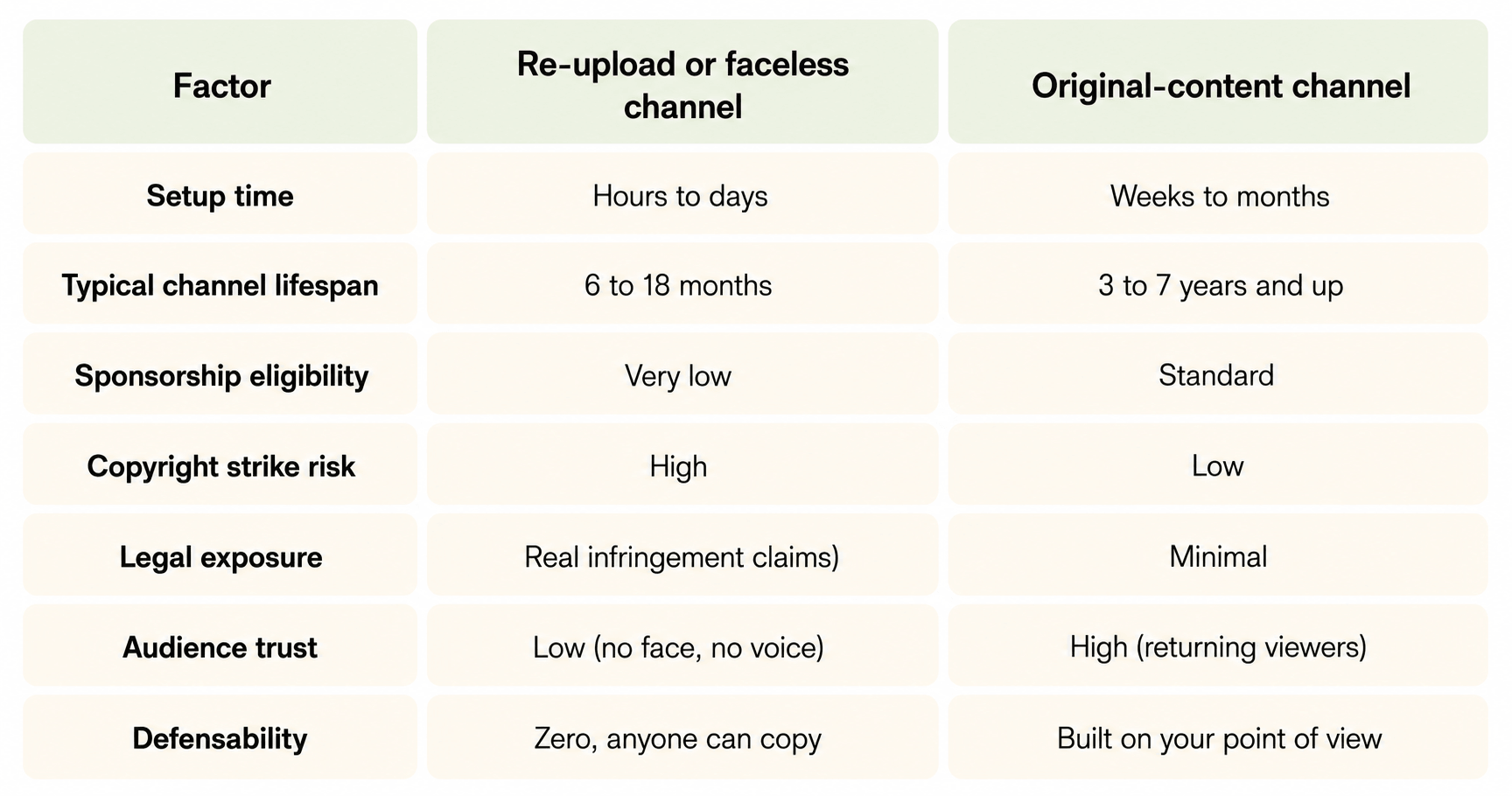
🧩 Read this straight: A channel built on other people's videos can hand you a small cash bump for a few months before it gets pulled. Your own work compounds. The numbers above are not a slogan. They are the median pattern from creator economy reporting and from what monetized creators tell us when we ask about lifetime channel value.
Get Paid Before the Algorithm Decides
Active Funds by MilX gives you access to up to 6 months of your future YouTube income today. Skip the wait and cash out on your terms with one free app. 👉 Try Active Funds.
No Ideas Yet? Start With Reaction Videos, Done Right
Maybe you do not have a topic of your own yet. That is a normal place to start, and it does not mean copying.
The cleanest on-ramp is the reaction video, where you watch something and respond to it on camera or in voice. Done properly, a reaction is your own work that happens to include a clip. Done lazily, it is the same theft as a repost with your webcam in the corner.
👉 Learn more about how to monetize reaction videos.
Why reactions can be legal: copyright law protects commentary and criticism. When you add a real reaction, analysis, or a joke that the original did not have, you are making something new on top of the source.
The law weighs how much new meaning and purpose you added, how much of the original you used, and whether your video competes with the original.
So treat the rules below as the line between a channel that survives and one that gets struck.
Do:
- Talk a lot. Your voice or face should carry most of the runtime, and the source clip should be the smaller part.
- Pause the clip often to add your take, context, or analysis. The stops are where your value lives.
- Keep the borrowed segments short. Show enough to make your point, then cut back to you.
- Pick sources that allow reactions. Some creators welcome them. Check the original channel's stance first.
- React to things you can say something real about. A reaction with no opinion is a re-upload with a face.
Don't:
- Play the full video start to finish. Watching someone else's content in silence is re-uploading with extra steps, and Content ID treats it that way.
- Stay silent through long stretches. Dead air over a borrowed clip is the fastest route to a claim.
- React to material with aggressive Content ID, like new music videos, films, TV episodes, or live sports. These match in seconds, and a clever edit will not save you.
- Re-upload the clip on its own "for context." If the source can stand alone in your video without you, you have not added enough.
- Assume fair use covers you because you said the words "fair use." It does not work that way. A rights holder can still claim or sue, and you carry the burden of proving your case.
🧩 Example: A film reaction channel with nearly 400,000 subscribers keeps every 12-minute video under 90 seconds of total movie footage, with each clip under 8 seconds. The creator does the talking, and the clips sit there as evidence for the point. That ratio reads as original work under YouTube's copyright policy review and answers most claims. The same footage with no talking would be a takedown.
👉 See YouTube's guidance on fair use.
Legal Ways to Use Other People's Clips
Reactions are one door. There are a few more, and they share one rule: you bring most of the value, and you hold the right to whatever footage you borrow.
- Licensed footage. Creative Commons clips with proper attribution, public domain material, footage you bought from a stock or agency library, or your own past uploads. If you cannot point to the license, do not use the clip.
- Direct deals with rights holders. Rare, lawyer-heavy, and real. Some channels run on signed contracts from the original owners.
🧩 The 70-30 rule: Monetized review and commentary channels on creator forums aim for at least 70% of their own input per video, meaning your script, edits, graphics, and voice. Source clips fill 30% or less, and only the clips you are cleared to use.
What Works Better Than Re-Uploading in 2026
Five moves small creators use to climb out of the re-upload trap and build YouTube income with original content:
- Stay faceless if you want, and still make it yours. A voice you wrote, a script you researched, and b-roll you licensed all count as original work. Faceless does not have to mean stolen.
- Use AI for production, not as the act itself. Editing assist, thumbnail variants, captions, and subtitle translation. The ideas stay yours.
- Publish less, finish more. One sharp 8-minute video beats five 2-minute re-uploads.
👉 Discover 8 YouTube trends for 2026.
Your 30-Day Pivot Plan: From Repost Channel to Real Channel
A month-long shift for small creators ready to stop building on other people's videos.
Week 1: Audit and Pick a Niche
Open YouTube Studio, go to Content, and work backward through your last 90 uploads. Tag each one: original, mixed, or re-upload. Be honest. "Mixed" means your voice or face is present, but the clip carries the video. "Re-upload" means someone else's material does the work, and you packaged it.
Anything that is a straight re-upload of content you do not own should come down. Do not unlist it to keep the watch time. An unlisted video can still draw a copyright claim, so the strike risk stays with you. Delete the infringing uploads. For your borderline "mixed" videos, unlist the weakest ones before you apply, so the review sees your strongest, cleanest work.
If reused content makes up more than 30% of your recent uploads, you are in the risk zone for a rejection or a manual review flag.
Then pick a niche. Not the highest CPM on a chart. The one you can show up for every week for a year without running dry. Narrow beats broad. "Budget travel in Eastern Europe" beats "travel." "Strength training after 40" beats "fitness." Write down three topics you could cover in ten videos right now with no research from scratch. That is your shortlist.
👉 Learn about the most profitable YouTube niches.
Week 2: Ship Your First Original
Script before you record. Not a word-for-word transcript, a tight outline with a hook, three or four clear points, and one takeaway that the viewer can use the same day. Aim for eight to twelve minutes. Long enough to build watch time, short enough to force you to cut anything weak.
Your intro has one job: tell the viewer exactly what they will know or be able to do by the end. No story about how you found the topic. State the value, then deliver it.
Week 3: Ship Video Two
Same niche, different angle. If video one was "how to start," video two is "the mistake most beginners make." Same audience, new entry point. This builds topical authority without repeating yourself.
Before you publish, spend 20 minutes on the title and thumbnail. Type your topic into YouTube Search and read the autocompletes, because those are the phrases your audience already uses. Put the clearest one in your title. Your thumbnail should land the value in two seconds, with no sound and no more than five words of text.
Week 4: Build a Weekly Pipeline
Pick one production day a week. Film two videos, rough-edit the first, outline the second. Batching cuts decision fatigue and keeps the channel steady without eating every evening.
Track four numbers weekly: watch time, click-through rate, average view duration, and RPM. Subscriber count is a lagging signal. If the click-through is low, fix the title or thumbnail. If the average view duration drops before the midpoint, the script loses the thread. Fix the right thing.
🧩 Reality check: This plan does not promise stardom. It moves you off a setup that one policy email can erase, onto a channel with original work, an audience, and cash flow you control. YouTube income without original content is a borrowed lottery ticket that ends with a takedown email. Original content with smart cash flow is a business. Pick the second one and keep it.
A Better Way to Cash Out: Active Funds by MilX
Most creators reach for re-uploads for one reason: they need money before the channel is ready to pay them. The logic makes sense. Original content takes time, gear, and people, and copying someone else's work feels like a faster route to cash. It is, right up until the strike hits or manual review pulls monetization across the whole channel.
The real fix is not more uploads. It is reaching the income you are already building, sooner.
With MilX, you can tap up to 6 months of your future AdSense income today through Active Funds. Repayment runs automatically at 5% of your future monthly income, with a daily commission of 0.33%. No credit checks, no impact on your credit score.
You also get:
- 10+ payout methods: bank card, bank transfer, PayPal, Payoneer, BTC, USDT, USDC, PIX, Zelle, GIM.
- 40+ currencies supported.
- Free P2P transfers between MilX users, so you can pay editors, designers, or thumbnail artists in under 5 minutes at a $0 fee.
- 4.6 out of 5 on Trustpilot, $500M+ processed, and 5,000+ creators on the platform.