

👉 If you haven't done a brand deal yet, start with our guide to YouTube brand partnerships for small channels.
Key takeaways
- A sponsor's rate is calculated from projected views, not subscribers. Two channels in the MilX and AIR creator base, each with about 450,000 subscribers, earned about $1,000 and about $10,000 a month.
- Your niche moves your price further than your channel size does. For the same 100,000 views, one integration pays 20 to 37 times what AdSense does in health and only 2 to 4 times in education, based on our research of 300 channels.
- Audience location can cut your rate by more than half. An AIR Media-Tech audit priced a 1.1-million-view news channel with a mostly South Asian audience at $2 to $5 per 1,000 views, against a $12 to $25 benchmark for news and politics.
- Brand money lands 30 to 60 days after you invoice, and you invoice after publication. For high-earning creators, that wait causes more cash flow gaps than the rate does.
- A repeat sponsor is cheaper to win than a new one and makes brand income predictable.
How a YouTube sponsorship rate is calculated in 2026
A YouTube sponsorship rate is the price a brand pays for a defined piece of your video, calculated against the views that piece is expected to earn. Brands buy attention they can forecast, and a subscriber count forecasts very little on its own.
Four inputs set every quote:
- projected views (your median per long-form video over the last 30 to 90 days),
- the sponsorship CPM in your niche,
- the format,
- and the rights attached to it.
Put together:
Your fee = niche sponsorship CPM × (projected views ÷ 1,000) × format multiplier
For your lowest acceptable price, add what the shoot costs you.
If an integration needs an extra filming day, props, or editor hours, that spend goes on top of the formula, because a deal that only covers your media value leaves you paying for production yourself.
🎯 Practical tip: use the median, not the mean. One viral outlier lifts your average and leaves you quoting a number you cannot deliver. A creator who quotes $3,000 against a 90,000-view average and delivers 28,000 views loses the renewal, and the brand tells its agency.
Sponsorship CPM by niche: how much sponsors pay per 1,000 views
Niche is the input that moves the formula most, because advertisers price what a viewer is worth to their business. A B2B SaaS brand that closes one $12,000 annual contract from your video can pay an $80 sponsorship CPM and still profit. A snack brand cannot, at any channel size.
|
Niche |
Sponsorship CPM (USD per 1,000 views) |
Price per 100,000 projected views |
Format brands buy most |
|---|---|---|---|
|
B2B SaaS / dev tools |
$40–$80 |
$4,000–$8,000 |
Dedicated video |
|
Personal finance / investing |
$30–$60 |
$3,000–$6,000 |
Integration |
|
AI tools / productivity |
$28–$55 |
$2,800–$5,500 |
Integration |
|
Tech / reviews |
$25–$45 |
$2,500–$4,500 |
Dedicated video |
|
Health & wellness |
$25–$45 |
$2,500–$4,500 |
Integration |
|
Education / self-improvement |
$20–$40 |
$2,000–$4,000 |
Integration |
|
Beauty / skincare |
$18–$35 |
$1,800–$3,500 |
Integration |
|
Cooking / food |
$18–$30 |
$1,800–$3,000 |
Integration |
|
Lifestyle / vlog |
$15–$30 |
$1,500–$3,000 |
Pre-roll |
|
Gaming |
$12–$30 |
$1,200–$3,000 |
Integration |
|
Entertainment / comedy |
$10–$20 |
$1,000–$2,000 |
Pre-roll |
Sources: 2026 benchmarks from SponsorRadar (built on a database of 50,000+ brands and their creator partnerships), OutlierKit, and Influencer Marketing Hub. Use them as direction for your category, not as a quote for your channel.
These ranges assume most of your audience is in the US or Western Europe. If most of it is elsewhere, US brands usually price your views 20% to 40% lower, according to Babbl Labs' 2026 rate guide.
In an audit by AIR Media-Tech, the company behind MilX, a news channel averaging 1.1 million views per long-form video, had most of its audience in South Asia. The audit put a realistic sponsorship CPM for that audience at $2 to $5, or $2,000 to $9,000 per integration after premiums for exclusivity and usage rights. At the $12 to $25 CPM that SponsorRadar lists for news and politics, the same views would price at $13,200 to $27,500.
Sponsors pay for buyers they can reach, so a large channel with a lower-income audience can earn less per deal than a smaller one watched mostly in the US. Check your top countries in YouTube Analytics before you pick your row in the table. For how far ad rates differ between markets, see our breakdown of YouTube CPM and RPM by country.
🎯 Practical tip: run the table both ways before a call and write down three numbers: floor, target, and walk-away. Without a walk-away number, it's easy to keep negotiating past the point where the shoot is worth doing.
Sponsorship vs AdSense: what 100,000 views earn in each niche
In every niche, a sponsor pays more per view than YouTube ads do. The table sets the sponsorship CPM ranges above against the median AdSense RPM from our research of 300 channels (by MilX and AIR Media-Tech, May 2025 to May 2026), for the same 100,000 views.
|
Niche |
Sponsor pays for one integration (100,000 views) |
AdSense pays at median RPM (100,000 views) |
Sponsor vs AdSense |
|---|---|---|---|
|
Health & wellness |
$2,500–$4,500 |
$123 |
20–37x |
|
Personal finance / investing* |
$3,000–$6,000 |
$201 |
15–30x |
|
Tech / reviews |
$2,500–$4,500 |
$233 |
11–19x |
|
Gaming |
$1,200–$3,000 |
$205 |
6–15x |
|
Cooking / food* |
$1,800–$3,000 |
$225 |
8–13x |
|
Lifestyle / vlog |
$1,500–$3,000 |
$298 |
5–10x |
|
Entertainment / comedy |
$1,000–$2,000 |
$243 |
4–8x |
|
Education |
$2,000–$4,000 |
$1,022 |
2–4x |
*Fewer than ten channels in the research sample for this niche, so treat the AdSense figure as directional. Sponsorship ranges come from the niche table above. AdSense figures are median RPMs from our research of 300 channels.
Education is the exception. Its viewers already bring a median RPM of $10.22, so a sponsor adds 2 to 4 times the ad money, not 20. In health and finance, one integration pays for the same views that ads would pay many times over.
The trade-off is timing. AdSense pays on a fixed calendar, between the 21st and 26th of the following month. A sponsor pays on its own terms, 30 to 60 days after your invoice, often after you have already paid for the shoot.
How much sponsors pay YouTubers by channel size
Brands still sort creators into subscriber tiers when they plan budgets, so it helps to know where your tier sits. The ranges below are wide because each tier contains channels with very different views, niches, and audiences.
|
Channel tier |
Subscribers |
Typical price per sponsored video (USD) |
|---|---|---|
|
Nano |
1,000–10,000 |
$50–$500 |
|
Micro |
10,000–100,000 |
$200–$5,000 |
|
Mid-tier |
100,000–500,000 |
$1,500–$25,000 |
|
Macro |
500,000–1,000,000 |
$5,000–$80,000 |
|
Mega |
1,000,000+ |
$15,000–$250,000+ |
Source: OutlierKit, YouTube sponsorship rates 2026; comparable tiers in 1of10's 2026 rate guide.
Inside each tier, the price comes back to the formula. Two channels from the MilX and AIR creator base show how far apart one tier can sit: a fitness channel and a documentary channel, each with about 450,000 subscribers, earned about $1,000 and about $10,000 a month from YouTube. The fitness channel posts 2-minute videos from a 221-video library. The documentary channel posts 16-minute videos from a library of 2,009. A sponsor pricing either channel starts from views per video and minutes watched, so the same gap shows up in the rate.
How many subscribers do you need to get sponsored?
There is no fixed threshold. Brands book nano channels with a few thousand subscribers when the audience fits, and YouTube's Creator Partnerships requirements add no subscriber minimum beyond the YouTube Partner Program's own.
🎯 Practical tip: if your niche CPM is low and switching niche is off the table, sell audience concentration instead. Open YouTube Analytics, find your top country by watch time and its share, and lead the pitch with it whenever it beats 25%. A 12,000-subscriber channel with 40% of watch time in one strong market can outprice a 300,000-subscriber channel with scattered geography.
Integration formats and pricing models: what each one costs
Each format carries a multiplier on your niche sponsorship CPM. Use these names in every quote. A brand that has to ask what you mean by "shoutout" reads you as new to the business.
|
Format |
What the brand gets |
Multiplier on your sponsorship CPM |
|---|---|---|
|
Pre-roll |
A 15–30 second read before the intro |
0.5–0.7x |
|
Integration |
A 60–90 second segment inside the video |
1.0x (baseline) |
|
Dedicated video |
A full video built around the product |
1.3–2.0x |
|
Shorts integration |
A sponsored mention in a Short tied to a long-form deal |
0.7–0.9x |
|
Standalone Short |
One sponsored Short, no long-form attached |
0.4–0.6x, or a flat fee of $100–$1,000 on micro channels (10,000–100,000 subscribers) and $500–$5,000 on mid-tier ones (100,000–500,000) |
Sources: format multipliers from OutlierKit and 1of10 (1of10 puts dedicated videos higher, at 2–4x).
Two worked examples:
- A tech reviewer averaging 60,000 views at a $30 sponsorship CPM prices an integration at $1,800, a pre-roll at $900 to $1,260, and a dedicated video at $2,340 to $3,600.
- A personal finance creator averaging 25,000 views at a $50 sponsorship CPM prices an integration at $1,250, a Shorts integration on top of it at $875 to $1,125, and a dedicated video at $1,625 to $2,500.
Flat fee, CPM, or performance deal: which pricing model to quote
Most brands ask for a flat fee, and for an integration it is the right default. You carry no risk if the video underperforms, and the brand gets a number its finance team can approve. Quote the flat fee and show the CPM arithmetic underneath it, so the two stop being separate conversations.
Other models appear too, each with its own trade-off:
- Performance deals (CPA, CPI, affiliate). The brand pays per sale, install, or sign-up. These suit channels with a proven buying audience. For everyone else, they move the brand's risk onto you.
- Hybrid (base fee plus bonus). A guaranteed fee with a bonus at a view or conversion milestone. This is the safest way to say yes to a brand that insists on performance pricing.
- Product instead of money. Fine for an unboxing you would film anyway. For a scripted 60-second integration, it means working for free.
- Multi-video packages. Brands expect 10% to 20% off per video on three or more, according to 1of10's negotiation benchmarks. Give that discount: a booked quarter beats a higher one-off rate you spend six weeks chasing.
🎯 Practical tip: bundle a Shorts integration into every long-form quote instead of selling Shorts separately. At 0.7x to 0.9x, it adds real money to the same shoot day. A standalone Short at 0.4x costs you the same 20 minutes of work for less.
Usage rights and exclusivity: the add-ons that raise your rate
Usage rights and an exclusivity clause are separate products with their own prices, and first-time creators often give both away. Quote them as line items.
|
Add-on |
What the brand gets |
Added to the base fee |
|---|---|---|
|
Usage rights, 3 months (organic) |
Reposts your segment on its own channels |
+20–40% |
|
Usage rights, 6–12 months (paid media) |
Runs your footage as paid ads |
+50–100% |
|
Whitelisting |
Runs ads from your handle, with your face, through your account |
+50–100% |
|
Category exclusivity, 30 days |
Blocks one competitor category for a month |
+20–40% |
|
Category exclusivity, 90 days |
Blocks the category for a quarter |
+50–100% |
|
Rush delivery (under 7 days) |
Publication faster than your normal schedule |
+25–50% |
Source: ranges based on 1of10's 2026 negotiation benchmarks, which put paid usage rights at +30–100%, 30-day exclusivity at +20–30%, and 90-day exclusivity at +50% or more.
Usage rights are the most underpriced line on a small creator's rate card. A brand that wants your 45-second segment as paid media for six months is buying media, and media carries a price everywhere else in advertising.
Exclusivity justifies a higher rate because it has a cost you can calculate. Accept 90 days of fitness exclusivity for an extra $200, and you have to refuse the $2,000 competitor offer that arrives in week three. Price the clause against the deals you expect in that window, and walk away when the math fails.
🎯 Practical tip: put a time limit on every rights line in writing. "30-day whitelisting included, extensions priced separately" stops a brand running your face in its ad account two years later. Write the clause into your terms document once, and it covers every deal after.
Brand deal payment terms: net-30, net-60 and the cash flow gap
Brands pay 30 to 60 days after you invoice, and you invoice after publication. On net-60 terms, that puts roughly 90 days between the handshake and the money, and for many high-earning creators this gap causes more trouble than the rate itself.
|
What happens |
AdSense |
Brand deal |
|---|---|---|
|
When you spend money |
After you are paid |
Before you are paid |
|
Payment trigger |
Automatic monthly cycle |
Your invoice, after publication |
|
Wait |
21st to 26th of the following month |
Net-30 or net-60 from the invoice date |
|
Worst case |
A slow month |
A July shoot paid in October |
A sponsored video runs backwards against your normal cash flow. You agree on the brief in week one. You shoot in week two and pay the editor, rent the lens, buy the props. You publish in week three, then invoice, and the brand's finance team pays on net-30 or net-60. You financed their campaign for a quarter.
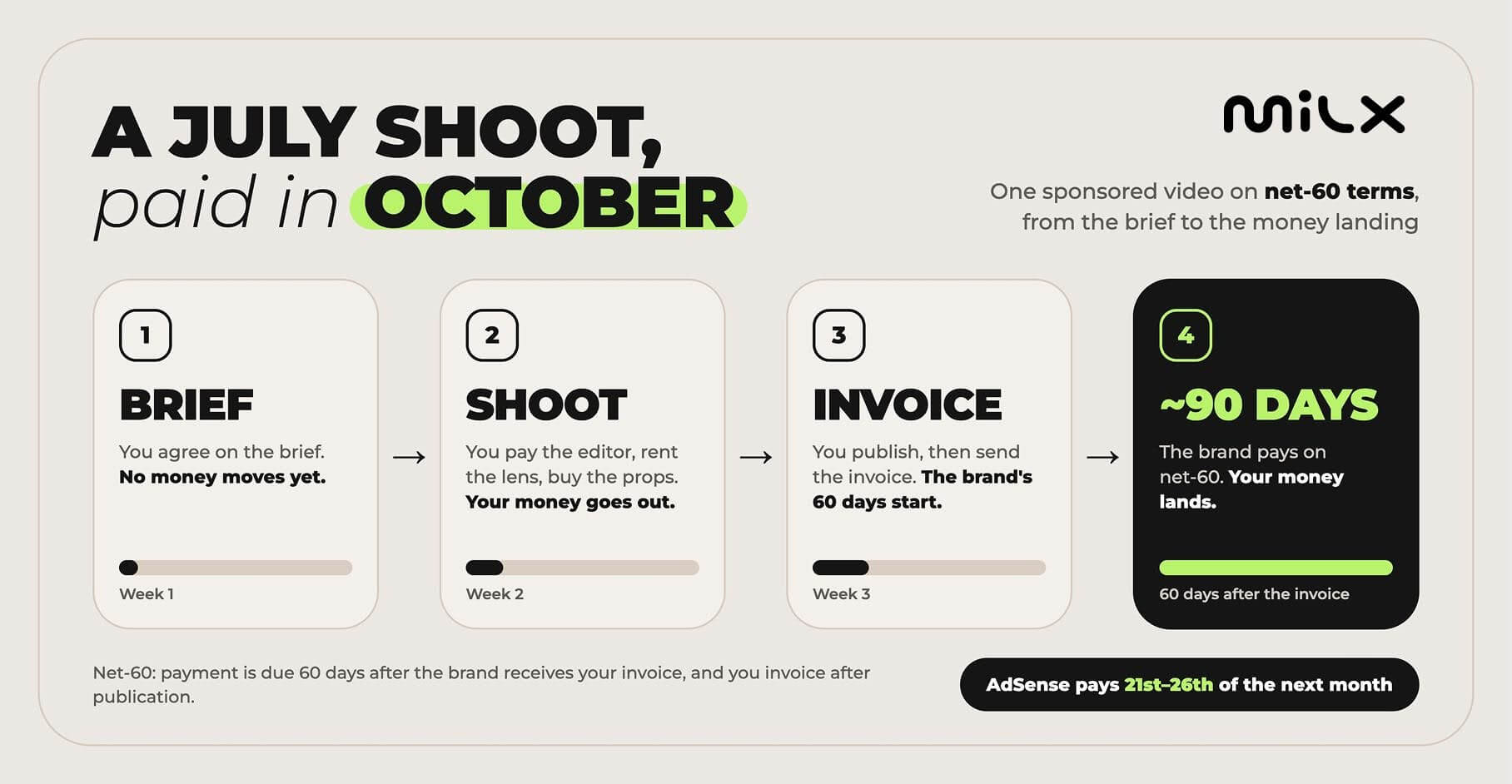
ALT: Timeline of a sponsored YouTube video on net-60 terms: brief in week 1, shoot and production costs in week 2, publication and invoice in week 3, payment about 90 days after the deal, compared with AdSense paying on the 21st to 26th of the next month. — Caption: On net-60 terms, a sponsor pays about 90 days after you agree on the deal.
MilX covers this pattern in why high-earning creators feel financially unstable anyway. A $600 integration that needs $250 of production spend upfront is hard to take on when rent is due on the 1st, so creators turn down deals that are priced perfectly well.
🎯 Practical tip: put a deposit clause in every contract, starting with your first. "50% on signature, 50% within 30 days of publication" is common across media, and most brands agree because their agencies already work this way. Ask in the first email: asking upfront reads as process; asking after the shoot reads as trouble.
Sponsor pays in 60 days, but the shoot costs money now?
If your channel qualifies, MilX Active Funds gives you up to 4 months of future YouTube revenue upfront, scored on your channel's own history, at 0.33% per day. Revenue you've already earned comes up to 2 months early with Advance Funds, for a one-time 4.3%.
Check if your channel qualifiesWhat goes into a YouTube sponsorship proposal
A proposal is one page, sent as a PDF, with seven blocks in the order a marketing manager reads them.
- The numbers, first and unpadded. Median views per long-form video over 30 days. Average view duration. Top country by watch time and its share. Subscriber count goes last, if at all.
- Deliverables, named by format. "One 60–90 second integration at 4:30, plus one Shorts integration within 7 days of publication." Use the format names from the table above.
- Price, anchored to the calculation. "At a $30 sponsorship CPM against 60,000 median views, the integration is an $1,800 flat fee. The Shorts integration adds $1,260 at 0.7x."
- Add-ons, priced separately. Usage rights with a duration and a price. The exclusivity clause with a window and a price. Keep them outside the headline number: a brand that gets them free once expects them free next time.
- Payment terms, stated as your default. "50% on signature, 50% within 30 days of publication. Invoice issued on the publication date." Write it as policy, not as a request.
- Process and revisions. One free revision round plus one paid round, agreed before the shoot. A $400 integration that goes through five rounds of feedback turns into a $40 job.
- Proof of intent. Two or three screenshots of viewers asking where to buy something you showed. In a pricing conversation, one real comment beats a retention graph.
Here is the same pitch, spoken, for when a brand asks on a call what you charge:
"My last three videos averaged 42,000 views with 5 minutes 20 seconds of average watch time. My integration rate is a $55 sponsorship CPM, so this comes to a $2,310 flat fee. Usage rights for a six-month paid media window are priced separately at 50% of base. Category exclusivity runs for 30 days."
Contract terms that cost you money
- Usage rights with no end date. "Perpetual" or "in all media" means the brand owns your face in its ads for good. Cap every right at a period you have priced.
- Exclusivity wider than the product. "Consumer electronics" for a headphone deal blocks half your sponsor pool. Name the product category.
- Payment "after the campaign ends" or on net-90. Tie payment to your invoice date, never to the brand's reporting cycle.
- Unlimited revisions. Write down the number of rounds before the shoot.
- No disclosure clause. You are the one who has to disclose. The FTC's influencer guidelines require it for US audiences, and YouTube requires you to tick "My video includes paid promotion" in video details, which adds a disclosure label for viewers.
🎯 Practical tip: ask four questions before you quote. What is the product, and what is the campaign goal? Where will the video run beyond my channel? Do you need exclusivity? What are your payment terms? A brand that dodges the fourth question has already answered it. MilX covers the full negotiation flow in its guide to paid collaboration on YouTube.
How YouTube Creator Partnerships and AI matching change who gets the deal
AI matching picks creators by audience fit more than by name. In March 2026, YouTube introduced Creator Partnerships, the new name and expanded version of BrandConnect, and built it into YouTube Studio for creators and into Google Ads for advertisers. Brands now surface creators by audience signals instead of search and reputation.
What that changes about your pricing:
- Your Studio rate field works as a filter. Preferences asks for a desired rate for long-form videos and a separate one for Shorts. Set it too low and gifting offers flood in. Set it too high, and brands with real budgets skip you before a conversation starts.
- The number YouTube shows you is an opening bid. When a campaign inquiry arrives, it shows a potential amount, and YouTube states that the figure comes from the advertiser and is not a final offer.
- Audience data counts for more than follower count. Matching runs on demographics, watch patterns, and category fit, so a concentrated niche audience now shows up in searches it would have missed two years ago.
To join, you need to be 18 or older, in the YouTube Partner Program, based in one of 24 supported countries and regions, and free of active Community Guidelines strikes. The Help Center sets no subscriber minimum beyond what the Partner Program itself requires.
🎯 Practical tip: turn on channel insights sharing in Studio if a concentrated audience is your strongest asset, and leave it off if your geography is fragmented. Feeding a matching system your weakest number is worse than feeding it nothing.
How to turn one brand deal into repeat income
A repeat sponsor is the cheapest revenue a creator can book. There is no pitching, the brief already exists, the brand already trusts your audience, and you negotiate from results instead of promises. One-off deals are what make brand income feel unreliable even in a strong year.
The step that earns the renewal is one most creators skip: an unrequested performance report, sent 14 and 30 days after publication. It puts you in front of the brand manager who allocates next quarter's budget.
Put five things in the report:
- total views at 30 days (not on launch day),
- average view duration across the sponsored segment,
- click-through rate on the link or code,
- conversions if you had a trackable link,
- and two or three viewer comments that name the product.
Then raise the price. If the video beat the projection you quoted against, 10% to 30% more on renewal is defensible, and the report makes the case for you in one line.
Check one risk before you renew with the same brand. A sponsored segment changes viewer behaviour at the timestamp where it sits, and a sharp retention drop there pulls down your ad revenue on that upload. MilX explains why some sponsorships lower your RPM. Open the retention graph at the integration timestamp before you sign again.
🎯 Practical tip: if retention at the integration held within 5% of the rest of the video, put that in the report word for word: "the integration did not cost us watch time." It persuades a brand manager faster than any number in your media kit.
A 10-step plan to price and close your next brand deal
Each step takes under an hour. At the end, you have a rate card, a proposal, contract terms, and a plan for the money.
- Pull your median. Views per long-form video over the last 30 days: median, not mean.
- Find your niche CPM. Take the midpoint of your row in the table if you have a track record, and the lower bound for a first deal. Adjust down if most of your watch time comes from lower-CPM markets.
- Calculate three numbers. Floor (including production cost), target, walk-away. Nothing goes into a negotiation before these exist on paper.
- Set your Studio rate field. YouTube Studio → Earn → Creator Partnerships → Preferences. Add a long-form rate, a separate lower Shorts rate, and a business contact email.
- Price the add-ons. One line each for usage rights at 3 and 6 months, whitelisting, and exclusivity at 30 and 90 days.
- Build the one-page proposal. Seven blocks, exported as a PDF. You will reuse it for every pitch this year.
- Write your terms document. Deliverables, one free plus one paid revision round, exclusivity window, usage rights duration, 50/50 payment terms, publication date, disclosure.
- Sort out where the money lands. Brands pay a person or a company, so the invoice needs payment details in your own name. Check what your bank charges for incoming international transfers and at what exchange rate it converts them. Many creators have never looked.
- Cover the production gap before you sign. If the shoot needs spending before the invoice clears, arrange that money first. Active Funds has its own qualification criteria, and you can check whether your channel qualifies in the MilX app in a few minutes. That is a much easier conversation before you commit to a net-60 contract than after.
- Book the follow-up. A recurring 20-minute calendar block titled "sponsor report" for 14 and 30 days after every sponsored publish date. It's the step that gets you the renewal.
Losing part of every YouTube payout to your bank's exchange rate?
With MilX, your YouTube revenue lands on a balance you control from the day you connect. You move only what you need, when you need it:
- Withdraw any day, as often as you want: 30+ payout methods, 54 currencies by bank transfer, plus BTC, USDT and USDC.
- Pay your editor or designer instantly and for free with P2P between MilX users.
- Reach revenue you've already earned up to 2 months early with Advance Funds, for a one-time 4.3%.
- If your channel qualifies, get up to 4 months of future revenue with Active Funds, at 0.33% per day, repaid automatically from 5% of monthly revenue.
$500M+ paid out across 3,100+ connected channels. Rated 4.6 out of 5 on Trustpilot.
Download MilX for free