


In the creator economy 2026, the question is not which platform is biggest. The answer comes from how money moves between fans and creators on each one. YouTube vs Patreon vs Substack is less a comparison of brands than a comparison of monetization models.
This guide breaks down where creators make money, what YouTube monetization vs subscriptions looks like, and how to build a creator income stack that holds up when one platform has a bad month.
Three Platforms, Three Completely Different Money Systems
- YouTube sells your viewers' attention to advertisers. The creator gets a cut.
- Patreon sells your community access to you. The creator keeps most of the cut.
- Substack sells your writing to readers as a recurring subscription. The creator keeps most of the cut.
That difference changes everything: the size of the audience you need, the income per person, the speed of payout, and the way your business survives a slow month.
For small YouTube creators, this matters more than it does for big ones. Big channels can run pure ad revenue and still pay rent. Small ones rarely can.

YouTube: Scale First, Monetization Second
YouTube pays creators through the YouTube Partner Program. The split is 55% to the creator on long-form ads, and 45% on Shorts after revenue share with the music rights pool. Memberships, Super Thanks, and Super Chat add smaller extra streams.
The catch is volume. RPM in most niches sits between $1 and $7 per 1,000 views in tier-1 countries. Lifestyle, gaming, and entertainment often land closer to $1 to $3. Finance, B2B, and personal development can hit $15 to $25 in narrow windows.
The math gets brutal at the small scale. 10,000 monthly views at a $3 RPM is $30. The same 10,000 views with 100 paying members at $5 each is $500 before fees. Same audience, very different bank account.
⭐ Practical tip for small channels: Track RPM per video, not by channel average. One video in a high-CPM topic can pay for three videos in a low-CPM topic. Pull the "Revenue source" tab in YouTube Studio and double down on the videos that pay, even when view counts are lower.
YouTube also has a payout lag. AdSense pays once a month, between the 21st and 26th, for revenue that closed at the end of the prior month. That means a 30 to 60-day wait between the view and the deposit. If your bills do not wait, this becomes a real cash flow problem.
Get money in your account now, not on the way to it
YouTube pays once a month. Your rent does not. With MilX, you can pull up to 2 months of already-earned YouTube revenue forward and route it to a bank card, e-wallet, or crypto across 40+ currencies. Start free, move money on your own clock.
Patreon: Small Audience, Direct Income
Patreon sits at the other end of the spectrum. The math here is not RPM. It is the paid members' times average tier price, minus Patreon's fee.
Patreon fees in 2026 run between 5% and 12% of creator income, and 10% for new creators, depending on plan, plus payment processing (around 2.9% + $0.30 per transaction for cards).
On the Pro tier at 8%, a creator with 200 patrons paying an average of $7 a month grosses around $1,400 and nets roughly $1,160 after fees. The same monthly income on YouTube would require somewhere between 200,000 and 470,000 monthly views, depending on the niche.
What this means for Patreon income creators: 100 superfans can outpay 50,000 casual viewers. The job is no longer "make videos so more people watch." The job becomes "make work a smaller group will pay for."
⭐ Practical tip: Patreon dies on big, complicated tier menus. Three tiers max, with one obvious "best value" pick in the middle. Bonus content should be cheap to produce but feel exclusive. Behind-the-scenes vlogs, early access cuts, a private Discord, and one monthly Q&A are enough for most channels under 100k subs.
The downside: Patreon income drops fast when you stop posting. Conversion from a YouTube viewer to a paying patron is brutal, usually between 0.5% and 2% of an engaged subscriber base. Patrons also churn. The average creator loses 5 to 10% of patrons per month if there is no fresh perk pipeline.
👉 Learn more about YouTube Memberships and Patreon.
Substack: High-Margin Subscription Engine
Substack runs on a single very clean number: 10% of paid subscription revenue, plus Stripe payment processing. If a reader pays $8 a month, Substack takes $0.80, and Stripe takes about $0.53. The writer keeps roughly $6.67.
That is the highest creator take of the three platforms by a clear margin. It is also the simplest revenue model in the creator economy in 2026.
The Substack revenue model rewards niche depth. The top-paid newsletters are not the broadest. They are the ones whose readers feel served by no one else.
For a small YouTube creator, the trick with Substack is to treat the newsletter as an extension of the video. Use it for things video does not do well: long-form analysis, sources, links, embedded charts, and off-camera takes. Avoid summaries. Readers will not pay for a recap of something they could just watch.
⭐ Practical tip: Start free for 3 to 6 months. Build the list to at least 1,000 free subscribers before turning on paid. Industry data on Substack puts free-to-paid conversion at 5 to 10% for healthy newsletters. 1,000 free subs at 7% paid conversion is 70 paid readers. At $8 a month, that is $560 a month before fees, from work you can do in a couple of evenings.
The risk on Substack is the same as Patreon, only sharper. Churn is unforgiving. Annual plans, usually priced at 2 months free ($80 a year vs $96 a year), lock readers in and smooth out cash flow.

Revenue Per User: Why Small Platforms Often Win
Here is what the math looks like side by side for a single paying person across one year (US-tier averages, 2026 industry data):
- YouTube view (1 person, ~52 video views per year, $3 RPM tier-1): roughly $0.16 per year per casual viewer.
- Patreon backer ($7 a month average, 12-month retention): around $74 net per year per backer.
- Substack paid subscriber ($8 a month, annual plan with 2 months free, $80 a year): around $69 net per year per subscriber.
The ratio is roughly 400x to 460x. One Patreon backer is worth, in pure dollars, what 400-plus casual YouTube viewers are worth per year.
That ratio is the whole story behind Patreon vs Substack earnings versus YouTube earnings. Platforms with smaller numbers print more money per person because they sell directly, not through an ad auction.
⭐ Practical tip for small YouTube creators:
Stop measuring success in subs. Track these on a simple spreadsheet instead:
- Revenue per active paid supporter per month.
- Churn rate of paid supporters.
- Conversion rate from free audience to paid audience.
- Cash flow gap (days between work delivered and money in the account).
Those four numbers tell you more about your business than the subscriber counter ever will.
Get paid before the views roll in
Active Funds from MilX let creators draw up to 6 months of future YouTube AdSense revenue today. Repayment is 5% monthly from future income, with a daily commission of 0.33%. Use it to fund the next series, pay your editor on time, or upgrade your gear before the channel grows out of it.
The Real Comparison Runs Through Monetization Models, Not Platforms
If you compare YouTube vs Patreon vs Substack as platforms, you end up with a meaningless feature list. If you compare them as monetization models, the picture sharpens fast.
Three models run the creator economy in 2026:
- Ad-supported attention (YouTube, TikTok, Meta). Pay scales with views. Per-person revenue is low. Audience size matters most.
- Tiered membership and patronage (Patreon, YouTube Memberships, Twitch subs). Pay scales with superfan count. Per-person revenue is moderate. Audience intensity matters most.
- Recurring subscription content (Substack, Beehiiv, Ghost). Pay scales with niche depth. Per-person revenue is high. Audience trust matters most.
Almost every full-time creator in 2026 runs at least two of these models, often all three.
The income spreads risk across different incentives. Ad rates drop in Q1 every year. Patreon churn spikes when content slows. Substack growth flattens when the writing gets generic. Running all three smooths the bumps.
Building several creator income streams into one stack is the single most under-discussed shift in the creator economy 2026. The question moves from "which platform is best for creators' monetization" to "which mix of monetization models is best for me."
Money sits in the monetization model behind each platform, not in the platform itself.
A platform with a smaller audience and a sharper paid model often beats a bigger one with a thin ad-based model. Run the math before you pick where to invest your hours.
Why YouTube is Still the Top of the Funnel and Patreon/Substack Fail Without It
Here is a small, uncomfortable fact for Patreon and Substack purists: their growth slows to a crawl without a discovery engine in front of them.
Patreon has almost no native discovery.
Substack has Notes and the recommendation network, but most paid subscribers still come from outside the platform.
YouTube is, by a wide margin, the most powerful organic discovery surface in the creator economy. A single video that performs well can deliver more new audience in a week than a year of newsletter writing. That is the YouTube vs Patreon and YouTube vs Substack reality.
YouTube is rarely the highest-paying platform per person, but it is almost always the highest-paying source of new people. The video does not have to monetize directly. Its job is to introduce strangers to your work and feed them into the paid layers.
The better structure for a small creator:
- YouTube video calls out a free Substack newsletter or Patreon community in the first 60 seconds and the description.
- Free Substack list builds trust over weeks with valuable writing and occasional paid teasers.
- Paid Substack or Patreon handles the income.
The video pays poorly per view. The subscribers it feeds into Patreon and Substack pay a lot per person. Together, the numbers work.
⭐ Practical tip: Put the funnel link in the first pinned comment on every video. Mention it once on camera in the first 90 seconds. Add it to the description above the fold. Then stop. More CTA than that hurts retention.
The 6-Step Income Stack Playbook for Small YouTube Creators
This is the working playbook for a small YouTube creator in 2026. It assumes 5,000 to 50,000 subscribers and at least one monetized video per month.
Step 1: Pick Your One Paid Platform First
Not both. Patreon if your audience wants community and behind-the-scenes content. Substack if your audience wants depth, writing, or analysis. Running both before you have one working is how creators burn out.
Step 2: Build a Free Email List
Even if your paid product is Patreon, build a free email list. Free Substack works fine for this. Email is the only audience channel you fully own. Algorithms can shut off YouTube traffic in a day. Email cannot.
Step 3: Set One Funnel Goal Per Video
Every video should push viewers toward one thing: a free list signup, a Patreon join, or a specific paid product. One. Mixed CTAs convert worse than focused ones.
Step 4: Layer in Direct Income Only After the Basics Work
Affiliate links, brand deals, digital products, and merch sit on top of the stack. They carry higher margins but only pay off once a free audience exists. Adding them too early dilutes your message and confuses your viewers.
Step 5: Solve the Cash Flow Gap
The hardest part of running a creator business is timing, not income. AdSense is 30 to 60 days behind. Patreon clears on the 1st. Substack clears on a 5-day rolling basis. Set up one operating account, route everything into it, and pay yourself a fixed salary. The rest stays as runway for slow months and reinvestment.
Step 6: Track Three Numbers Monthly
Net income, paid supporter churn, and cash on hand. Skip everything else for the first year. The full dashboard can come later, once you know what your business is actually doing.
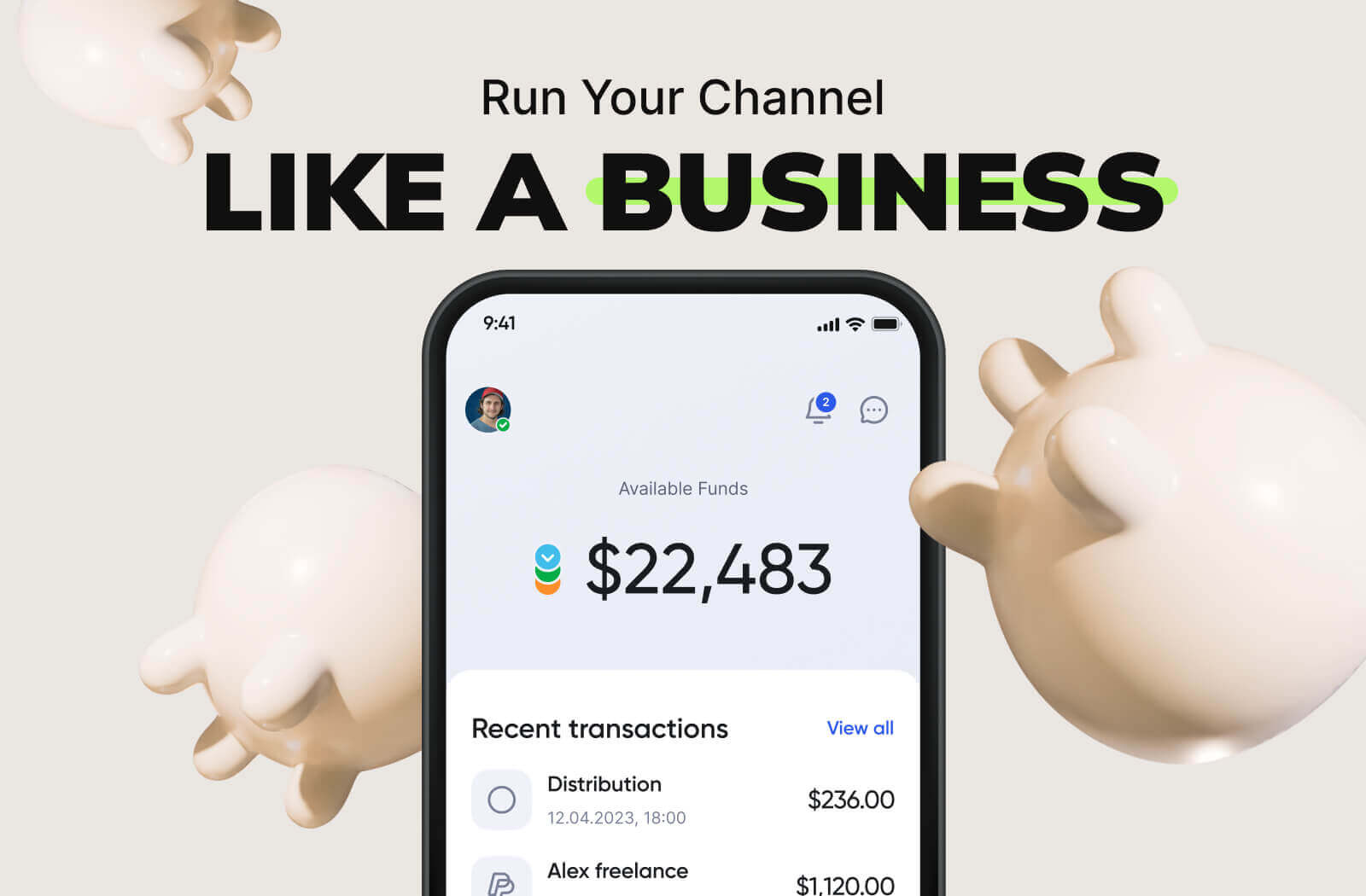
How MilX Fits Into Your Creator Income Stack
MilX is a financial tool: your YouTube revenue in one place upfront. For small YouTube creators, these features pull most of the weight.
- Active Funds. MilX gives creators up to 6 months of future YouTube AdSense revenue today. Repayment is automatic at 5% monthly from future income, with a daily commission of 0.33%. Useful when AdSense is 60 days behind, and the next project starts now.
- Instant Payments. Move money out of your MilX account in under 5 minutes, across 40+ currencies, to a bank card, PayPal, Payoneer, crypto wallet, PIX, Zelle, or GIM. The fee is 1%. P2P transfers between MilX users are free, which matters when your editor, thumbnail designer, or co-host runs on the same app.
👉 Explore why YouTube creators love MilX.
Over 5,000+ creators run their money through MilX. The platform has processed $500M+ in creator revenue and carries a 4.6 out of 5 rating on Trustpilot.
Cash out your YouTube revenue your way, fund the next series before AdSense pays, and pay your team without losing a cut on every transfer.
👉 Try MilX free and see if your channel qualifies for Active Funds.