

You’re ready to go full-time on YouTube when your net income covers 100% of your total monthly expenses for 6 straight months, and you hold at least 3 months of expenses in savings.
This guide hands you that math. No “follow your dream” speech, no horror story either. You get the real numbers on full-time creator income, a break-even formula you can drop into a spreadsheet, and a readiness checklist to score yourself before you hand in any notice.
Full-Time YouTube: Are You Really Ready?
|
Quit Your Job If… |
Wait If… |
|
YouTube covers 100%+ of your expenses |
You still need your salary |
|
Income is stable for 6+ months |
Income is highly inconsistent |
|
You have 3–6 months of savings |
You have little or no savings |
|
You know your break-even number |
You don't know your break-even point |
|
You earn from multiple income streams |
You rely mostly on AdSense |
|
One slow month won't hurt you |
One bad month puts you at risk |
How Much Do Full-Time YouTube Creators Earn?
Most creators do not make a full-time wage – 71% of independent creators earned under $30,000 last year, and only 9% cleared $100,000. A full third earned under $5,000.
The numbers come from MBO Partners’ 2024 research. The gap between the top and the middle is not a cliff. It’s a canyon.
Ad revenue alone is even thinner. A widely cited 2018 analysis by Mathias Bärtl at Offenburg University found that roughly 96.5% of YouTube channels do not pull enough ad money to clear the U.S. poverty line. Breaking into the top 3% by views translated to about $16,800 a year from ads.
Where does MrBeast fit? He doesn’t. Mega-creators are statistical outliers, not benchmarks. Planning your exit around them is like planning your retirement around a lottery ticket.
👉 Learn more about why the MrBeast strategy won’t work for 99% of creators.
🎯 One more number that decides your ceiling: RPM, your real take per thousand views after YouTube’s cut.
For most creators, that sits around $4 to $8. Channels above $10 mostly live in finance, insurance, legal, or B2B.
According to MilX data from a comparison of two channels with nearly identical reach – around 450,000 subscribers each – one cashed out roughly $1K a month while the other reached about $10K. Same audience size. Very different monetization base.
👉 Discover more about CPM & RPM rates for 2026.
🎯 The takeaway is simple: Plan around your median month, not your best one. The median is the honest base for going full-time on YouTube.

What Expenses Do You Need to Cover Before Quitting Your Job for YouTube?
Your day job hides a lot of costs. The moment you leave, they all land on you. Before you ask how much money it takes to become a full-time creator, list every expense in two buckets: personal and channel.
Personal Expenses
Rent or mortgage, food, utilities, transport, insurance, and debt payments.
This is your survival number. It does not care how the algorithm felt this week.
Channel Expenses
Gear, software, subscriptions, editing, freelancer fees, and any ad spend you use to grow.
Most creators forget this bucket entirely when they daydream about quitting.
It is often 15% to 30% of what the channel brings in.
One More Thing …
Then comes the hidden bucket. As a creator, you are self-employed, which means you handle your own taxes and lose every employer benefit.
No company health plan, matched pension, or paid sick days. Those have to be budgeted as real line items, not afterthoughts.
🎯 Practical tip: Pull your last three bank statements and tag every charge as personal or channel. Most people undercount by 20% because small subscriptions and one-off gear buys slip through. Your YouTube creator financial planning is only as good as this list.
How Big Should Your Financial Cushion Be?
A creator emergency fund is not optional when your paycheck moves with the algorithm. The standard personal-finance rule is 3 to 6 months of total expenses.
For self-employed people with irregular income, advisors often push that to 6 to 12 months, because no unemployment check comes with self-employment.
Size it this way. Take your total monthly expenses – personal plus channel – and multiply.
- Formula: Total monthly expenses × number of months = Cushion target
- Plain version: the more your income swings, the more months you stack.
- Example: $5,000 total monthly expenses × 3 to 6 months = a cushion of $15,000 to $30,000.
Pick your multiple by how stable your money is. If you live on AdSense alone, treat your income as fragile and aim for 6 months.
If you have sponsorships, memberships, and product sales across three or more sources, 3 months can hold.
👉 Explore more about how to get repeat sponsors on YouTube.
Why so cautious? Because income can vanish for reasons that have nothing to do with your videos.
According to MilX data, one managed creator portfolio lost 23% of its revenue in a single quarter when two channels were blocked.
A cushion is what buys you time to fix that kind of shock.
How Do You Calculate Your YouTube Income Break-Even Point?
Your break-even comes down to four numbers:
- personal expenses,
- channel expenses,
- net monthly income after tax,
- and the size of your cushion.
Run them in order.
Step 1: Total Monthly Expenses
- Formula: Personal expenses + Channel expenses = Total expenses
- Example: $2,800 personal + $1,200 channel = $4,000 total.
Step 2: Net YouTube Income After Tax
- Formula: Average monthly income × (1 − tax rate) = Net income
- Example: $6,000 average × (1 − 0.25) = $4,500 net.
Use your average from the last 12 months, not last month.
The tax rate is your own estimate for self-employment, so check it with a local accountant.
Step 3: Coverage Ratio
- Formula: Net income ÷ Total expenses × 100 = Coverage %
- Example: $4,500 ÷ $4,000 × 100 = 112.5%.
Anything under 100% means YouTube does not yet cover your life.
Step 4: Runway
Formula: Current Cushion ÷ (Total Monthly Expenses − Total Monthly Revenue) = Months of Runway
When income beats expenses, the gap is negative, which means your cushion is not being drained at all. It stays as backup.
Example where income falls short: $20,000 cushion ÷ ($4,000 − $3,000) = 20 months of runway.
Now read the verdict off the table.
|
Coverage ratio |
Runway |
What it means |
|---|---|---|
|
≥ 100% |
≥ 6 months |
Financially ready. You can move. |
|
70–99% |
3–6 months |
Proceed with caution. Build a plan B first. |
|
< 70% |
< 3 months |
Not yet. Stack your cushion before anything else. |
🎯 Worked example:
- A creator with $4,500 net income, $4,000 total expenses, and a $20,000 cushion.
- Coverage is 112.5%, comfortably over 100%.
- Income beats expenses by $500 a month, so the cushion is not drawn down and acts as pure backup.
- The cushion equals five months of expenses, close to the safe zone.
Verdict: Financially ready, with a note to top the cushion past six months for full peace of mind. This is your personal YouTube income break-even, in numbers you can defend.

Build Your Cushion Without Begging AdSense
Waiting on the 21st of the month makes a cushion hard to grow. With MilX Active Funds, you can access up to six months of your future YouTube income today and park it as your safety buffer before you ever quit. Check if your channel qualifies for Active Funds
Why Does Income Stability Matter More Than Total Income Size?
Because consistent income is more reliable than occasional high earnings, it is safer to cover your monthly expenses. Stability is hard to fake and easy to lose.
👉 Explore how to manage seasonal YouTube income drops
A single viral month is the most dangerous number on your dashboard – it looks like a signal when it's usually noise.
👉 Learn more about the dark side of virality.
A peak month is a fluke until proven otherwise.
The rule that protects you is brutal but fair: judge your readiness by your worst month of the last year, not your average.
If your weakest month still covers your basic expenses, you have a real floor.
This is also why diversification beats raw size.
Turn one video into 5 income streams: Key diversification methods
- Platform-paid views – post short, high-retention clips (15–45 sec) on monetization-first platforms like Whop, Juicer, or Recast, which pay per 1,000 views regardless of algorithm luck.
- Affiliate revenue – repost the same clip on TikTok, YouTube Shorts, or Instagram Reels and tie a relevant affiliate link to the caption, pinned comment, or bio.
- Digital products – turn the video's core insight into a Notion template, PDF planner, or quick-start guide, priced at $5–$15, and sell it on Gumroad, Payhip, or Etsy.
- Email list building – offer a free related download in exchange for an email, collected via Beacons, MailerLite, or Substack, to create a channel for repeat sales.
- Cross-platform repurposing – reformat the same content into a blog post, Medium article, Pinterest pin, podcast snippet, or LinkedIn carousel, each linking back to the other income streams.
👉 Discover more on how to turn one video into five income streams.
🎯 Practical tip: Open Analytics, find your lowest revenue month in the last 12, and run the break-even formula using that figure. If it survives the worst month, your plan is real.
👉 Reading YouTube Analytics to optimize earnings tells you which months were low versus just algorithmically slow.
Smooth Out the Spiky Months
YouTube pays in waves. Your rent does not. With MilX you can access up to six months of future YouTube income upfront and cash out anytime in 40+ currencies, so a slow month never decides your future. Try MilX and see if your channel qualifies.
Readiness Checklist: Are You Ready to Quit?
Score yourself: сheck out these 6. The more boxes you tick, the closer you are.
- YouTube covers 100% or more of your total expenses for 6 months straight, not just once.
- You hold a cushion of 3 to 6 months of expenses, channel costs included.
- Your income is diversified, not pure AdSense (sponsorships, memberships, products).
- Your worst month of the past year still covers your basic personal expenses.
- You have budgeted for self-employment taxes and the loss of employer benefits.
- You have a written plan B for what you cut if income drops 40 to 50%.
Most boxes ticked means go. A few ticks means wait and build. None of this asks whether you believe in yourself. It asks whether the numbers do.
What Are the Safer Alternatives to Quitting Your Job Cold Turkey?
Quitting is not a single switch. A whole ramp runs between a full-time job and a full-time creator, and the smart move is usually to walk it. The safest alternative is to transition gradually with part-time work, savings, and multiple income streams.
Go Part-Time First
Drop to four days or three before you drop to zero.
You keep some steady income and benefits while you test whether the channel can carry more weight. It is the cheapest experiment you can run.
Set a Runway and a Deadline
Save 6 to 12 months of expenses, then give yourself a hard review date.
“If YouTube covers my costs for six straight months by next March, I commit. If not, I rethink.”
A deadline turns a vague dream into a testable plan.
Diversify Before You Leap, Not After
Add a second and third income layer while you still have a salary cushioning the risk – memberships, a digital product, sponsorships, and a Shorts catalog that keeps paying.
👉 Check out these top revenue streams beyond AdSense.
MilX data on the automotive niche shows the upside: one channel expanded its formats and grew revenue from about $5.3K to $8.5K in a quarter, a 60% jump, while views rose only 23%.
The money grew faster than the audience because the monetization base got stronger.
Stabilize Your Cash Flow
Irregular pay is the real enemy of a clean exit. Advancing part of your future revenue lets you smooth the dips without taking on a bank loan or touching your emergency fund.
For the deeper monetization play, read our companion guide on pivoting a low-CPM channel without starting over. A stronger CPM changes every number in your calculator.
Bridge the Income Gap with MilX
You did the math. The cushion is the hard part, and the YouTube platform makes it harder by paying once a month, weeks after the views happen.
That timing gap is what trips up a clean exit.
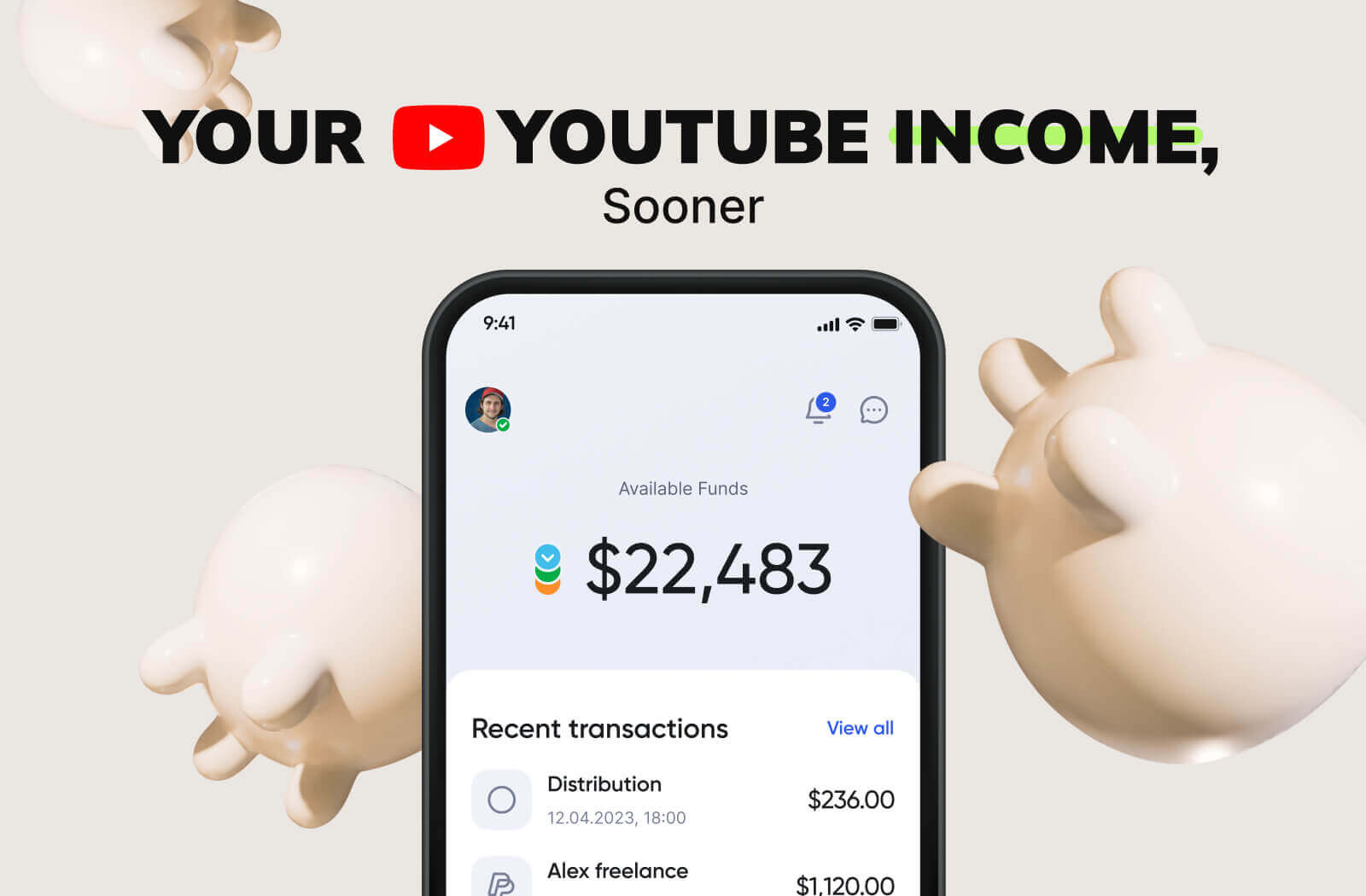
Active Funds by MilX solves that timing problem directly. You can access up to six months of your future YouTube income upfront and put it straight into your cushion, your next shoot, or your editor. No long waits, you cash out on your own clock.
What keeps you in control while you do it:
- Automatic repayment of 5% monthly from future income, so there is nothing to track.
- Low daily commission from 0.33%, with the full cost shown upfront.
- No credit checks and no hit to your credit score.
- Cash out in 40+ currencies, including crypto.
- 10+ payout methods, from bank and card to wallet and crypto.
- Free P2P transfers to pay editors, designers, and collaborators in minutes.
Whether you are stacking a safety buffer, launching a new series, or covering a shoot before AdSense clears, MilX gives you room to move without looking over your shoulder. 5,000+ creators already use it to stay ahead without taking on debt.
👉 Take control of your creator finances with MilX – download the app.
FAQs
Can I go full-time on YouTube with AdSense alone?
Usually no, most full-time creators rely on 3+ income streams, not just AdSense. Ad revenue fluctuates with CPM, seasonality, and algorithm changes. A more sustainable creator business combines AdSense with sponsorships, affiliate marketing, digital products, memberships, or other revenue sources.
How much money do I need to quit my job for YouTube?
You need your net YouTube income to cover 100% of your total monthly expenses (personal + channel) for at least 6 straight months, plus a savings cushion of 3 to 6 months of those same expenses. For a creator with $4,000/month in total costs, that means $4,000+ net after tax per month consistently, plus $12,000–$24,000 in savings before quitting.
What is a good YouTube income to go full-time?
"Good" depends on your expenses. A creator spending $3,000/month needs $3,000+ net after tax. A creator spending $6,000/month needs twice that. The floor is 100% coverage of your real costs – not a specific dollar figure. Run the break-even formula in this article with your own numbers to get your exact target.
How many subscribers do I need to quit my day job?
Subscriber count does not determine income – RPM and monetization mix do. Two channels with 450,000 subscribers can earn $1,000 and $10,000 per month. Focus on coverage ratio and income stability, not subscriber milestones.
Is YouTube income stable enough to rely on full-time?
YouTube income is inherently variable. Algorithm changes, seasonal CPM swings (RPM drops 30–50% in January), and platform policy shifts can cut revenue without warning. Creators who diversify across 3+ income streams (AdSense, sponsorships, memberships) and hold a 6-month cushion are more stable than those relying on AdSense alone.
What expenses do YouTubers have that employees don’t?
Self-employed creators pay the full self-employment tax (employees split this with employers), fund their own health insurance, save for retirement without employer matching, and have no paid sick days or vacation. Channel costs – gear, editing, software, freelancers – add another 15–30% on top of personal expenses. Budget for all of these before you quit.