


Key takeaways about membership income
- Memberships are not passive income. They are a second content stream with a monthly deadline, and the deadline is the product.
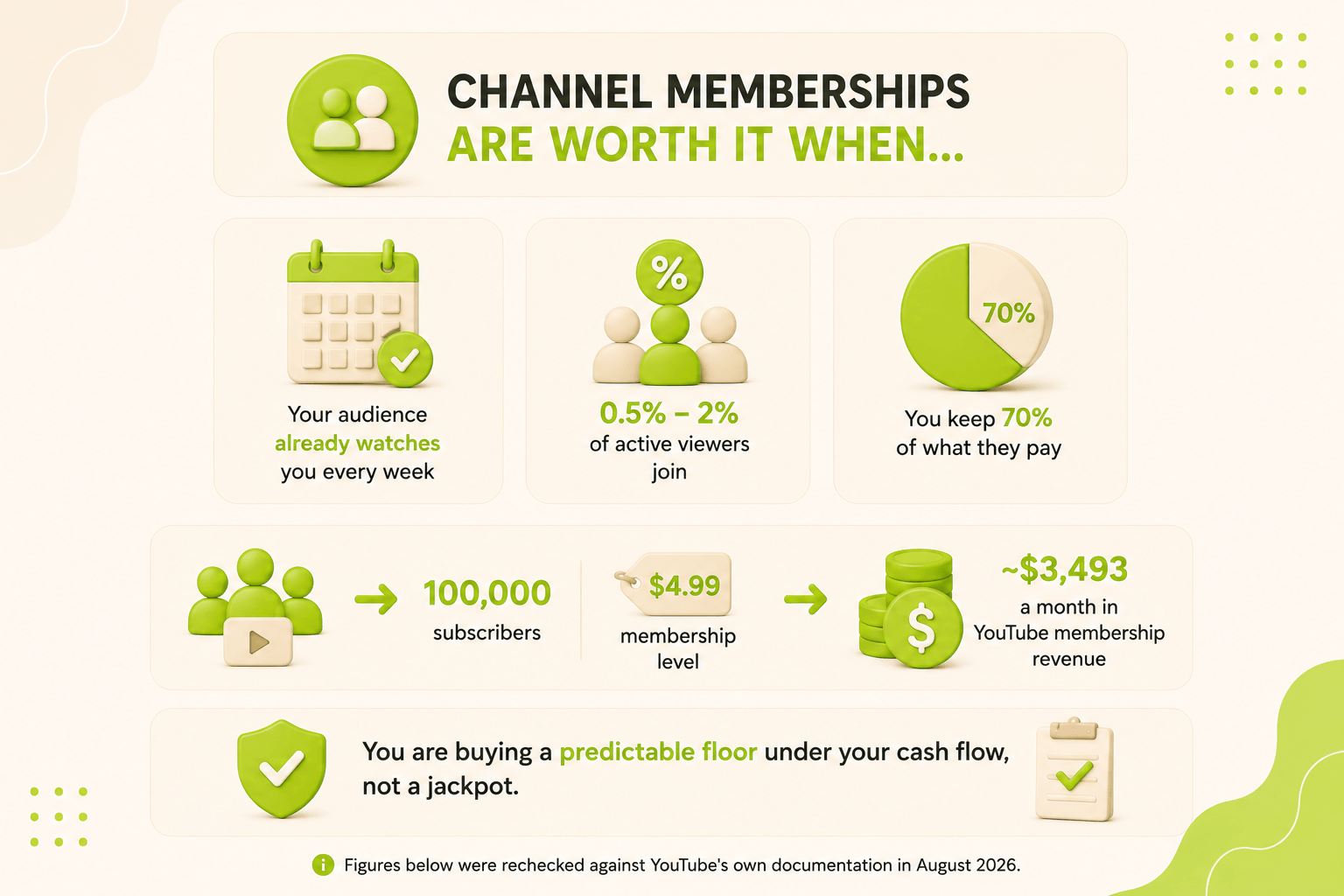
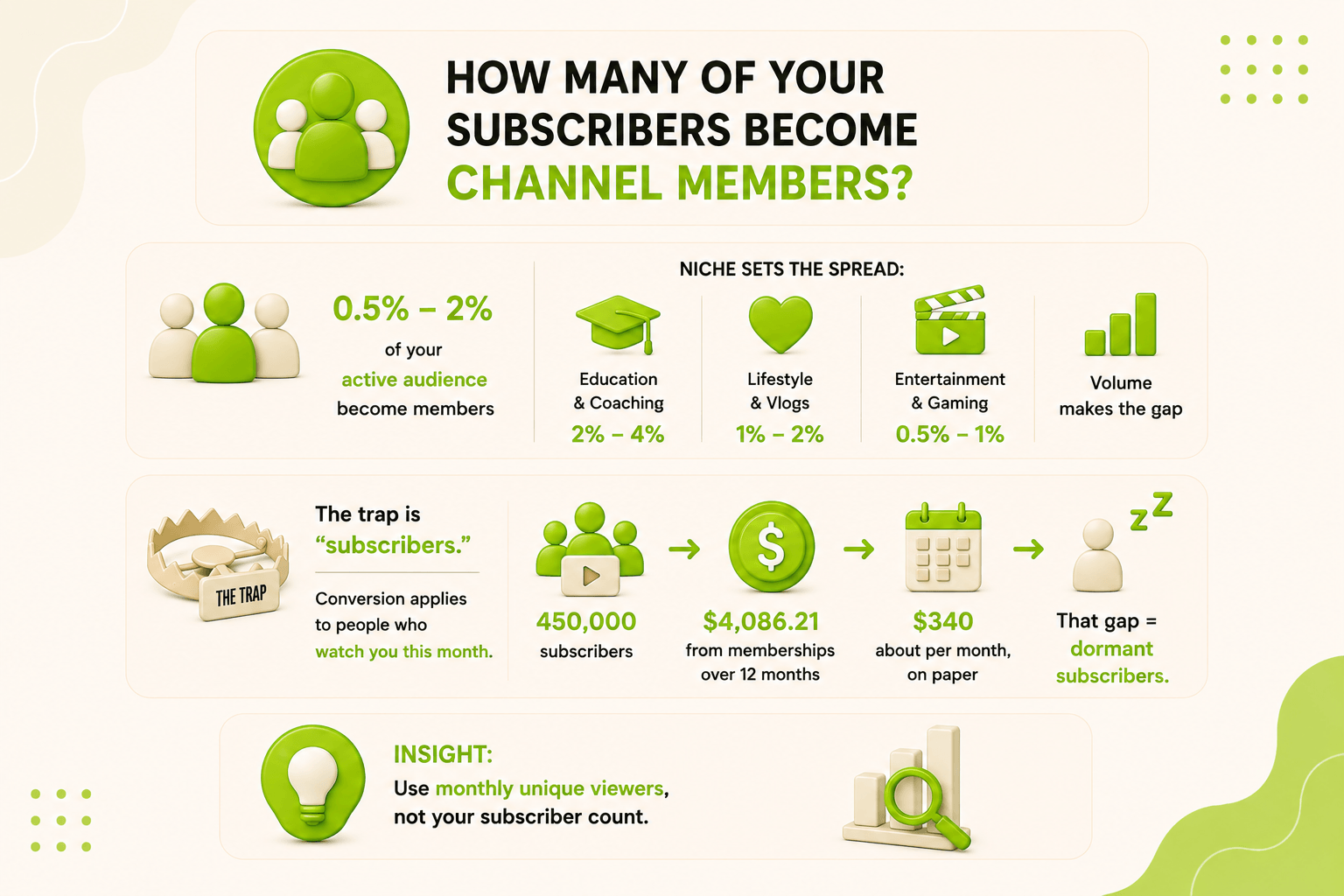
- To estimate Membership conversion upfront, use 0.5% to 2% of the people who watched you this month, not your subscriber count. Monthly viewers usually run several times higher than subscribers, so basing the math on subscribers overstates the rate creators see.
- The value is predictability, not size. $699 a month that arrives, whatever the algorithm does, beats a $2,000 ad spike in one quarter.
- Churn is mostly a memory problem. 38% of leavers in digital media never chose to go, and most of the rest forgot they were paying.
- Patreon keeps more per dollar. YouTube converts more people. Pick by where your audience already is.
Are YouTube memberships worth it for a creator in 2026?
Yes, for any channel with a repeat audience and one monthly perk, it can ship without missing uploads.
The bar dropped in 2026:
YouTube's expanded Partner Program admits channels at 500 subscribers with 3 valid public uploads in 90 days plus either 3,000 valid watch hours in 12 months or 3 million Shorts views in 90 days, and channel memberships sit inside that fan-funding tier, per YouTube Help. Ad revenue sharing still needs 1,000 subscribers.
Memberships now run in 150+ countries, and you can build up to 6 membership levels (typically ranging from $0.99 to $49.99 per month) with five perks each, custom emoji scaling from 4 at launch to 54+ past 5,000 members, documented by YouTube.
The workload has not changed. A membership is a second content stream with its own deadline, and one layer in a stack rather than a replacement for ads, as our guide to the top revenue streams for a full-time YouTube creator lays out.
🎯Tip: Switch memberships on before you feel big enough. Forty members at $4.99 covers an editor's retainer, and a tier structure is easier to grow than to invent under pressure at 200K subscribers.
If MilX guidelines help you, add the MilX blog to your preferred sources.

How many of your subscribers become channel members?
Between 0.5% and 2% of your active audience, and niche sets the spread. Across channels in MilX's users, education and coaching convert 2% to 4% of subscribers into channel members; lifestyle and vlogs land at 1% to 2%, entertainment and gaming sit at 0.5% to 1% and make up the gap on volume.
The trap is the word "subscribers."
Conversion rate applies to people who watch you this month, not to a counter holding everyone who clicked subscribe in 2026.
Estimated Channel Membership Conversion
|
Monthly Views |
Est. Conversion |
Members — Month 1 |
Members — Quarter |
|
10,000 |
0.5–2% |
50–200 |
150–600 |
|
50,000 |
0.5–2% |
250–1,000 |
750–3,000 |
|
100,000 |
0.5–2% |
500–2,000 |
1,500–6,000 |
|
500,000 |
0.5–2% |
2,500–10,000 |
7,500–30,000 |
|
1,000,000 |
0.5–2% |
5,000–20,000 |
15,000–60,000 |
A 450,000-subscriber fitness channel in MilX's users booked $4,086.21 from memberships over 12 months, about $340 a month- what a channel one-tenth its size earns on paper. That gap is dormant subscribers, and every channel has them.
🎯Insight: Run the estimate against monthly unique viewers from YouTube Studio, not your subscriber count. Smaller number, right number.
How much YouTube membership revenue will you make per month?
Multiply your active audience by your conversion rate, then by your level price, then by 0.7. The table runs that math on a $4.99 level.
|
Subscriber base |
Members at 0.5% |
Members at 1% |
Members at 2% |
Your monthly share at 1% |
|---|---|---|---|---|
|
10,000 |
50 |
100 |
200 |
$349 |
|
50,000 |
250 |
500 |
1,000 |
$1,746 |
|
100,000 |
500 |
1,000 |
2,000 |
$3,493 |
|
500,000 |
2,500 |
5,000 |
10,000 |
$17,465 |
|
1,000,000 |
5,000 |
10,000 |
20,000 |
$34,930 |
Monthly recurring revenue (MRR) after YouTube's 30% share, single $4.99 level, before tax and payout fees.
🎯Example: A 60,000-subscriber cooking channel with 18,000 monthly viewers converting 1.5% gets 270 channel members, or $944 a month before tax. The same math on raw subscribers promises $2,100, and creators spend the difference in advance.
How much does YouTube take from channel memberships?
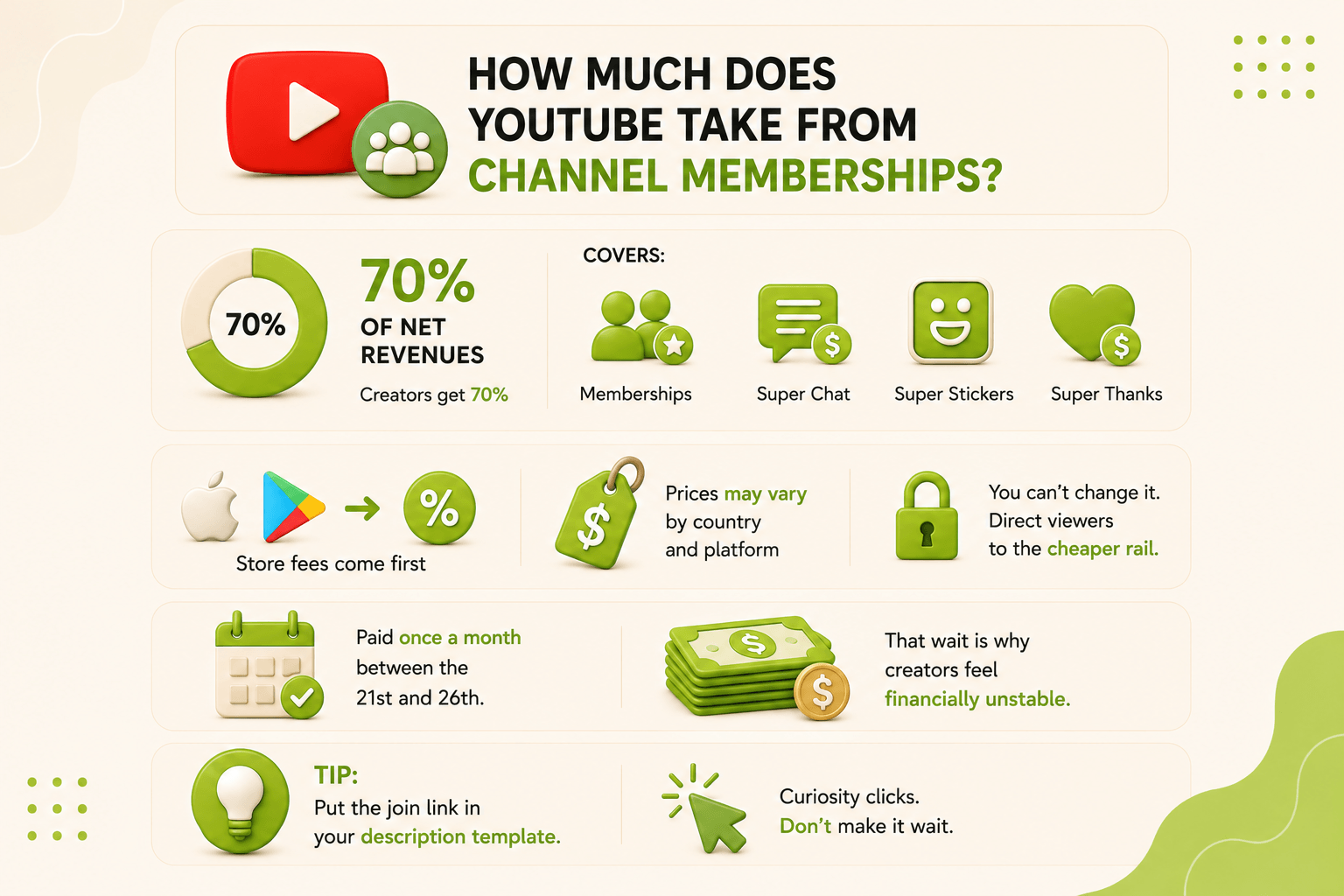
YouTube pays creators 70% of net revenues from the Commerce Product Module, covering channel memberships, Super Chat, Super Stickers, and Super Thanks, as stated in YouTube Help.
The word doing the work is "net":
Apple App Store and Google Play commissions come off the top before the 70/30 revenue share applies, which is why YouTube notes memberships "may be priced differently depending on your country and the platform you use," in its billing documentation.
You cannot change that split. You can point people at the cheaper rail: one description line saying a desktop browser costs less moves a slice of your joins off mobile billing.
After YouTube comes the wait. Membership money rides the same AdSense schedule, paid once a month between the 21st and 26th, which is much of why high-earning creators still feel financially unstable.
🎯Tip: Put the join link in your description template, not in individual descriptions. Casual viewers click when they are curious, and curiosity does not wait for the video where you remembered to paste it.
How should you price and stack your membership levels?
Three levels, priced for volume, with perks that ladder instead of repeating. YouTube allows six, and most channels that use all six confuse viewers into joining none.
Entry level: $0.99 to $2.99
Sell status, not labour.
A loyalty badge beside the member's name in comments and live chat, custom emoji, and a community-tab shout-out cost you nothing recurring.
This level converts volume, and volume is where recurring creator income comes from.
Mid level: $4.99 to $9.99
Put your one real perk here, because this is where most members land.
Members-only content is what retains: one exclusive video, extended cut, or behind-the-scenes reel a month.
Entry perks carry up.
Premium level: $19.99 and above
Sell access and cap the seats. A monthly members-only live Q&A or direct video replies work at this price because scarcity does the pricing for you.
Twenty seats at $19.99 is $279 a month for one hour of your time.
🎯 Insight: Price the mid-level at what your audience pays for one coffee, not at what you think your work is worth. A $5.99 level with ten times the members beats a $20 level, and the monthly drop costs the same either way.
What does churn cost you, and how much content do members need?
Churn runs at 4.14% for digital media and entertainment, and members need at least one members-only drop a month to stay. Recurly's July 2026 network benchmarks break that 4.14% down, and 1.59 points of it are involuntary: 38% of everyone who leaves never chose to, their card expired, or a charge failed, per Recurly's churn benchmarks. YouTube retries billing itself, which hands you the churn category hardest to fix alone.
The voluntary half is yours, and the cause is dull. Recurly found 52% of consumers cancelled at least one subscription in the past year because they were not using it, in its State of Subscriptions report. Members rarely leave over a weak perk. They leave because they forgot it existed.
The membership programs that hold retention ship on a date members can predict.
- One of the MilX users left the feature on for five years with nothing after launch week and averaged $50 a month; relaunched with a fixed cadence and clear perks, its membership income grew 16x in six months, and active members grew 9x.
- A gaming channel, above a million subscribers and dormant since 2020, added a 90-second explainer, a JOIN widget on the homepage, and monthly drops, and passed 30% of total channel revenue in 60 days.
Both were community work before monetization work, which is the argument behind why building a community pays better than chasing views.
🎯 Tip: Fix the drop to the same date each month and post a community reminder 24 hours ahead. The reminder does the retention.
Recurring Income Steadies You. It Still Lands Next Month.
Your first 200 members are a real floor, and none of that money sits in your account on the day the editor invoice is due. Access up to six months of your future YouTube income with MilX Active Funds, no credit check and no credit score impact, and fund the members-
only series that keeps those 200 paying. See how Active Funds work
Memberships vs Patreon in 2026: which keeps more of your money?
Patreon leaves more per dollar at $5, and the advantage disappears at $2 because its fixed processing charge eats small pledges. New Patreon creators pay a 10% platform fee since 4 August 2025, plus 2.9% + $0.30 per transaction and a payout fee of $0.25 by bank or 1% by PayPal, set out in Patreon's documentation.
|
Parameters |
YouTube channel memberships |
Patreon (new creator, 2026) |
|---|---|---|
|
Platform cut |
30% of net revenue |
10% platform fee |
|
Payment processing |
Inside YouTube's 30% |
2.9% + $0.30 per transaction |
|
Payout fee |
None on the platform side |
$0.25 bank, or 1% PayPal capped at $20 |
|
You keep on a $5 pledge |
$3.49 |
$4.06 |
|
You keep on a $2 pledge |
$1.39 |
$1.44 |
|
Discovery |
JOIN button sits beside Subscribe |
You drive every visit yourself |
|
Audience ownership |
YouTube holds the relationship |
You hold emails and direct contact |
|
Perk workload |
One monthly drop inside YouTube |
The same drop plus a second platform |
|
Recommended for |
Channels whose audience already lives on YouTube and who want joins with no funnel |
Creators selling across podcasts, newsletters or Discord who need the email list |
Patreon's 16% edge on a $5 pledge is real, and smaller than the conversion you lose by asking viewers to leave YouTube, click a link, make an account, and enter a card. Memberships convert because the button is already on screen. Patreon pays more per member because it converts fewer of them. Running both doubles the perk workload instead of splitting it.
We mapped the wider picture in the real money flow in 2026 across YouTube, Patreon and Substack.
How do you launch channel memberships in 30 days?
Four weeks, one action each. Skipping to week three is how creators end up at $50 a month.
Read your audience before you price anything
Pull three numbers from YouTube Studio: monthly unique viewers, top 5 videos by watch time, and the share of comments from repeat names.
Set your target at 1% of monthly viewers.
Build three levels and one real perk
Entry at $1.99 with badge and emoji. Mid at $5.99 with one members-only video a month. Premium at $19.99 with a live Q&A and 20 seats.
Put next month's members-only video in your content calendar now, before anyone has joined.
Make joining visible in five places
A 60- to 90-second explainer pinned to your memberships page and homepage, the JOIN widget above your playlists, the join link in your description template, an end screen, and one community post showing the first exclusive drop.
Ship the first drop and say the date out loud
Publish the members-only video, thank new members by name in your next upload, and announce the fixed monthly date. Then track four numbers monthly: conversion rate against viewers, MRR, churn rate, and which level pays the bills.
🎯 Reality check: You will miss your target in month one, and month three is the earliest fair verdict. The first 50 members take longer than the next 200.
How does MilX fit in?
Memberships make your income more predictable, not faster. You know roughly what recurring revenue is coming before the month starts, but the money itself still lands on YouTube's schedule, once a month between the 21st and 26th, weeks after the work that earned it.
Get Paid Before the Views Roll In
Stop waiting on the 21st of the month. MilX has moved $500M+ for 5,000+ creators and puts up to six months of your future YouTube income today, ready for your next shoot, your editor, or your gear. Try MilX
MilX is a financial app built for that gap:
- Active Funds: up to 6 months of future revenue in one lump sum, repaid automatically at 5% monthly, fees from 0.33% per day, no credit checks.
- Advance Funds: your earned but unpaid YouTube revenue, 60+ days before YouTube's payout cycle reaches you.
- 17+ payout methods, 50+ currencies: card, bank transfer, PayPal, Payoneer, PIX, Zelle, and crypto in BTC, USDT, or USDC.
- Free P2P transfers: pay the editor cutting your members-only videos in under five minutes, for $0.
Upfront capital needs 1,500+ subscribers, 5,000+ watch hours in 12 months, earnings from $70 a month, a clean policy record, and a linked, monetization-enabled AdSense account.
MilX is an official YouTube partner, holds an MSB licence regulated by Canada's FinTrac, and sits at 4.6 out of 5 on Trustpilot.
👉 Take control of your creator finances with MilX; download the app for free.