
In dubbing tests on channels AIR Media-Tech works with, AI-voiced audio tracks held viewers 4 to 10 times less than actor-voiced tracks on the same videos. A voice actor, though, costs about $11,500 to $38,400 a year for 8 videos a month, against $264 for an AI voice plan.
Key takeaways
- An AI voice doesn’t demonetize a channel by itself. YouTube stops paying channels that mass-produce near-identical videos, under its inauthentic content policy, whichever voice reads them.
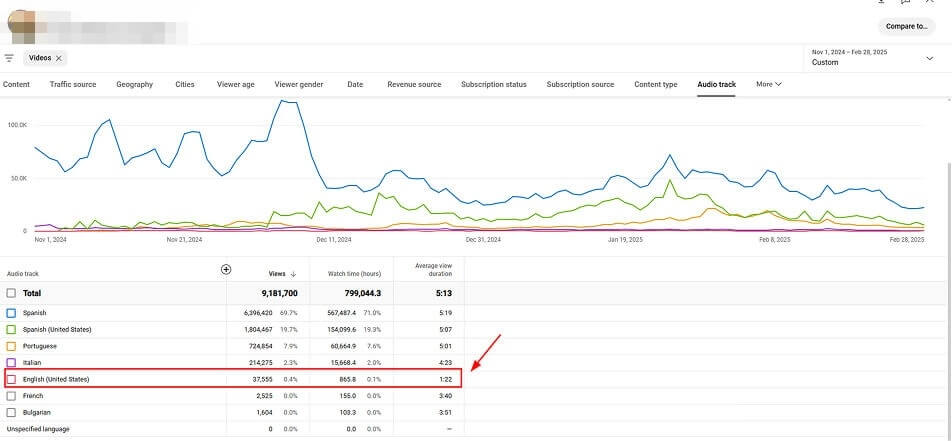
- AI voices often cost watch time. In AIR Media-Tech’s dubbing tests, an AI English track held viewers for 1:22 on a wildlife channel, against 3:40 to 5:19 on actor-voiced tracks of the same videos.
- The gap depends on format and language. A kids’ channel and a long-form story channel lost the most, while one channel’s AI Arabic track held viewers slightly longer than its original.
- A voice actor pays off only at scale. At the $2.30 median RPM in our research of 300 channels, a $11,520 yearly voice budget needs about 5 million extra views to pay for itself.
- Cloning your own voice needs no AI label, and YouTube says a label alone doesn’t change whether a video can earn money.
AI voice RPM: why YouTube pays both voices the same rate
Across 300 channels in our research (by MilX and AIR Media-Tech), the median RPM was $2.30 per 1,000 views from May 2025 to May 2026. The niche moved that number more than anything else. Education & Science channels earned a $10.22 median, and Kids & Teens channels earned $0.33.
The voice doesn't appear anywhere in that math.
YouTube Help defines RPM as your revenue per 1,000 views after YouTube's share, and the steps it lists for raising it are turning on monetization for every video, adding mid-roll ads, and switching on memberships and other revenue features. Who narrates the video isn't one of them.
An AI voiceover doesn't earn less per view. It earns less when an AI voice brings a retention drop, because a shorter watch reaches fewer ads.
Mid-roll ads run only on videos of 8 minutes or longer, so a viewer who leaves a 12-minute video at minute 2 never gets to them.
The AI label doesn't touch the money either. YouTube's blog says that "a disclosure label alone does not change how a video is recommended or whether it's eligible to earn money" (YouTube, May 27, 2026).
The low RPMs people quote for AI channels usually come from the niche. A faceless kids' channel sits near the $0.33 Kids & Teens median, whichever voice it uses, because videos made for kids can't show personalized ads.
Using AI for more than the voice?
Our guide checks each AI step, from scripts and visuals to the voiceover, against what keeps a channel monetized in 2026.
See which AI steps are safe →Want our updates first in Google? Add MilX to your preferred sources.
AI voice and retention: what AIR Media-Tech's dubbing tests show
A wildlife channel with nine dubbed language versions tried YouTube's auto-dubbing on one English audio track. The AI track held viewers for 1:22 on average. On the same videos, the tracks voiced by actors held them for 3:40 to 5:19.
AIR Media-Tech ran the same comparison on two more channels it works with.
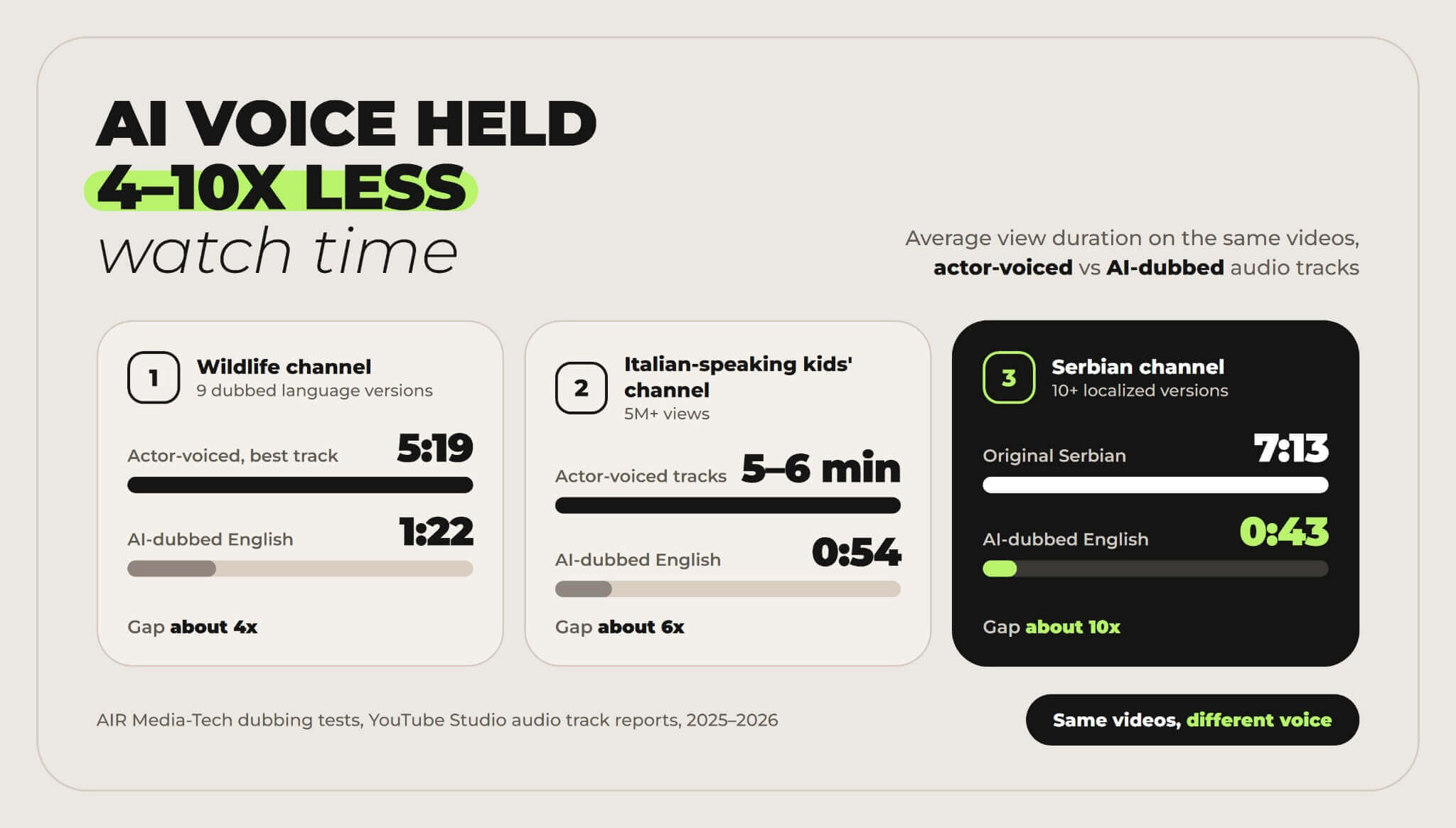
- An Italian-speaking kids' channel with more than 5 million views dropped from 5–6 minutes on actor-voiced tracks to 0:54 on its AI English track.
- A Serbian channel with 10+ localized versions held 7:13 on the original and 0:43 on the AI English track.
Across the three channels, AI-dubbed tracks kept viewers 4 to 10 times less than human-voiced tracks on the same videos, and the channel with the longest views lost the most (AIR's AI dubbing retention data).
These are dubbed versions of existing videos, so they show how one audience reacts to an AI voice next to a human one on the same content.
A channel narrated by AI from its first upload has no human track to compare, and its viewers found it with that voice.
No public study compares the same video narrated both ways, which makes the dubbing tests the closest real YouTube data on AI voice and retention.
Some languages hold an AI voice, and others don't
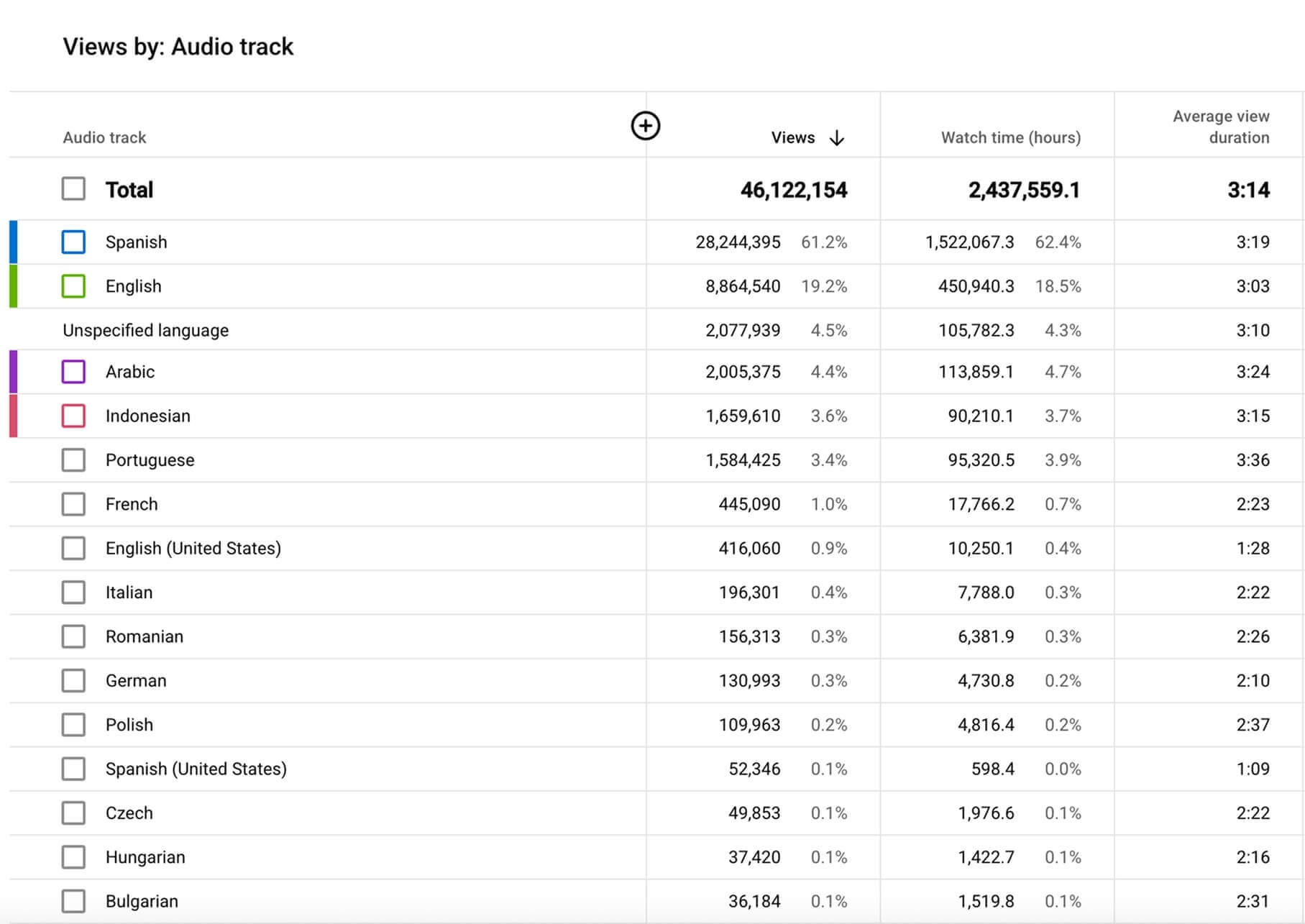
On a Spanish-language channel AIR works with, the AI-dubbed Arabic track held viewers for 3:24, slightly longer than the 3:19 original.
The AI English track held 3:03.
The AI French and Italian tracks fell to 2:23 and 2:22.
"Some languages hold. Others don't. It's not random," says Anton Yanovskyi, Growth Expert on AIR Media-Tech's Translation Operations team.
How well AI tools know a language and how used an audience is to dubbed content explain most of the difference, per AIR's AI dubbing guide.
AI voiceover vs human voice compared: cost, speed, retention and risk
Here's how the two options compare on the things that affect your income.
|
Criterion |
AI voiceover |
Human voice (voice actor) |
|---|---|---|
|
Cost for 8 videos a month, 10–15 minutes each |
About $264 a year on ElevenLabs Creator ($22 a month, 121,000 credits) |
About $11,520–$38,400 a year at $120–$400 per video |
|
Speed |
Narration in minutes once the script is ready, and any line can be regenerated |
Depends on the actor's schedule, and fixes need a new session |
|
Retention |
4–10 times shorter on AI-dubbed tracks in AIR Media-Tech's tests, close to the original in some languages |
The baseline the AI tracks were measured against |
|
Audience trust |
Flat or mispronounced lines are easy to notice |
A recognizable voice becomes part of the channel |
|
Policy risk |
Same rules as any video. Risk grows when one voice and one template repeat across uploads |
Same rules. A human voice doesn't protect a templated channel |
|
RPM |
No separate rate for AI voices |
No separate rate for human voices |
Sources: ElevenLabs pricing, VoiceBros 2026 voice-over rates, AIR Media-Tech dubbing tests, YouTube Help, checked October 2026.
What's cheaper in the end, a voice actor or an AI voice
For 8 videos a month, the actor is the bigger bill by far.
- VoiceBros' 2026 rate guide puts a standard 10–15 minute YouTube voiceover at $120 to $400, so 96 videos a year cost $11,520 to $38,400.
- ElevenLabs, a text-to-speech (TTS) tool, charges $22 a month for its Creator plan, or $264 a year, which includes 121,000 credits and professional voice cloning.
Voice cost for 8 videos a month, one year, October 2026
AI voice, ElevenLabs Creator
$264
a year
Voice actor, 96 videos
$11,520–$38,400
a year
Even the cheapest actor costs about 44 times more than the AI plan.
The question that decides it is how many extra views a human voice has to bring to pay for itself.
Take the $11,520 low end, subtract the $264 AI plan, and divide by your RPM. Here's the result for four niches from our research of 300 channels.
|
Niche and median RPM |
Extra views a year to cover $11,520 |
Extra views a year to cover $38,400 |
|---|---|---|
|
Education & Science, $10.22 |
About 1.1 million (92,000 a month) |
About 3.7 million |
|
All niches, $2.30 |
About 4.9 million (408,000 a month) |
About 16.6 million |
|
Gaming, $2.05 |
About 5.5 million (458,000 a month) |
About 18.6 million |
|
Kids & Teens, $0.33 |
About 34.1 million (2.8 million a month) |
About 115.6 million |
RPM medians from our research of 300 channels (by MilX and AIR Media-Tech), May 2025 – May 2026. Voice costs as above, minus the $264 AI plan.
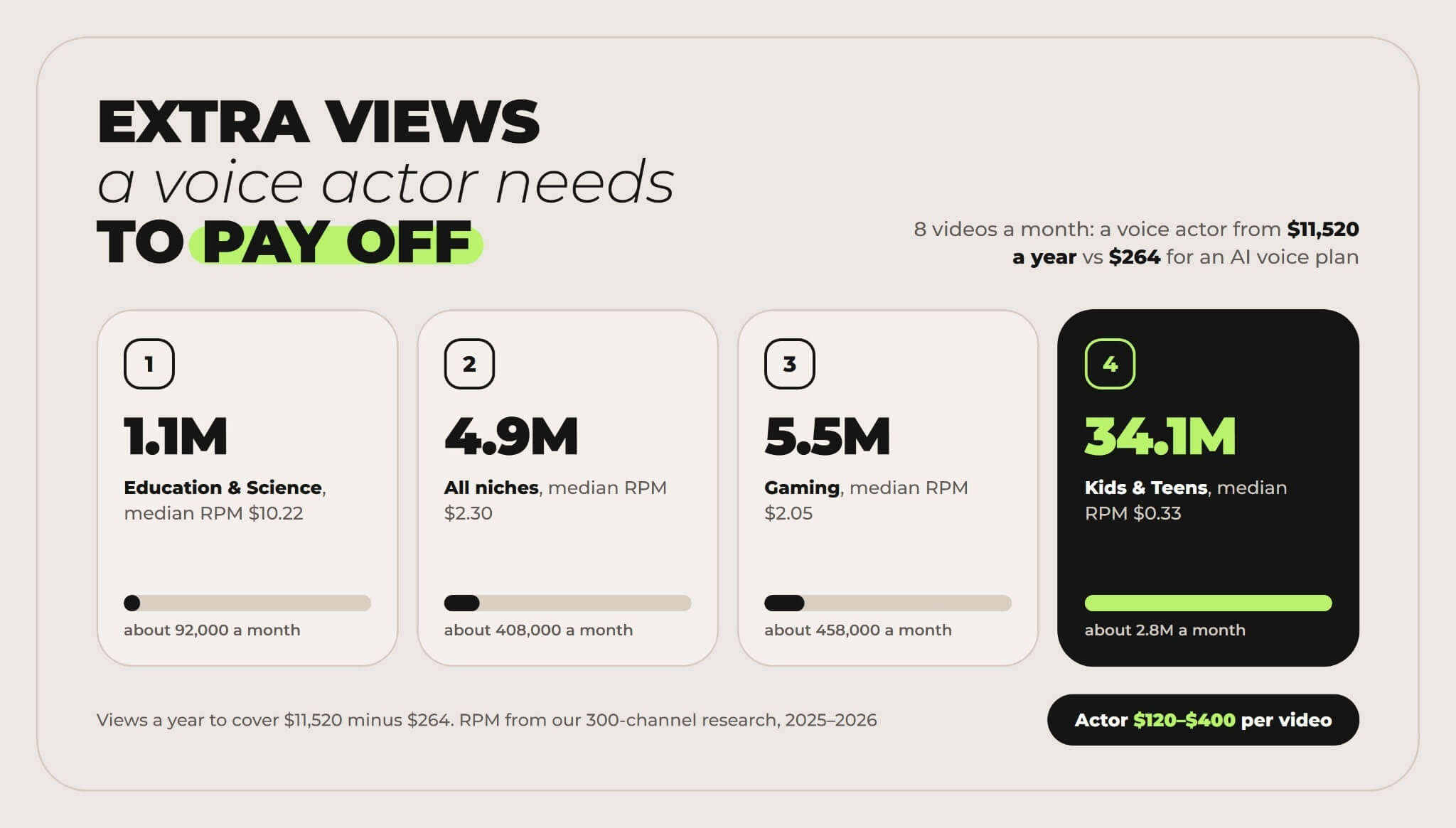
So on a small channel, the AI voice wins on money even if it costs some watch time. A channel with 50,000 views a month at the $2.30 median earns about $115, less than one actor-voiced video.
A human voice starts paying for itself when the channel already has the views, the niche pays well, or the format lives on the voice.
The middle option is a clone of your own voice
Cloning your own voice gives every video your voice without a recording session, and YouTube doesn't ask you to label it.
ElevenLabs includes professional voice cloning from the Creator plan. If you want a voice actor's clone instead, get their written permission and agree on how you'll use it.
For other AI tools that cut production time, see how creators boost YouTube income with AI tools.
Where an AI voiceover works and where it costs you
AIR's tests and YouTube's own policy examples point the same way. The more a video depends on the voice, the more an AI voice costs. An AI voice fits these formats.
- Explainers, tutorials, and lists, where visuals and on-screen text carry most of the meaning.
- Testing a new language before paying for actors. AIR uses AI dubbing to see which markets want a channel's videos, then hires actors for the ones that do.
- Faceless channels where every script has its own research and story. Our guide covers how to earn on YouTube without showing your face.
It costs the most in these.
- Kids' videos. The kids' channel in AIR's tests fell from 5–6 minutes to 0:54 on its AI track.
- Long stories and documentaries. The channel with the longest views, 7:13 on the original, kept only 0:43 on AI.
- Personality-led channels, where people come back for the person. The voice is part of what they subscribed to.
- French- and Italian-speaking audiences, whose AI tracks fell furthest on the Spanish-language channel above.
Before you switch a whole channel, test the voice on two similar videos and compare average view duration and the first 30 seconds of the retention curve in YouTube Studio.
Want YouTube's AI rules in its own words?
Every official AI policy change from 2023 to 2026, and what each one means for your revenue.
Read what YouTube says about AI →Synthetic voice YouTube policy in 2026: monetization, disclosure and voice protection
YouTube doesn't ban synthetic voices.
Its channel monetization policies ask that videos "not be mass-produced, generic, repetitive, or manipulative." On July 15, 2025, YouTube renamed its repetitious content policy to inauthentic content to make that clearer.
The policy sets no share of human narration a video must have. Reviewers check the channel as a whole, including its main theme and its most-viewed and newest videos.
One AI voice reading 30 near-identical scripts reads as mass production. The same voice on 30 researched, different videos doesn't.
Synthetic voice disclosure depends on what the voice makes viewers believe. YouTube Help lists "cloning one's own voice to create voice overs or dubs" among the uses you don't have to disclose, and a generic AI narrator reading your own script isn't on the disclosure list either. Realistic content is. Making it appear as if someone gave advice they didn't give is one of YouTube's examples, so a cloned voice of another real person needs the AI use label in YouTube Studio.
Protection for your own voice is growing. YouTube lets people request removal of AI content that simulates their face or voice through its privacy process. Its likeness detection tool finds faces for now, and on September 23, 2026, YouTube announced voice detection for later in 2026. In the US, the NO FAKES Act would create a federal right over your voice and likeness.
As of October 2026, S.4591 was reported to the Senate and isn't law yet. Setup steps are in our guide to likeness detection and the NO FAKES Act.
Whichever voice you pick, the bills come before the money. A voice actor is paid per video, and AdSense pays for last month's views between the 21st and 26th of the next month.
Paying a voice actor per video while AdSense pays 50 days later?
With MilX, your channel's revenue lands on a balance you own every day from the day you connect. Advance Funds lets you reach what you've already earned up to 50 days before AdSense pays.
- Earned revenue up to 2 months early, for a one-time 4.3% on the amount you take
- Pay voice actors, editors and scriptwriters instantly with no transfer fee when they're on MilX
- Withdraw any day in 54 currencies through 30+ payout methods
- No subscription and no revenue share