
Key takeaways
- Successful Shorts channels earn most of their money outside the ad pool: from sponsorships, their own products, and viewers who move on to long videos.
- Shorts RPM is 3–14% of long-form RPM in the same niche, per our research of 274 channels (by MilX and AIR Media-Tech). Music is the exception at 41–60%.
- Scale needs a production system. A viral Short gives you one spike. Monthly income comes from a steady pipeline.
- YouTube has announced that from February 1, 2027, only channels with 10 million qualified Shorts views in the last 90 days will earn from the Shorts Creator Pool.
Who earns the most on YouTube Shorts in 2026
The creators who earn the most on Shorts use their views to sell something else. Alan Chikin Chow, YouTube Shorts' top creator in 2023, adds brand deals with HBO Max, McDonald's and Old Spice, product tagging and a TV development deal to his Shorts revenue, per Fortune.
Jenny Hoyos earned about $1,200 from 22 million Shorts views in 2023, under the old view count, and gained 1.5 million subscribers from 90 Shorts. That $1,200 was under 10% of her short-form income, per TubeBuddy's breakdown. Brand deals and her own products brought in the rest.
Inside channels, the pattern repeats. In our research of 274 monetized channels (by MilX and AIR Media-Tech), Shorts brought in under 2% of total revenue for most channels while taking 1–35% of their views. Three channels from our creator base show where the rest of the money comes from:
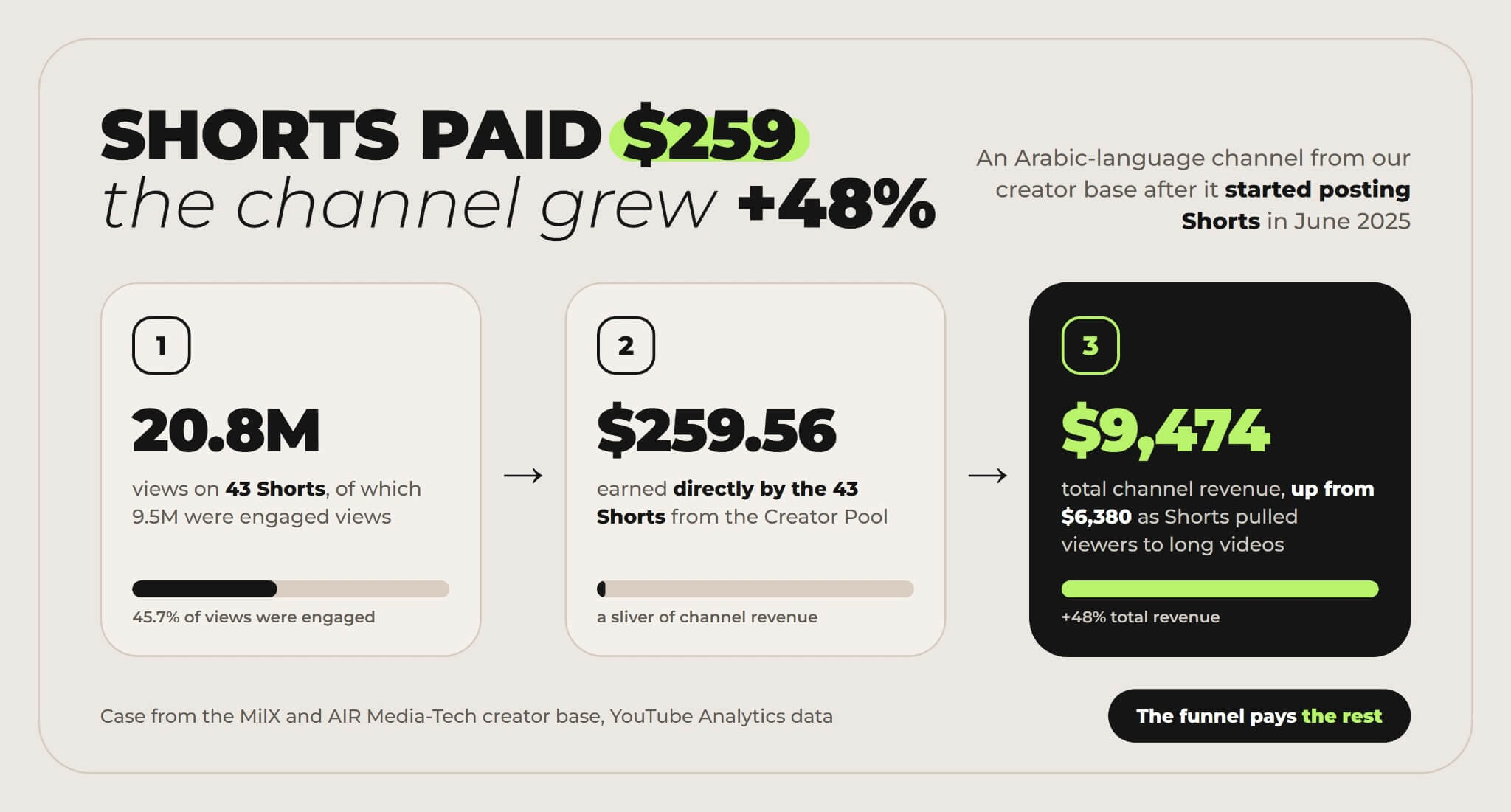
- An Arabic-language channel started posting Shorts in June 2025. Its 43 Shorts earned $259.56 directly, while total channel revenue rose from $6,380 to $9,474 (+48%).
- A kids network publishing in five languages launched a Shorts strategy in Q4 2025. Main channel views grew from 24.1M to 299M, and quarterly revenue from $6,069 to $29,536.
- A kids channel with 5.68M subscribers raised the Shorts share of its traffic from 6.2% to 15.7% between Q3 and Q4 2025, published 35% fewer videos, and grew revenue by 153%, mostly from long-form sessions.
🎯 Practical tip: track Shorts revenue as a share of total channel revenue each month. If it sits at 2–5% while total revenue climbs, your Shorts work as a funnel.
Getting Shorts views but no payout yet?
Our Shorts monetization guide covers eligibility, setup and your first payout step by step. Then add MilX to your preferred sources to see new creator pay data first in Google.
Read the Shorts monetization guide →How much successful Shorts creators earn in 2026: what 617 million views pay
Lucan Pevidor, a Brazilian Shorts creator, gained 8 million subscribers in the 30 days to October 8, 2026, and pulled 617 million views, mostly on Shorts. At the typical Shorts rate in our research of 274 channels (by MilX and AIR Media-Tech), those views would pay about $19,000–$56,000 from the Creator Pool for the month, or up to about $93,000 with a mostly US audience. Social Blade puts the same month at $154,000–$2.5 million. That range works out to $0.25–$4 per 1,000 views, well above the $0.03–$0.09 per 1,000 plays in our data.
Five more channels from AIR Media-Tech's October ranking of the fastest-growing YouTube channels also grow mostly on Shorts. None of them publish their revenue, so the last column is our estimate: views in 30 days times $0.03–$0.09 per 1,000 plays, the typical niche rate from our research converted from engaged views.
|
Channel |
Country or language |
Subscribers, Oct 8, 2026 |
Gained in 30 days |
Views in 30 days |
Creator Pool pay for those views (our estimate) |
|
Brazil |
43.9M |
+8M |
617M |
~$19,000–$56,000 |
|
|
Spain |
27.1M |
+3.8M |
359M |
~$11,000–$32,000 |
|
|
India |
9.61M |
+3M |
368M |
~$11,000–$33,000* |
|
|
Brazil |
7.57M |
+2.2M |
127M |
~$4,000–$11,000 |
|
|
Spanish-language |
18.7M |
+2M |
455M |
~$14,000–$41,000 |
|
|
Mexico |
31.2M |
+1.5M |
347M |
~$10,000–$31,000 |
Source: Social Blade, 30 days to October 8, 2026. Estimates use the typical niche rate from our research. Audiences outside the US and Western Europe often pay less: an Arabic-language channel from our creator base earned about $0.012 per 1,000 plays on its Shorts. Licensed music also takes its cut first. *Kishore Mondal Official posts music Shorts: Content ID can add revenue when the songs are the channel's own, while viewers in India pay less than the typical rate.
The pool pays real money only at this scale. At 1–2 million views a month, the same rate gives $30–$180, and from February 2027 a channel at that level drops out of the pool entirely. That's why the three income lines further down matter more for most channels.
How the Shorts Creator Pool pays you
Shorts don't run on the long-form ad auction. YouTube collects the money from ads shown between Shorts in the feed and splits it in four steps, set out in YouTube's Shorts monetization policy:
- Ads shown between Shorts in the feed are added up each month, per country.
- A music licensing deduction comes out first. One licensed track sends half of the revenue tied to your views to music partners; two tracks send two-thirds.
- The rest forms the Creator Pool, divided by each creator's share of eligible engaged views.
- You keep a revenue share of 45% of your allocation, against 55% on long-form ads.
Only monetized Shorts views count: non-original clips, invalid traffic and content that breaks advertiser guidelines are left out. Shorts of one to three minutes with a Content ID claim uploaded before September 24, 2026 stay blocked, while newer ones aren't blocked automatically, per YouTube Help.
The counting rule changed in 2025. From March 31, 2025, a Shorts view registers on every start or replay, and the older metric moved to "engaged views" in Studio. On the Arabic-language channel from our creator base, 20.8 million views turned into 9.5 million engaged views (45.7%), so compare engaged views when you read pre-2025 earnings claims. For the payout math at scale, see what 10 million Shorts views pay in 2026.
What changes for Shorts pay on February 1, 2027
YouTube has announced that from February 1, 2027, only channels with 10 million qualified Shorts views in the last 90 days will earn from the Shorts Creator Pool. Channels below that line stay in the YouTube Partner Program, keep their long-form earnings, and get Shorts revenue back once they reach 10 million again.
New applicants will need 1,000 subscribers plus 8,000 qualified watch hours in the last 365 days or 20 million qualified Shorts views in the last 90 days, per YouTube Help. Creators already in the program keep their status if they accept the updated terms in YouTube Studio by January 31, 2027 and meet a new activity rule.
For successful Shorts channels, little changes: 10 million views in 90 days is about 3.3 million a month. A channel at 1–2 million Shorts views a month will stop earning from the pool, so for mid-size channels the income lines below become the main plan. For channels below the line, YouTube has announced bonuses for YouTube Shopping, incentives for brand deals, and earnings boosts for starting and growing trends, with details to come.
Shorts RPM benchmarks by country and niche
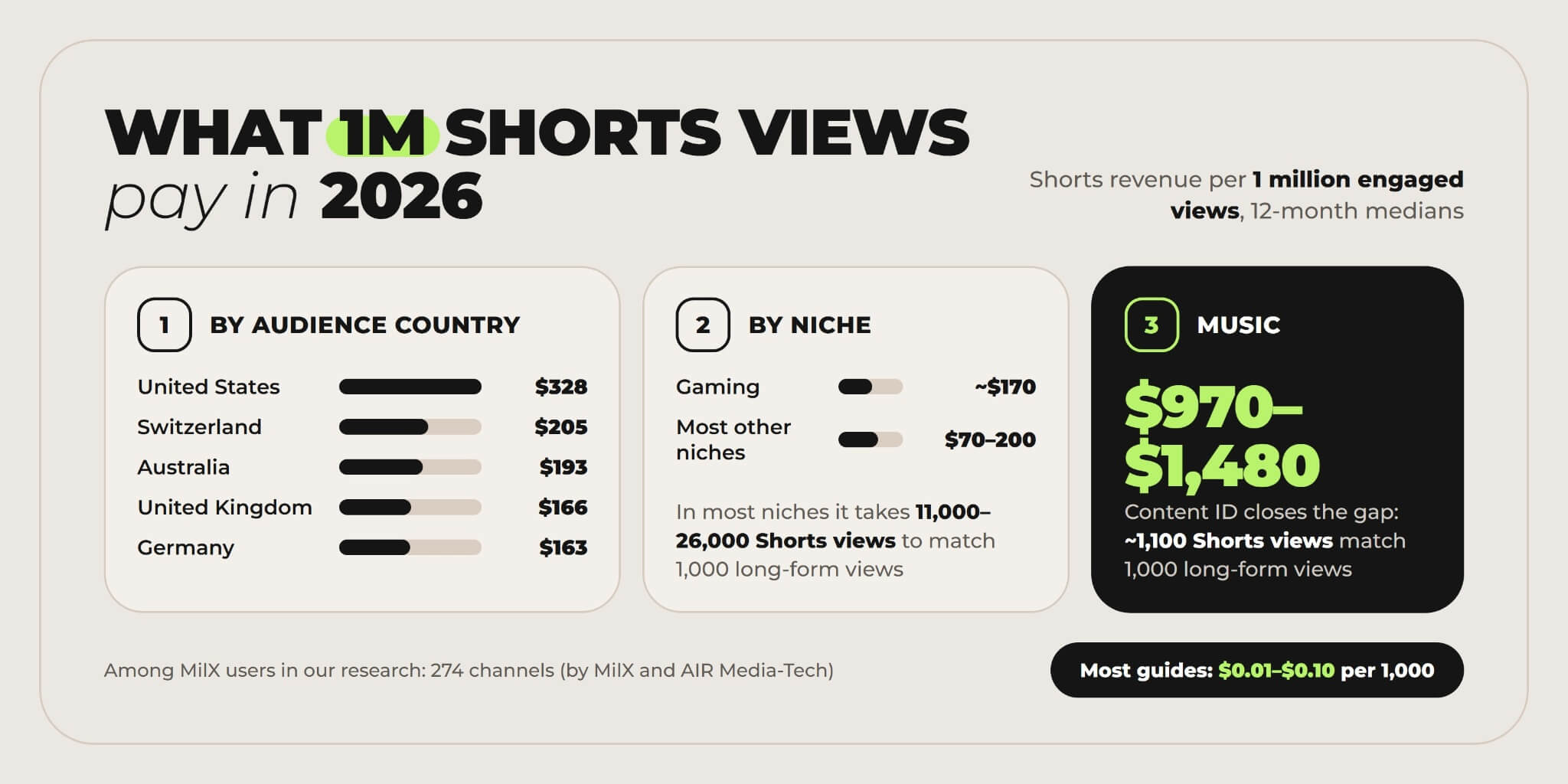
Channel size doesn't change the rate. The pool pays per view, so Shorts RPM for successful creators also comes down to audience country and niche. Among MilX users in our research, these were the 12-month median Shorts RPMs, pulled from YouTube Analytics:
|
Audience country |
Shorts RPM (per 1,000 engaged views) |
Shorts revenue per 1M engaged views |
|---|---|---|
|
United States |
$0.328 |
~$328 |
|
Switzerland |
$0.205 |
~$205 |
|
Australia |
$0.193 |
~$193 |
|
United Kingdom |
$0.166 |
~$166 |
|
Germany |
$0.163 |
~$163 |
Most guides quote $0.01–$0.10 per 1,000 Shorts views, below the medians in our data. Part of the gap is which views get counted: the Creator Pool is split on engaged views, while the Views column counts every play. On an Arabic-language channel from our creator base, 45.7% of plays became engaged views, so $0.07–$0.20 per 1,000 engaged views is roughly $0.03–$0.09 per 1,000 plays. Our sample is also monetized channels only.
Check what a number of views counts before you plan around it.
|
Niche |
Shorts RPM (per 1,000 engaged views) |
Shorts revenue per 1M engaged views |
Shorts views needed to match 1,000 long-form views |
|---|---|---|---|
|
Music |
$0.97–$1.48 |
~$970–$1,480 |
~1,100 |
|
Gaming |
~$0.17 |
~$170 |
~18,600 |
|
Most other niches |
$0.07–$0.20 |
~$70–$200 |
11,000–26,000 |
Music wins because rights holders collect through Content ID. Kids channels are the second exception: among MilX users in our research, nearly 1 in 2 kids Shorts views carried an ad, against 1 in 8 on long-form, a side effect of ad limits on made-for-kids videos. Large kids channels posting 21+ Shorts a month got up to 41% of their revenue from Shorts.
These are full-year medians. In December, CPM can run 40–60% higher than in January, so a Q4 month beats the table and a Q1 month falls short.
Three income lines big Shorts channels add on top of AdSense
YouTube's RPM leaves this money out: per YouTube Help, it doesn't count brand deals, sponsorships, or merchandise. For big Shorts channels, these lines bring most of their Shorts monetization earnings, and each pays more per view than the Creator Pool.
Sponsorship
Brands price a Shorts sponsorship off your long-form rate. In MilX's sponsorship rate breakdown, a Shorts integration bundled into a long-form deal sells for 0.7–0.9x of the long-form price, and a standalone Short for about 0.4x. Even a small deal beats the pool: at $0.10 RPM, $200 of Creator Pool income takes 2 million engaged views.
Own products
Affiliate links, YouTube product tagging, and your own digital products turn reach into sales. A $29 template bought by 0.1% of 500,000 engaged viewers brings $14,500. The Creator Pool pays under $165 for the same views, even at US rates.
Funnel to long-form
The funnel to long-form is where most successful Shorts channels earn. Among MilX users in our research, entertainment channels that posted Shorts irregularly got 26% of their views from Shorts and 1.5% of their revenue. A crafts channel from our creator base started posting Shorts in September 2025 and got +41.8% views and +64.1% revenue in 30 days, almost all of it from long videos.
🎯 Practical tip: add a Related Video link to every Short and repeat its title wording in the long video. In most niches, one long-form view pays as much as 7 to 33 Shorts views, so every tap-through counts.
Millions of Shorts views, a few hundred dollars?
The Creator Pool is the smallest part of a successful channel's income. See the 7 revenue streams full-time creators add on top of AdSense, and pick the one that fits your Shorts audience first.
See the 7 revenue streams →Can you make a living off YouTube Shorts?
A few creators do. In 2024, YouTube's blog featured Sydney Morgan, with 7.6M subscribers, who lives on Shorts revenue. YouTube picked her as a showcase, and most channels are far from her numbers.
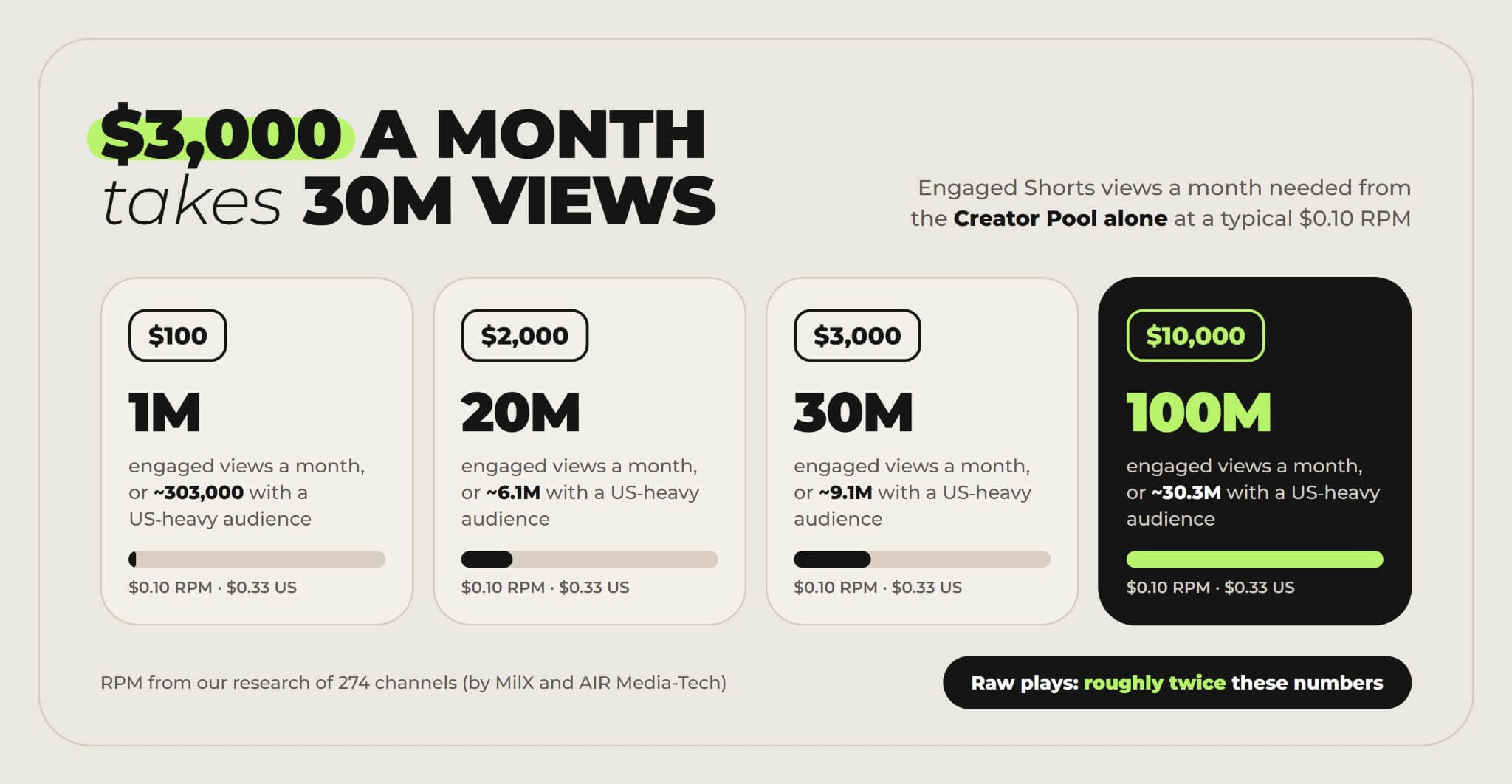
The math shows why. Here's how many engaged Shorts views a month it takes to reach common income targets from the Creator Pool alone, at a typical niche RPM and at the US rate from our research:
|
Monthly Shorts income target |
Engaged views a month at $0.10 RPM (typical niche) |
Engaged views a month at $0.33 RPM (US-heavy audience) |
|---|---|---|
|
$100 |
1 million |
~303,000 |
|
$2,000 |
20 million |
~6.1 million |
|
$3,000 |
30 million |
~9.1 million |
|
$10,000 |
100 million |
~30.3 million |
Raw plays run roughly twice these numbers, so $3,000 a month in a typical niche means about 60 million plays every month. From February 2027, a channel will also need 10 million qualified Shorts views every 90 days to stay in the pool, which a $100-a-month channel in a typical niche won't reach.
Music channels, with Shorts RPM at 41–60% of long-form, and large kids channels get closest. For everyone else, Shorts work best as the top of a funnel.
YouTube Shorts vs TikTok vs Instagram Reels: who pays creators more
Per view, TikTok pays more. Per viewer over time, Shorts can pay more, because a viewer who moves on to your long videos earns you 55% of long-form ad revenue.
|
Criterion |
YouTube Shorts |
TikTok |
Instagram Reels |
|---|---|---|---|
|
Pay model |
45% of the Creator Pool |
Creator Rewards Program |
No per-view payout |
|
Typical rate |
$0.07–$0.33 per 1,000 engaged views (music up to $1.48) |
$0.40–$1.20 per 1,000 qualified views |
$0 per view |
|
Entry bar |
1,000 subscribers + 10M Shorts views in 90 days (20M for new applicants from Feb 1, 2027) |
10,000 followers + 100,000 views in 30 days |
Invite-only bonuses |
|
Funnel to long-form |
Same channel, 55% share on long-form |
Limited |
None |
TikTok and Reels rates come from MilX's platform pay comparison and TikTok's program rules. YouTube's thresholds are on its YPP eligibility page.
🎯 Practical tip: if you post on both, export a 70–90 second cut for TikTok, which only pays for videos over 1 minute, and a 30–45 second version for Shorts.
A 6-week plan to build a Shorts income system
The Creator Pool pays on monthly volume, and from 2027 on a 90-day threshold, so a steady system beats a single viral hit. Our study of 18,000 English-language channels (by MilX and AIR Media-Tech) found the best results when Shorts made up 25–40% of uploads. Channels that pivoted hard to Shorts did worse.
Check one risk first. Among MilX users in our research, entertainment channels earned $4.58 long-form RPM in months without Shorts and $1.84 in months with them. The data can't prove Shorts caused the drop, so if you run an entertainment channel, scale Shorts slowly and watch RPM monthly.
- Week 1: measure. Pull engaged views, Shorts RPM, Shorts share of revenue and top countries for the last 90 days.
- Week 2: set a cadence. Cut one Short for every two or three long videos.
- Week 3: build bridges. Link every Short to one long video with matching title wording.
- Week 4: clean the audio. Move half your Shorts to original sound, so less of their revenue goes to music licensing.
- Week 5: price a sponsorship. Put your average engaged views per Short on a rate sheet and pitch three brands in your niche.
- Week 6: plan the cash. Match the next 60 days of costs to when money lands. AdSense pays between the 21st and 26th for last month's revenue.
Waiting 50 days for money your Shorts already earned?
With MilX Advance Funds, you reach revenue your channel has already earned up to 50 days earlier than AdSense, for a one-time 4.3%. Connect your channel and you get:
- Revenue on your MilX balance daily from the day you connect
- Withdrawals any day through 30+ methods: bank transfers in 54 currencies, plus BTC, USDT and USDC
- Free, instant P2P payments to your Shorts editor
- Contracts, acts and invoices for your payments
MilX works with revenue earned after you connect. $500M+ paid out to creators across 3,100+ connected channels, 4.6/5 on Trustpilot. Payments are processed by a licensed Money Service Business regulated by FinTrac in Canada.
Download MilX for free →