


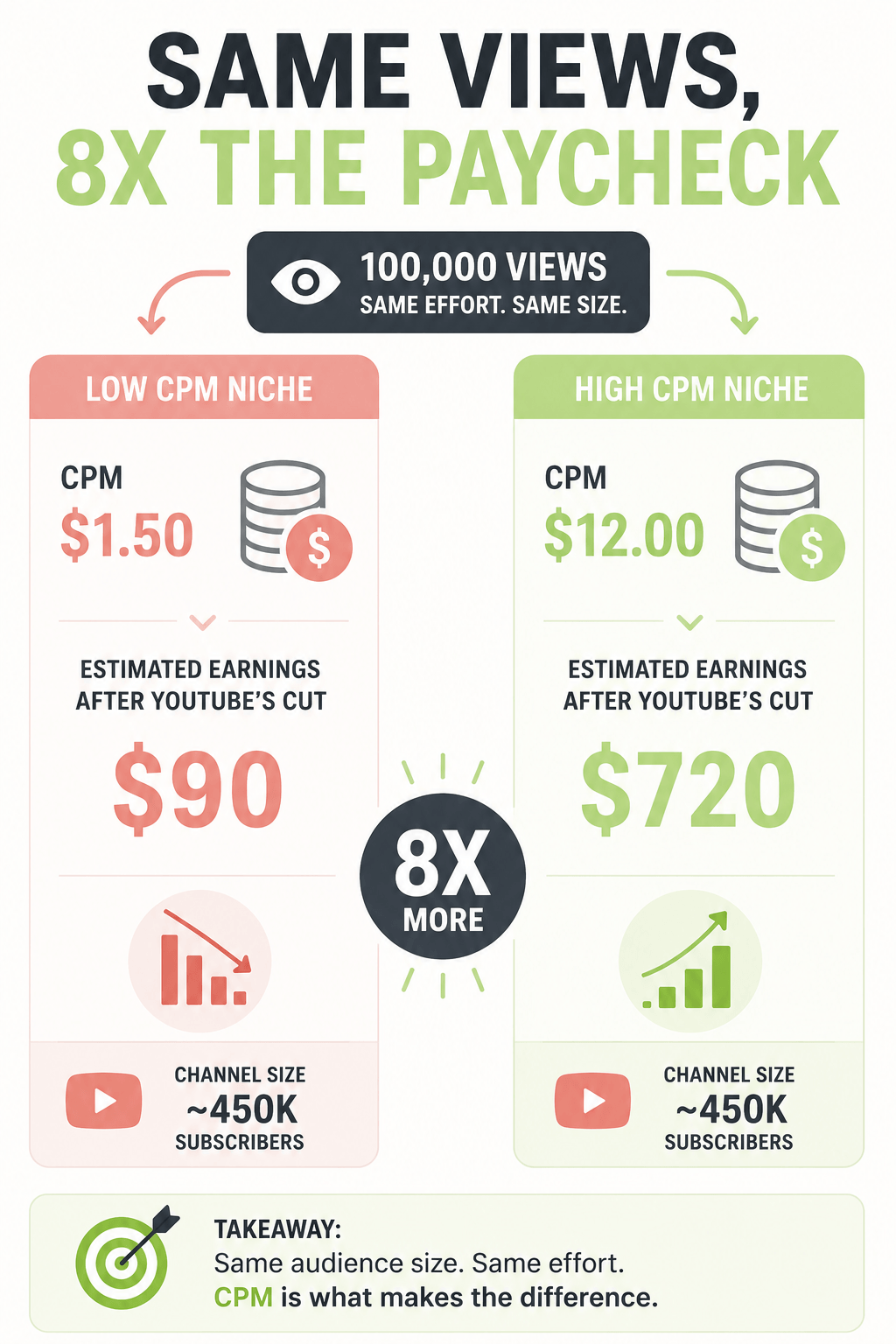
A CPM under $2 puts your 100,000-view month at roughly $90 after YouTube's cut—the same views in a finance or AI tools niche: $720 or more. The most common fix is to start a new channel in a higher-paying niche — a clean slate, the right audience from day one. You keep the old channel running as a passive income source while the new one builds. Pivoting within the same channel is possible but carries real risks: subscriber mismatch, algorithm confusion, and a slow reset period. The right destination is the highest-paying niche your skills and credibility can carry.
What Does a CPM Under $2 Mean for Your Channel?
A CPM under $2 means the same 100,000 views earns $90 instead of $720 — the difference is structural, not fixable by uploading more.
Take 100,000 views a month.
- In a $1.50 CPM niche, that puts roughly $90 in your pocket after YouTube's cut.
- The same 100,000 views in a $12 niche: about $720. Same effort, same audience size, same upload schedule.
- Eight times the paycheck. That is the difference between a channel that pays for its own editing and one that slowly drains your savings.
👉 Is your niche undermonetizable? How to pivot without starting over
Across channels tracked by MilX, two channels with the same subscriber base — roughly 450,000 each — showed a $1K vs $10K monthly revenue gap. The lower earner was not less popular. It was built on a thinner monetization base. Subscriber count measures reach. CPM decides what that reach is worth.
👉 Why a 1M-view video can earn less than a 100K one — and why high views don't always mean high income.
🎯 Practical tip: Before you do anything, pull your CPM by country in Analytics, not just the channel average. A $1.80 blended CPM sometimes hides a strong US or German audience dragged down by low-CPM traffic. If that is your case, geography and metadata changes may fix the leak before a full niche switch is even needed.
👉 Learn more about the key metrics for YouTube monetization.
Which Niches Are Keeping Your CPM Low?
Some of the most watchable niches are also the worst payers. Advertisers bid low here because the audience is broad, hard to target, or not in a buying mindset while watching.
- Entertainment/comedy: $0.50–$1.50 CPM. Huge reach, casual viewers, almost no commercial intent.
- Music/clips: $0.80–$1.80 CPM. Short watch sessions and frequent copyright friction.
- Gaming (casual): $1.50–$4 CPM. A young audience that advertisers underbid for premium products.
- Reaction content: $1–$2.50 CPM. Low advertiser targeting and recurring rights issues.
- Lifestyle vlogging: $1–$3 CPM. Broad and personal, but rarely tied to a high-value purchase.
Advertisers pay less when the viewer is not close to spending money on something expensive. A gamer watching a casual playthrough is not shopping for tax software. That is the whole story behind the low number.
🎯 Practical tip: You do not always have to abandon these niches entirely. You can angle them toward commercial intent — a gaming channel that reviews gear, a music channel that teaches production, a vlogger who covers money habits. That keeps the format while moving the audience closer to what advertisers pay for. But the most direct path to a real CPM jump is a new channel built for the new niche from day one.
Pivot Path Matrix: Where Can You Go From Here?
This matrix maps common low-CPM starting points to realistic, higher-paying destinations. Each row is built on skills and audience adjacency together — not just on the destination's pay.
|
From (low CPM) |
Realistic move to (higher CPM) |
Why it works |
|---|---|---|
|
Gaming |
AI tools for gamers, PC / tech reviews, productivity for streamers |
Same tech-fluent audience, far stronger advertiser demand |
|
Comedy / Entertainment |
Creator-economy education, personal branding, social media strategy |
Keeps your charisma, adds commercial intent |
|
Lifestyle vlogging |
Personal finance for millennials, health & wellness, remote-work lifestyle |
Personal voice transfers; viewers already trust you on life choices |
|
Music |
Music production tutorials, the music business, and audio gear reviews |
Same passion, now tied to gear and software budgets |
|
Reaction content |
Media commentary, entertainment analysis, pop-culture criticism |
Same instinct, more advertiser-friendly angles |
None of these rows asks you to start completely from zero — they reroute your existing skills toward a topic advertisers pay more to reach. The question is whether you carry that move to a new channel or try it on the existing one. That decision matters more than which niche you pick.
Which High-CPM Niches Are Worth Switching to In 2026?
These niches pay more because they reach viewers near a decision: a purchase, a subscription, a career move.
👉 Check out the most profitable YouTube niches.
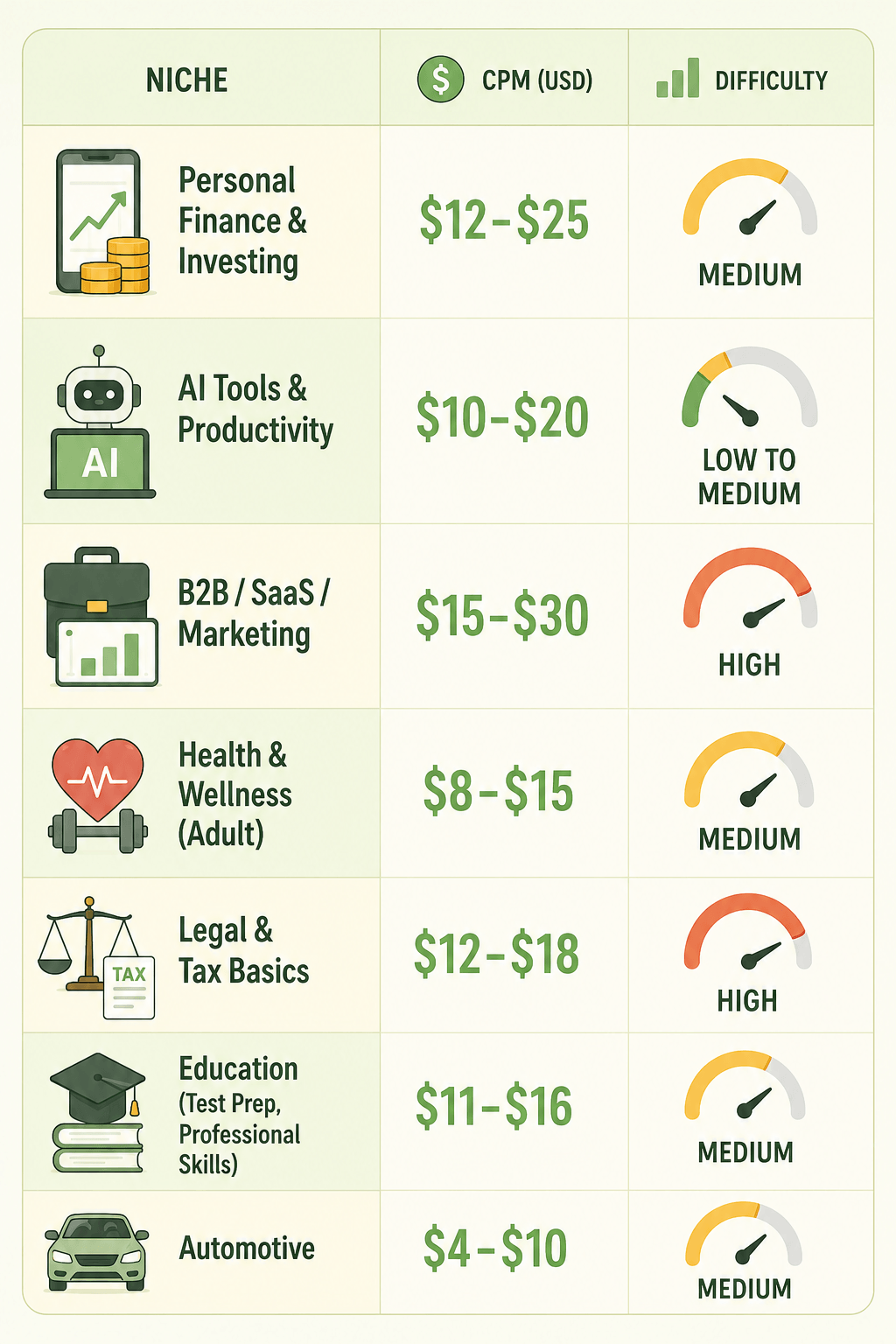
Personal Finance & Investing
CPM $12–$25. Difficulty: medium.
You do not need a license or a finance degree. Personal experience and a clear teaching format are enough. Sub-niches like investing for Gen Z or budgeting for freelancers are far less crowded than broad "personal finance."
Format that works: "I tracked every expense for 90 days" or "How I built my first $1,000 emergency fund."
AI Tools & Productivity
CPM $10–$20. Difficulty: low to medium.
The fastest-rising paying niche right now. AI companies have large ad budgets in 2026 and compete hard for the same tech-curious viewer.
Format that works: tool walkthroughs, "I tested 5 AI tools so you don't have to" comparisons, workflow setups.
B2B / SaaS / Marketing
CPM $15–$30. Difficulty: high.
The highest payer on this list is because closing one customer can be worth thousands to the advertiser. The cost of entry is credibility and an audience with professional intent.
Format that works: software tutorials, case breakdowns, niche marketing strategy.
Health & Wellness (Adult)
CPM $8–$15. Difficulty: medium.
Personal experience plus an educational angle carries this one. Stay clear of medical claims and supplements you cannot stand behind.
Format that works: sleep, recovery, sustainable fitness, habit change.
Legal & Tax Basics
CPM $12–$18. Difficulty: high, but sub-niches are open.
You do not need a law degree for "taxes for freelancers," "small claims explained," or "contracts for creators."
Format that works: plain-language explainers for one specific situation.
Education (Test Prep, Professional Skills)
CPM $11–$16. Difficulty: medium.
Format that works: structured lessons, certification prep, skill courses with clear before-and-after outcomes. Pairs well with memberships and paid courses.
Automotive
CPM $4–$10. Difficulty: medium.
The most accessible step up for lifestyle or tech creators. Carmakers, insurers, and parts retailers all bid here.
Format that works: reviews, comparisons, ownership, and maintenance breakdowns.
The AIR Media Tech shared a case with us, where the channel network didn't fully switch niche. They expanded formats inside automotive: broader comparisons, stronger hooks, clearer thumbnails. Revenue rose from about $5.3K to $8.5K in a single quarter, a 60% jump, while views grew only 23%. The money moved faster than the audience.
A Pivot Needs Runway, Not a Prayer
New formats take a few months to find their CPM. With MilX Active Funds you can access up to six months of your future YouTube income today and use it to fund the test: new thumbnails, a better mic, an editor for the transition. No credit check. Check if your channel qualifies for Active Funds
CPM Comparison Table: From Low Earners to High Earners
|
Niche |
CPM range |
Entry difficulty |
Best for |
|---|---|---|---|
|
Entertainment / Comedy |
$0.50–$1.50 |
Low |
Brand building, early stage |
|
Lifestyle vlogging |
$1–$3 |
Low |
Personal brand |
|
Gaming (casual) |
$1.50–$4 |
Low |
Large audiences, merch |
|
Automotive |
$4–$10 |
Medium |
Tech/lifestyle overlap |
|
Health & Wellness |
$8–$15 |
Medium |
Products, coaching |
|
AI Tools & Productivity |
$10–$20 |
Low–Medium |
2025–2026 growth niche |
|
Education |
$11–$16 |
Medium |
Courses, memberships |
|
Legal & Tax |
$12–$18 |
High |
Sub-niches available |
|
Personal Finance |
$12–$25 |
Medium |
High AdSense + sponsorships |
|
B2B / SaaS / Marketing |
$15–$30 |
High |
Professional audience |
CPM figures compiled from open 2025–2026 data: VidIQ, Lenos, Tasty Edits, and OutlierKit. Treat them as direction, not a guarantee for your specific channel.
🎯 Practical tip: The right move is the highest-paying niche you can reach from where you already stand — not the one with the biggest number in the table.
👉 Explore the countries with the highest CPM.
How Do You Start a New Channel in a Higher-Paying Niche?
Starting a new channel is the most common approach.
- You build for the right audience from the first video
- You keep the old channel running as a passive income stream
- And you don't drag the wrong subscriber base into a niche it didn't sign up for.
The tradeoff is time. A new channel starts at zero watch hours, zero subscribers, zero algorithm history. That gap takes 3–6 months to close before monetization is even possible, and another 3–6 months before CPM stabilizes at a niche rate. Plan accordingly.
How to set up the new channel for the right niche from day one:
- The first 10 videos determine your algorithm identity. YouTube builds its initial audience model from your first batch of content. Every video in that batch should be squarely in the niche. The algorithm needs a clean, consistent signal to know who to push your videos to.
- Design for the niche's CPM audience. Finance viewers want authority and specificity. AI tools viewers want practical walkthroughs. B2B viewers want case data. The format, pacing, thumbnail style, and language should match what performs in the destination niche, not what worked in the old one.
- Link the old channel in the about section, not in the content. The two channels should not share content or cross-promote in videos — that muddies both audiences. The about section link is enough for viewers who want to find you.
- Keep the old channel monetized and publishing at a minimum frequency. Every old video keeps generating search traffic and AdSense income daily. A channel with 1 video per month still earns. Don't let it go dark — passive income from a low-CPM catalog still pays while the new channel builds.
We watched one legal advice channel serving a 60+ audience (the MilX user). They grew revenue 141% in two months without even starting a new channel, just by restructuring metadata, Shorts monetization, and content pacing on the existing one.
👉 Localization can lift your CPM on the same content without changing a word: subtitles, translated metadata, and dubbed audio tracks unlock high-paying audiences in German, Dutch, and Spanish markets that your current videos already can't reach. See how much video translation can increase your YouTube income.
The point: sometimes the channel you already have is fixable. But when the niche itself is the ceiling, starting fresh is faster than trying to drag the wrong audience somewhere it doesn't want to go.
Get Paid Before the Views Roll In
A hybrid pivot means a slow stretch before the new CPM kicks in. Stop waiting on the 21st of the month, access up to six months of your future YouTube income today with MilX Active Funds, then put it straight into your next shoot, your editor, or your gear. Check if your channel qualifies for Active Funds
Can You Switch Niches on the Same Channel? The Real Risks.
It's possible. It works in specific conditions. But it is not the common path, and most creators who try it underestimate what they're walking into.
Here is what happens when you switch niches on an existing channel:
The algorithm pushes your new video to the wrong audience first. YouTube builds its initial distribution model from your subscriber base and watch history. According to YouTube's own documentation on how recommendations work, the primary signals the system considers are watch history, subscriptions, and past engagement — meaning your new finance video gets served to the gaming audience that built those signals. They don't engage. What can lead to a decline in overall channel views is when viewers stop watching most of your videos when they're recommended to them. The algorithm reads low CTR and retention as a signal that the video isn't good, and reduces its reach further.
Subscribers who don't match the new niche become dead weight. A large subscriber base in the wrong niche actively hurts you. YouTube's Help Center explains that the subscriber feed traffic source often reveals that viewers skip a majority of videos in their subscription feeds — meaning inactive or mismatched subscribers suppress your videos in recommended feeds without contributing any positive signal. Another niche audience is a headwind.
The reset period is real and unpredictable. Creators who have made this move report a 3–6 month period where both old and new content underperforms while the algorithm recalibrates. One creator in the BlackHatWorld thread on niche switching described it directly: "For me, it took 4 months to see some views and I'm losing subscribers daily." Revenue can drop across the board during that window — including on videos that were previously earning steadily.
Worth noting: YouTube's recommendation system documentation states that "the algorithm uses fresh performance data for each video, rather than relying on past results" — meaning a niche switch is not a permanent penalty. The engagement mismatch during transition is the actual problem, not some irreversible label on your channel.
When does same-channel switching work?
- The niches are adjacent, not orthogonal. A gaming channel moving to PC hardware reviews. A lifestyle vlogger moving to personal finance. The existing audience has meaningful overlap with the new topic.
- The channel is personality-led, not topic-led. Creators whose audience follows them rather than a specific subject retain more viewers through a shift. This is rarer than most creators think.
- The channel is small enough that the subscriber base doesn't yet have entrenched expectations. YouTube's own guidance notes that viewers are naturally drawn to channels that have demonstrated a clear niche — meaning the algorithm's model of your channel hardens over time. Under ~10K subscribers, that model is still reshapable.
If you do decide to pivot on the same channel:
- Go slow: mix 30–40% new-niche content alongside your usual uploads for at least 8 weeks before fully committing.
- Tell your audience directly in a video — not in a community post — what is changing and why.
- Never delete old videos. They keep earning and keep the channel's existing traffic alive.
- Give it 8–12 weeks before drawing conclusions. CPM seasonality and the algorithm reset both take time to stabilize.
- Accept that you will lose some percentage of your subscriber base. That loss is not a failure — it is the cost of realignment.
Fund the Pivot, Keep the Reins
One hub for every dollar your channel makes. Access future income when a niche test cannot wait, withdraw in 40+ currencies, and pay your crew free. Try MilX and see if your channel qualifies for Active Funds.
New Channel vs. Same Channel: Which Move Is Right for You?
|
New channel |
Same channel pivot |
|
|
Starting CPM |
Niche rate from day one |
Mixed until the algorithm resets |
|
Audience risk |
Zero — no wrong subscribers |
High — old audience suppresses reach |
|
Algorithm reset |
None — clean slate |
3–6 months of underperformance |
|
Time to monetization |
3–6 months minimum |
Immediate, but revenue may drop |
|
Old channel income |
Keeps running in parallel |
Competes for your time and content |
|
Best when |
Niches are distant, channel is topic-led |
Niches are adjacent, channel is personality-led |
|
Biggest risk |
Slow start, split attention |
Losing both audiences at once |
|
Recommended for |
Most creators |
Channels under ~10K or adjacent pivots only |
Your 30-Day Pivot Starter Plan
One month, four steps. Works for both paths.
Week 1: Diagnose and target. Pull your CPM by country and your top 10 videos by revenue — not by views, the lists differ. Identify which niche from the pivot matrix passes all three fit filters: your skills can carry it, your current audience has some overlap, and you understand how that niche actually earns (AdSense, sponsorships, courses — know the engine before you switch).
Decide here: new channel or same channel? If the destination niche shares less than 30–40% audience overlap with your current one, the answer is almost always a new channel.
Week 2: Set up or test.
New channel: Register it, design everything for the niche audience — name, banner, about section — and publish the first video squarely in the new niche. No experiments, no cross-content. The algorithm needs a clean signal from video one.
Same channel: Publish one new-niche video without dropping your regular schedule. Watch CTR and retention against your channel baseline. This is your first real data point — not a commitment.
Week 3: Run both in parallel.
New channel: Maintain the old upload schedule at minimum frequency — don't let passive income drop. Set 1–2 videos per week on the new channel. They operate independently; don't cross-promote in content.
Same channel: Introduce new-niche content at 30–40% of your schedule. Create a separate playlist. Tell your audience directly in a video — not a community post — what is shifting and why. Keep old videos live.
Week 4: Read the data and fund the runway. Compare new content CPM, retention, and CTR against niche benchmarks. One week of data tells you almost nothing — but four weeks show a direction. If the signal is positive, plan the next 8–12 weeks. If cash flow is tight during the transition, line up Advance or Active Funds before the lean months arrive, not during them.
How MilX Helps You Fund the Switch
A niche change is a cash-flow problem before it is a content problem. The new channel earns almost nothing for months, and AdSense still makes you wait 30–60 days for the revenue you do have.
- Advance Funds gives you earned-but-unpaid revenue up to 60+ days early, so the income from the old channel bankrolls the new one.
- Active Funds gives you up to six months of future revenue upfront to cover the lean transition months.
- Instant Payments land money in under 5 minutes, and free P2P pays the editor or thumbnail designer you hire for the new channel at $0 between MilX users.
- 10+ payout methods in 40+ currencies: bank, card, PayPal, Payoneer, and crypto.
MilX will not pick your niche or promise the switch works. What it does is take the money pressure off the months when the new channel is still finding its CPM.
More than 5,000+ creators already use it. $500M+ in creator revenue processed. Official YouTube Partner. Regulated by Canada's Fintrac. 4.6/5 on Trustpilot. No monthly subscription fees.
Take control of your creator finances with MilX — download the app for free.
FAQ
Is a CPM under $2 bad?
A CPM under $2 puts your 100,000-view month at roughly $90 after YouTube's cut — low by most creator standards. It means advertisers value your audience's views below $2 per thousand impressions, usually because the niche is broad or far from a purchase decision. It is fixable through niche, geography, or format.
What is the highest-paying YouTube niche in 2026?
B2B/SaaS/marketing tops the list at $15–$30 CPM, followed by personal finance at $12–$25. Both reach viewers close to a high-value decision, which is what drives the premium.
Should I start a new channel or switch niches on my existing one?
Starting a new channel is the more common and lower-risk approach. You build the right audience from the first video, keep the old channel generating passive income, and avoid dragging a mismatched subscriber base into the new niche. Switching on the same channel works when the niches are adjacent, and the channel is personality-led — but it carries real risks: algorithm suppression during transition, subscriber loss, and a 3–6 month reset period.
Do I need credentials to make finance or legal content?
No. Personal experience and educational angles work, and sub-niches like "taxes for freelancers" or "budgeting for students" are open. Avoid giving regulated advice, and never present yourself as a licensed professional if you are not one.
How long before I know a new niche is working?
Give it 8–12 weeks minimum. Monthly CPM is noisy, and AdSense seasonality alone can swing the number around 30% across the year. One slow month tells you almost nothing.
How do I survive the income dip during a pivot?
Keep the old channel running and earning. Bridge the gap with early access to your revenue — MilX Advance Funds covers earned-but-unpaid income up to 60+ days early, and Active Funds cover up to six months of future revenue, so a slow transition doesn't end the experiment.