


Why Is Creator Income Harder to Manage Than a Regular Salary?
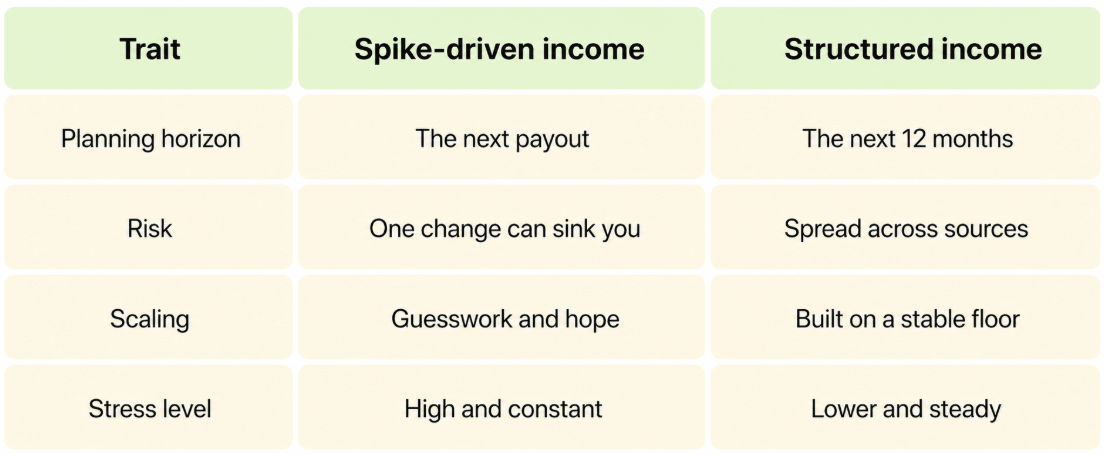
YouTube income is structurally different from a paycheck, and managing it like one is what causes most financial crises for creators. A salary arrives in equal amounts on a fixed schedule. Creator income arrives in bursts — one strong quarter, a flat one, a brand deal that pays Net 60, a January CPM crash that cuts earnings by 30–50% overnight.
The result: a channel earning a strong average can still face a cash crisis in any given month, not because income is low on average, but because the timing and size of payments make budgeting against any single month unreliable.
The system below is built for that reality.
👉 Learn why some viral videos bring zero money — and why high views don't always mean high income.
What Does the Six-Month Average Rule Look Like?
The six-month average is the foundation of creator income management — it converts irregular income into something plannable.
- Take your last six months of income.
- Add them up.
- Divide by six.
- That number is your average.
Your actual monthly "salary" should sit below that average — not equal to it — so surplus builds automatically in strong months and covers the gap in weak ones.
Here's what it looks like with illustrative numbers:
|
Month |
Income |
|
Month 1 |
$4,200 |
|
Month 2 |
$8,100 |
|
Month 3 |
$6,500 |
|
Month 4 |
$3,800 |
|
Month 5 |
$9,200 |
|
Month 6 |
$5,100 |
|
6-Month Total |
$36,900 |
|
Average |
$6,150 |
|
Your salary |
$5,000 |
In the best month ($9,200 in), $4,200 moves automatically into the buffer. In the worst month ($3,800 in), the shortfall comes from the buffer already built. Nothing changes at home either way. That's the entire point.
Do this calculation now, before the next payout arrives. Write the number down. Pick a salary below it.
👉 For context on where creator income is heading, MilX's analysis of how YouTube creator income may change in 2026 covers the structural shifts worth planning around.
Get Paid Before the Views Land
With MilX Active Funds, you can access up to 6 months of future YouTube revenue today, in one lump sum. Use it to scale on your terms instead of the algorithm’s.
How Do Creators Build a Financial Buffer?
A 3–6 month expense buffer in a separate account is the single structural difference between a creator who survives a slow season and one who goes into crisis. It is not an investment. It is not savings. It is an operating reserve — the same thing any business keeps to cover fixed costs when revenue dips.
How to build it:
- Calculate your fixed monthly costs (rent, team salaries, software, gear subscriptions — everything recurring).
- Multiply by three. That's the minimum buffer target.
- Every month, transfer the gap between your actual income and your salary number into the buffer account automatically, the moment the income lands.
- Do not touch it for anything except a genuine slow month shortfall.
Keep fixed costs below 50% of your six-month average income. If your fixed costs are higher than that, a normal slow month becomes a payroll crisis. The math works with this rule in place; it stops working without it.
What Happens to Income When Creators Scale Too Fast?
Fast growth creates a cost structure problem that's harder to see than a revenue problem. After one strong quarter, the camera, the editor, the studio, the apartment upgrade — all of it feels affordable because the income that paid for it was real. The problem is that the costs are now permanent, and the income was a spike.
Across channels tracked by MilX, monthly income swings of 40–60% between consecutive months are normal, even for channels with 500,000+ subscribers.
A month pulling $15,000 followed by a month at $7,500 is not a failure. It's the standard distribution. Building a cost structure on the high end of that range, and then having income settle at the low end, is what turns a growth period into a financial emergency.
The pattern AIR Media-Tech shared with MilX:
A kids' entertainment channel with 940M+ views in its recovery period had previously seen views crash by 75% over 18 days following an algorithmic disruption — from ~$25,000 monthly revenue to $8,200 — with no warning and no change in content quality. Creators without a buffer went straight into crisis during that window. The channel recovered, but the 18-day revenue gap was real and had to be covered somehow.
The fix is not a smaller team or less gear. It is a buffer that exists before the cost structure expands, and fixed costs that stay proportional to the average, not the peak.
How Does CPM Seasonality Affect Creator Finances?
Q4 and January are the most financially dangerous transitions for creators who don't plan around them — because they hit in opposite directions within eight weeks of each other.
- Q4 peak: October through December is when advertisers dump budget before year-end. CPMs average around $5.70 across niches, with Cyber Week weeks reaching $6.93. Every view earned during this window generates more revenue than at any other point in the year.
- January reset: Advertiser budgets restart. RPMs drop 30–50% across almost every niche, with early-January CPMs dipping toward $1.98. A creator who spent their Q4 surplus treating peak earnings as their new baseline gets corrected fast.
The right use of Q4 is to pre-fund Q1. The December surplus should sit in the buffer, not in the lifestyle. When January arrives, nothing changes — because you built the expectation into the system in October.
Content calendar implication: Q4 is when your highest-effort, highest-reach videos should publish, because you're getting a rate increase on every view. Q1 is when you experiment, build evergreen content, and develop the next series. Treat it as R&D funded by the Q4 surplus you kept.
You can dig into the full breakdown of current rates in MilX's guide to 2026 CPM and RPM by niche and country.
How Should Creators Handle Brand Deal Timing?
Brand deals look like fast income until you read the contract. Most pay Net 30, Net 60, or Net 90 after the video goes live. Sign in October, publish in November, and that $20,000 may not hit your account until late January or February — at the bottom of the post-Q4 RPM trough.
The money is real. The cash isn't there yet. If you've mentally spent against it, January becomes brutal.
Practical fix:
- Log every brand deal with its expected payment date, not its signing date.
- Your real cash position is what lands in your account this month, not what is technically owed.
- Build the brand deal payment timeline into the same buffer system as AdSense income.
You can also use MilX Advance Payments to access earned AdSense revenue up to 60+ days earlier than YouTube's standard payout cycle, which closes the gap between publishing and getting paid without waiting on a brand's net terms.
👉 Explore how to get repeat sponsors on YouTube so brand income becomes more predictable over time.
What Should Creators Do With Surplus Once the Buffer Is Built?
Almost everything written about creator finances focuses on survival. The stage after the buffer is built gets less attention, but it's where the real decisions compound.
Once the buffer is funded, fixed costs are capped, and the monthly salary system is running automatically, the question is where the surplus goes. Three directions make sense depending on the channel stage.
- Growing channel: Reinvest in what moves the metrics — better production, a dedicated editor, paid research. Buy it from surplus.
- Plateaued channel: The surplus can build a second income line — a course, a newsletter, a product, anything that doesn't depend on the algorithm performing next month. Creator income management at this stage means reducing the percentage of total income that AdSense or any single sponsor represents. No single source should sit above roughly 40% of total income.
- Mature, consistent channel: The surplus is investable, meaning it could go somewhere it compounds without direct involvement.
The creators who reached the third stage consistently did the same thing at stage one: they stopped treating income as a signal of what they could spend, and started treating it as material they could build with.
What Do Creators Do With Taxes?
The standard creator tax set-aside is 25–30% of gross income, moved into a separate tax account the moment income lands. It never touches the spending account.
This single habit eliminates the most common creator financial crisis: a strong year followed by a tax bill that arrives in April for money already spent in October.
Three accounts are a convenient structure:
- One for income
- One for taxes
- One for personal spending
The income account receives everything. Taxes move out immediately. The salary moves to personal. Everything else stays as an operating reserve.
MilX Make It All Easier to Implement
The system above requires consistent execution over months, which is where the right tools matter. MilX is built to handle the mechanics so the structure runs seamlessly rather than requiring willpower every payout cycle.
- Active Funds: Access up to 6 months of future YouTube revenue upfront in one lump sum. Useful for the "growing channel" stage — reinvesting in production without waiting for earnings to accumulate. Automatic 5% monthly repayment, daily commission from 0.33%, no credit check, no impact on credit score.
- Advance Payments: Access earned revenue up to 60+ days earlier than YouTube's standard payout cycle. Closes the gap between publishing and getting paid.
- Instant Payments: Cash out in under 5 minutes.
- 10+ payout methods, 40+ currencies: Bank, card, PayPal, Payoneer, and crypto — in the currency that suits you.
- Free P2P transfers: Pay editors, designers, and crew instantly for $0 between MilX users.
- Recurring Payments: Schedule automatic transfers on a daily, weekly, or monthly basis — so spiky AdSense income becomes a steady salary you can budget against without manually moving money each cycle.
MilX has processed $500M+ across 5,000+ creators, holds an Official YouTube Partner status, and has a 4.6/5 Trustpilot rating.
Are You Already Running a Reactive Pattern?
The difference between a creator who survives a slow quarter and one who doesn't is almost never talent. It's the structure built before the slow quarter arrived. These five questions identify which pattern is running right now.
- Do you know your exact fixed monthly costs, to the dollar?
- Do you have a separate account holding only tax money?
- Has the January RPM drop surprised you more than once?
- Did your personal spending increase within three months of a strong quarter?
- If a single sponsor pulled out today, would this month still be fine?
If most of those are no, the reactive pattern is active. That's not a character flaw — it's what the creator income structure trains you to do without a deliberate system in place. The fix is the same regardless: build the structure before the next spike arrives, not after the next crash.
Screenshot those questions. Answer them again in 90 days. Progress shows up in the answers before it shows up in the bank balance.
To take control of your creator finances easily — download the free MilX app.