

The year YouTube started watching who, not just what.
Something shifted on YouTube in the last twelve months. It no longer feels like the platform is only reviewing videos. It is reviewing intent and whether a real person is behind the camera, the script, and the upload schedule.
Below is a breakdown of the YouTube monetization changes ahead, why they are coming, who is most at risk, and what to do this quarter to stay on the safe side of the algorithm.
Change #1: Stricter Definition of Eligibility
On paper, the YouTube monetization requirements still look familiar:
- 1,000 subscribers, either 4,000 watch hours in the past year or 10 million Shorts views in 90 days. What is changing is what happens after you hit them.
YouTube is layering a quality review on top of the numbers. Reviewers and automated systems now check whether your content shows meaningful original effort, whether you are the real voice behind the channel, and whether your niche is prone to recycled material. Crossing the subscriber line no longer guarantees the green dollar sign.
Expect a slower path into the YouTube Partner Program in 2026, especially for faceless channels, compilation channels, and anything that looks copy-paste.
If your channel is borderline, film at least one signature video this month that shows a real person making real decisions. It is the fastest way to clear the new eligibility bar.
🤓 Practical tips:
- Before you apply to YPP, add a 10-second personal intro to your three most recent videos so reviewers can hear a human voice and see a human face.
- Rewrite your channel "About" page in the first person. A clear creator identity boosts the eligibility review.
- Keep a private "proof folder" with raw footage, script drafts, and project files. If you are ever reviewed, you can show originality in 30 seconds.
- Audit any auto-generated titles or thumbnails and replace the templated ones with handcrafted versions for your top 10 videos by traffic.
Do not chase the subscriber milestone as the finish line. Treat it as the starting line. Show a real human on screen, in the voice, or in the edit before you submit for monetization, and your approval will move faster than a channel twice your size without a creator identity.
Change #2: The Expanded Inauthentic Content Policy
In July 2025, YouTube retired the old repetitive content rule and replaced it with the inauthentic content policy that YouTube now enforces across the board.
In January 2026, that policy hit its first big enforcement wave. 16 major channels were removed in a single sweep, with a combined 4.7 billion lifetime views and roughly $10 million in annual ad revenue wiped off the platform.
The policy targets mass-produced, templated, or easily repeatable videos.
- Think AI voiceover over stock footage with zero commentary.
- Text-on-screen slideshows with no narrative.
- News articles are read aloud word for word.
If another channel could recreate your video in an afternoon, you are in the risk zone.
The YouTube demonetization policy now treats these formats as ineligible for ad revenue, not as a warning. That is a real shift.
Getting flagged is no longer a yellow icon. It is the faucet off.
🤓 Practical tips:
- Add an original framing segment to every video: a personal take, a behind-the-scenes note, or a contrarian opinion. Even 30 seconds of "your angle" changes how the policy reads the upload.
- If you use AI voice, layer in at least one segment with your real voice, plus on-screen commentary or handwriting.
- Delete or make private any old videos that are 100% AI voice-over stock footage. They might drag down your whole channel score.
- Vary your thumbnails and intros across videos. If your last 10 uploads look identical, rework them before the next batch publishes.
Ask yourself one question before publishing: could a random person copy this exact video in an afternoon?
If the answer is yes, do not upload it. Add a personal reaction, a unique angle, or original footage until the answer is no. That is the single fastest way to stay out of the inauthentic content policy net.
Get Paid Before the Views Roll In
With MilX Active Funds, you can unlock up to six months of future YouTube revenue upfront, with no credit checks. Use it to cover a shoot, a hire, or just a slow policy month. Check if your channel qualifies.
Change #3: Algorithmic Evaluation of Monetization Signals
YouTube is scoring your channel on signals that used to be invisible.
- How often viewers return.
- Whether comments read like real conversations.
- Whether your thumbnails, titles, and topics feel connected to one creator identity.
- Whether your uploads pattern like a human or like a content farm.
These signals feed into whether your videos even get a monetization review, and how much ad inventory they pull.
Two channels with the same view count can now see very different RPMs based on this trust score.
The takeaway is simple: Predictable, personality-driven channels win.
If you film, edit, and post like a studio of one, that consistency is now a currency.
🤓 Practical tips:
- Reply to the first 20 comments on every video in the first hour. Comment depth is a trust signal YouTube now tracks.
- Pin a question in your comment section that invites real answers.
- Keep your upload rhythm human: two or three thoughtful videos a week outperform daily dumps for trust scoring.
- Use the same face, logo, or signature element across thumbnails so the system associates videos with one creator identity.
Stop optimizing for one viral upload and start optimizing for a recognizable channel. The 2026 algorithm rewards trust built across 20 videos, more than one lucky hit.
A consistent voice, a consistent face, and a consistent posting rhythm will quietly push your RPM up month over month.
Change #4: Evolving Ad Formats And Payout Models
YouTube is pushing harder on non-skippable mid-rolls, shoppable formats, and Shorts ads. The YouTube revenue policy update for 2026 leans into variable splits, with a stronger share for long-form creators who keep viewers on the platform, and shifting Shorts payouts tied to the Creator Pool formula.
Two practical effects.
First, your RPM in 2026 will swing month to month more than it did in 2025.
Second, long-form content that holds attention beyond eight minutes is getting rewarded again, after years of the Shorts gold rush.
If your channel is 100% Shorts, this is the year to test a weekly long-form upload. To diversify before the pay mix shifts under you.
🤓 Practical tips:
- Place mid-rolls at natural pauses around the 3-minute and 6-minute marks. Viewers tolerate them, advertisers pay more for them.
- Test one long-form video per week over 8 minutes and track RPM vs. your Shorts revenue for 30 days.
- Enable shoppable formats if your niche fits. Even a small affiliate layer stabilizes income when ad RPMs dip.
- Budget your month, assuming a 20% RPM swing in either direction. That is the new normal in 2026.
Plan your content mix the way a restaurant plans a menu. Keep your Shorts as the appetizer that drives discovery, and build long-form videos as the main course that holds attention past the 8-minute mark. Diversifying format now is cheaper than scrambling when the payout model shifts mid-year.

Change #5: Brand Safety And Advertiser Preferences
Advertisers are getting more granular controls, and YouTube is giving them what they want. Categories that used to be yellow-icon territory, like some news, health, and political topics, are now sorted into tighter buckets.
Some get fewer ads. Some get premium ads. A few get almost none.
Even clean channels feel this.
One episode about a sensitive news story can pull your whole week of uploads into a lower ad tier until the cycle resets. The YouTube ads eligibility changes in 2026 will make that whiplash more common, not less.
The fix is not to sanitize your voice. It is to plan your release calendar around the revenue hit and to build income streams that do not hinge on one brand-safety moment.
🤓 Practical tips:
- Keep sensitive-topic videos in a dedicated uploads slot. Do not release them on the same day as a sponsor-heavy upload.
- Write brand-safe titles and thumbnails even for edgy videos. Sensational wording pulls ad tiers down more than the topic itself.
- Appeal every limited-ad decision you disagree with. The 2026 appeal flow is faster, and reinstated ads often recover 60 to 90% of the lost revenue.
- Build a sponsor backup. One direct sponsor deal per month can replace an entire demonetized week.
Do not self-censor to stay safe for advertisers. That kills your voice, and the algorithm still demotes boring. Instead, pair every risky upload with a brand-safe one the same week, and keep a sponsor pipeline warm so one cold ad week never decides your month.
Pay Yourself on a Creator Schedule, Not a YouTube One
Waiting for the 21st of the month is a business risk. With MilX, you cash out in 40+ currencies to a bank, card, e-wallet, or crypto wallet in under five minutes. It is free to open, built for creators, and takes your income wherever you want it to go. Open your MilX account.
Change #6: Audience Engagement Metrics As Pay Signals
Views are no longer the whole story.
Engagement velocity, comment depth, and return-viewer rate are being baked harder into how YouTube decides which videos get premium ads.
A 500,000-view video with shallow engagement can underperform a 150,000-view video with a loyal audience.
This hits faceless and AI-assisted channels the hardest, because their audiences tend to be drive-by rather than loyal. It rewards smaller creators with real communities, which is a rare piece of good news in this update cycle.
Start tracking your return-viewer percentage in YouTube Studio. If it is under 10%, that is your biggest 2026 growth lever, and it will protect your ad revenue directly.
🤓 Practical tips:
- Post one community tab post between every video upload. It keeps returning viewers warm and lifts your return-viewer metric.
- Use end screens that point to your best evergreen video. Return-viewer rate matters more than click-through rate in 2026.
- Ask one specific question in the first 20 seconds of each video. Early comments signal engagement velocity to the algorithm.
- Run a monthly "community video" that references past comments by name. Nothing builds loyal viewers faster.
Think in return visits, not views. If you had to pick between 10,000 new viewers or 1,000 viewers who come back weekly, pick the 1,000. The 2026 pay signals favor loyal audiences, and loyalty compounds every upload while a viral spike fades in a week.
👉 Learn more about why YouTubers get paid for likes.
Change #7: New Tools And Dashboards For Creators
The one piece of actual relief is better visibility. Expect expanded monetization insights in Studio, a clearer breakdown of why a video got limited ads, and more granular Shorts revenue reporting. Appeals for demonetized videos are also getting a faster review path.
Use these tools the moment they appear. Most creators lose money because they do not check the dashboard for three weeks and miss a cluster of limited-ad videos they could have appealed.
🤓 Practical tips:
- Set a weekly 15-minute "monetization audit" on your calendar. Open Studio, filter for limited or no ads, and appeal anything questionable.
- Track your monthly RPM by video length and format in a simple spreadsheet. Patterns show up by month three.
- Turn on email alerts for monetization status changes so you never miss a new limited-ad decision.
- Screenshot your dashboard on the 1st of every month. A paper trail helps if you ever need to escalate an appeal.
Treat the new creator dashboard like a bank statement, not a notification feed. A 15-minute weekly review will catch limited-ad videos while appeals are still fresh, and recovered revenue from one successful appeal can pay for a full month of editing.
👉 Discover how to boost your income with AI tools.

YouTube Monetization Changes Overview For 2026
Pulling it together, the direction is clear. YouTube wants original creators, engaged audiences, and content advertisers to feel safe buying against. It is willing to shrink the Partner Program to get there.
If you are a human-driven channel with a loyal audience, you will likely see higher RPMs. If you are a volume-driven channel, your margin of safety is shrinking fast.
What channels have a high risk of demonetization in 2026?
- AI voiceover channels with no face, no narrative voice, and stock footage only;
- Compilation channels reusing clips without meaningful commentary or transformation;
- News-reader channels that read articles verbatim instead of analyzing them;
- Faceless Shorts farms pushing 10+ videos a day on the same template;
- Kids or family channels that skirt the updated misleading family content rules;
- Channels with sudden topic pivots that look like an algorithm play, not a creator choice.
Case Example: Channels Hit By The New Policy
The January 2026 removal wave is the clearest case study we have. Sixteen channels. 35 million subscribers between them. 4.7 billion lifetime views. Roughly $10 million in annual ad revenue, all pulled from the YouTube Partner Program in one move.
None was tiny. Some had years of steady payouts.
The common thread was not the topic. It was a production pattern. Heavy AI voice use, templated thumbnails, slideshows or stock-footage loops, and a speed of output no human team could plausibly produce. That is the fingerprint YouTube is now hunting for.
If any of that sounds close to home, the message is not that YouTube hates AI. It is that YouTube hates content with no fingerprint. Put yours back into your videos this month.
👉 Explore why YouTube just suspended thousands of AI channels.
How Creators Can Prepare Now For The YouTube Monetization Policy 2026
You need to audit your channel.
- Re-read the Partner Program rules in YouTube Studio and screenshot the current status of every flag on your channel this week.
- Add at least one clear signal of human authorship to every upload: a piece-to-camera, a voice diary, a unique data point, or on-screen handwritten notes.
- Retire videos that are 100% AI voiceover over stock footage with no commentary. They are more dangerous to the channel than they are profitable.
- Diversify income. Sponsorships, memberships, affiliate, merch, and upfront funding against your future AdSense reduce how much one demonetization event can hurt you.
- Build a financial buffer equal to at least 60 days of payouts. The 2026 YouTube demonetization policy will produce surprise dips; a buffer keeps your content calendar running.
That last point is where most creators get stuck. YouTube pays on a 30 to 60-day lag. If you need a buffer, you need access to cash that is already yours on paper.
The Smarter Way for Payouts
You cannot out-strategy every YouTube monetization change. What you can do is stop letting a single monthly AdSense payout decide whether you keep shooting.
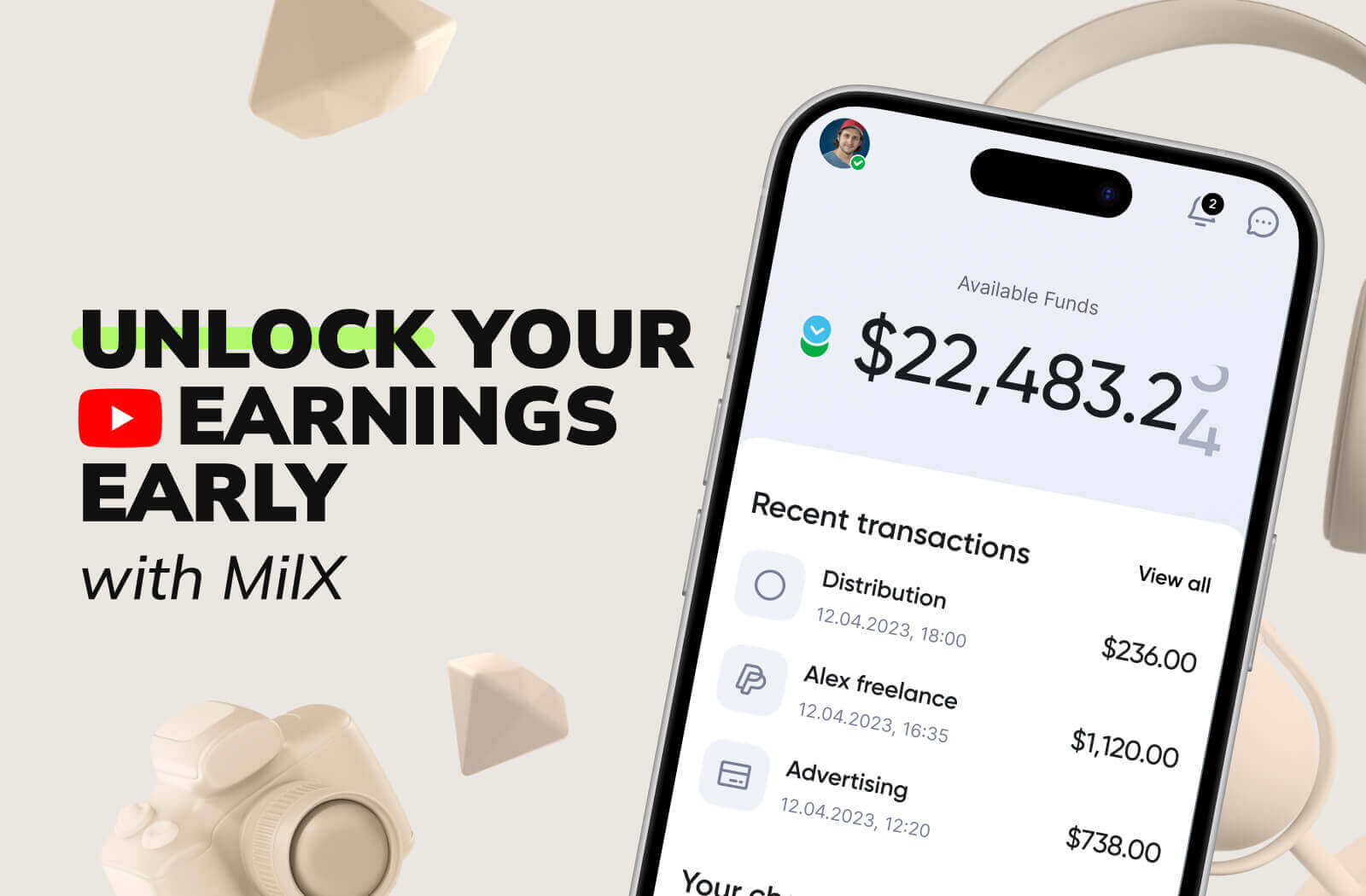
MilX is built for exactly that. With MilX Active Funds, creators can cash out up to six months of future YouTube monetization today and use it for gear, ads, editors, or just to cover a shaky quarter.
Here is what keeps creators in control, not in debt:
- Automatic repayment of 5% a month from your incoming revenue, no manual tracking;
- Daily commission from 0.33%, with no credit checks and no hit to your credit score
- Cash out in 40+ currencies, including BTC, USDT, and USDC;
- 10+ payout methods: bank card, bank transfer, PayPal, Payoneer, PIX, Zelle, and crypto;
- Free P2P transfers inside MilX to pay editors, designers, and collaborators in under five minutes;
👉Inside the MilX App: Exploring your earnings dashboard.
More than 5,000 creators already use MilX to stay ahead of the payout calendar, and over $500M in creator revenue has moved through the platform.
If YouTube is going to move the goalposts in 2026, your cash flow does not have to move with them.
Maximize your YouTube monetization with MilX.
Cash out upfront instead of waiting on the 21st. Use your future monetization to invest in the next shoot, not to cover the last one.
Move money across 40+ currencies and 10+ payment methods in under five minutes.
MilX is fast, secure, and built for creators who want financial freedom without friction.
Want the monetization safety net that works while you film? Try MilX and see if your channel qualifies for Active Funds.