
Creators get paid differently on YouTube, TikTok, and Twitch. YouTube primarily shares advertising revenue through the YouTube Partner Program, paying creators based on views, watch time, audience location, and advertiser demand. TikTok recently introduced its Creator Rewards Program, shifting from low-paying creator funds to a monetization model that rewards longer, higher-quality videos, more closely resembling YouTube. Twitch relies less on advertising and more on direct audience support through subscriptions, Bits, donations, and ad revenue sharing.
While all three platforms offer ways to earn money, the stability and predictability of payouts can vary significantly depending on how each monetization system works.
Key monetization differences:
- YouTube: Revenue mainly comes from ad sharing, with earnings influenced by CPM, watch time, and audience quality.
- TikTok: Creator Rewards Program pays for eligible long-form content, with earnings tied to performance and engagement.
- Twitch: Income is driven primarily by subscriptions, Bits, donations, and livestream engagement rather than views alone.
In this blog, we'll break down how YouTube, TikTok, and Twitch differ in payout infrastructure, including how creators earn money, payout thresholds, payment schedules, revenue-sharing models, and which platform offers the most stable income for small creators.
Why Does Payout Infrastructure Beat Revenue Size?
Revenue is a number on a dashboard. Cash flow is money you can spend today. They are not the same thing.
Payment infrastructure is the system that turns one into the other. It is the threshold you must hit, the schedule you wait on, the methods you can withdraw with, and the model that pays you in the first place. Two channels with identical revenue can hold very different cash because their platforms move money differently.
For small creators, this weighs more than it does for the giants. When your monthly income sits between $500 and $2,000, a three-week delay or a high threshold is the difference between covering a shoot and skipping it.
📌 Here is the key idea: what determines stability is your payment infrastructure. Revenue size matters far less than most creators think.
How Does the YouTube Payout System Work?
YouTube pays through Google AdSense, and the model is advertising. Brands pay to run ads. YouTube keeps 45% of ad revenue and pays you the other 55% (for long-form video and vice versa for Shorts). Your slice depends on RPM, which swings with your audience's country, niche, and watch time.
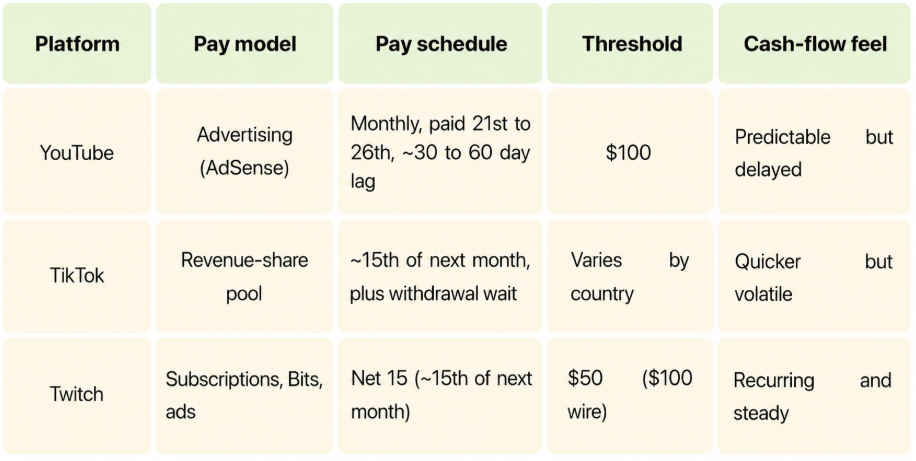
The YouTube monetization structure is built like a business ledger, not a tip jar. Earnings are finalized once a month. Around the 7th to 10th, last month's verified income shows up in AdSense. If your balance has crossed the $100 threshold, payment goes out between the 21st and the 26th, and direct deposit lands a few days later.
👉Understand the AdSense for YouTube payment process.
Add it up, and money made in January often reaches your bank in late February or early March. That is a 30 to 60-day lag baked into the system. The upside is that it is predictable, professional, and easy to forecast. The downside for small creators is that you live a full cycle behind your own work.
📌 Practical tip: Open YouTube Analytics and watch your estimated revenue daily. Treat the 21st as payday and keep a one-month buffer so a slow CPM month does not catch you short. If you sit just under $100, a single well-timed upload can pull your payout forward by a whole month.
👉See the official breakdown of YouTube revenue thresholds for payment.
TikTok Monetization Payouts: Fast Cadence, Thin and Shifting
TikTok runs on the Creator Rewards Program, which replaced the old Creator Fund. It pays for qualified views on videos longer than one minute. This is a revenue-share pool, not a fixed rate, so your RPM moves. Most creators see somewhere between $0.40 and $1.20 per 1,000 qualified views, depending on niche and audience country.
The rhythm looks friendlier than YouTube on paper. TikTok tallies earnings by month and pays around the 15th of the following month. The money lands in your TikTok balance first. From there, you push it to a bank account or PayPal, which adds another 3 to 10 business days.
The catch is volatility. TikTok monetization payouts shift with view quality, program rules, and country thresholds. A video that pays well this month may pay less next month for the same views. When creators compare YouTube vs TikTok earnings, they look at totals and miss the part that bites: how reliably each one turns into spendable cash.
📌 Practical tip: never anchor a fixed cost, like rent or a software bill, to TikTok income. Treat it as a variable bonus on top of a steadier base. Check your current country withdrawal minimum before you count on a payout, since it can be higher than you expect.
👉 TikTok explains the rules on its Creator Rewards Program support page.
Your Money, Your Rules
Cash out your channel revenue on your terms, in 40+ currencies, to a bank, card, e-wallet, or crypto. With MilX, it is free to start and fully in your hands.
Twitch Revenue System: Subscriptions as a Steady Heartbeat
Twitch is built around subscriptions, and that changes everything. A standard sub is $5.99 a month.
The default split is 50/50, and some streamers reach 70/30. Viewers also tip with Bits, worth about $0.01 each to the streamer, and ads add a smaller layer.
The Twitch revenue system pays monthly on a Net 15 schedule. March earnings settle at month's end and payout around April 15, once you clear a $50 balance (or $100 for a wire transfer). Below that, your balance rolls forward.
👉 Discover what YouTubers can learn from Twitch streamers.
The real difference is not speed. It is a shape. Twitch subscription revenue recurs. A viewer who subscribes keeps paying every month unless they cancel. That gives streamers a base they can predict, instead of starting from zero with each upload. It is why a Twitch streamer and a TikTok creator can post the same revenue and feel worlds apart.
📌 Practical tip for small YouTube creators: Copy the structure, not the platform. YouTube Memberships are your version of recurring subscription revenue. Across channels we have studied, Memberships have grown into 30% to 46% of total income, and creators describe that slice as steadier than ad revenue. A recurring base smooths out the months when views dip.
👉 Twitch documents thresholds and timing in its payout balance FAQ.
Same Income, Three Different Realities
Picture three creators, each clearing about $1,500 a month.
- The YouTube creator makes that money in January but sees the cash in late February. If a strike or an AdSense verification snag hits, the gap stretches further. We have seen payouts frozen for weeks over account checks that had nothing to do with content quality.
- The TikTok creator gets paid around mid-February, then waits again to move money out of the app. The amount also wobbles because the view pool is not fixed.
- The Twitch creator collects on Net 15, and roughly the same group of subscribers pays again next month. Same headline number, calmer cash flow.
Three identical incomes. Three different financial realities. The variable is creator payout infrastructure, not effort.
|
Metric |
YouTube |
TikTok |
Twitch |
|
Primary monetization model |
Ad revenue sharing (YouTube Partner Program) |
Creator Rewards Program (qualified views) |
Subscriptions, Bits, donations, ads |
|
Current monetization program launched |
YouTube Partner Program (2007) |
Creator Rewards Program (2024, replacing the Creator Fund) |
Partner/Affiliate monetization model since platform launch |
|
Main revenue source for most creators |
Advertising revenue |
Video views |
Subscriptions |
|
Minimum monetization threshold |
1,000 subscribers + 4,000 watch hours OR 10M Shorts views |
Typically 10,000 followers + 100,000 views in the last 30 days (varies by country) |
25 followers + Affiliate status |
|
Minimum payout threshold |
Usually $10–$50 depending on the country and withdrawal method |
$50 (or $100 for some international wire transfers) |
|
|
Payout frequency |
Monthly |
Monthly |
Monthly |
|
Typical delay between earning and receiving funds |
30–60 days |
15–40 days |
15–30 days |
|
Average creator RPM (earnings per 1,000 views) |
~$1–20+ depending on niche and audience location |
~$0.40–1.20 per 1,000 qualified views |
Not a primary metric |
|
Average advertiser CPM |
~$2–40+ depending on niche |
~$1–10 |
~$2–10 |
|
Dependence on views for income |
High |
Very high |
Low to medium |
|
Dependence on audience loyalty |
Medium |
Low |
Very high |
|
Recurring revenue opportunities |
Memberships, Channel Memberships |
Limited |
Core monetization model (Subscriptions) |
|
Income predictability |
High |
Low |
High |
|
Revenue volatility |
Low |
High |
Low to medium |
|
Biggest creator risk |
CPM fluctuations and seasonal advertising demand |
Program changes and fluctuating RPMs |
Subscriber churn |
|
Scalability potential |
Very high |
Medium |
High |
|
Best suited for |
Building a long-term creator business and maximizing ad revenue |
Fast audience growth and discovery |
Building a loyal community and recurring income |
|
Brand deal potential |
Very high |
High |
Medium |
|
Revenue diversification options |
Ads, Memberships, Super Chats, Shopping, Brand Deals |
Creator Rewards, TikTok Shop, Brand Deals |
Subscriptions, Bits, Donations, Sponsorships |
|
Most stable revenue source |
Memberships + Ad Revenue |
Brand Deals |
Subscriptions |
|
Best platform for small creators seeking stability |
Good, especially with Memberships enabled |
Weakest due to payout volatility |
Strongest due to recurring subscriptions |
Payment Delays and Thresholds: The Hidden Levers in Your Plan
Two things decide how hard a delay hits you: the schedule and the threshold.
The schedule is the wait. A 30 to 60 day lag on YouTube means January's work funds March's bills. Plan around the date you made the money, and you will run short. Plan around the date it lands, and you stay calm.
The threshold is the floor you must cross before any money moves. YouTube holds payment until $100. TikTok and Twitch set their own minimums, and some climb past $100 by country. For a creator making $1,500 a month, this is minor. For a creator making $120 a month, a $100 threshold can mean getting paid every other month, not monthly. Thresholds hit the smallest creators hardest because the less you make, the longer your money sits locked.
📌 Practical tip: build a simple cash calendar. For each platform, write the date you make the money and the date it truly lands in your bank. Pay your fixed costs from the landing dates only. This one habit removes most cash flow surprises across creator cash flow platforms.
Platform Dependency, Risk, and Room to Scale
Leaning on one platform is the biggest risk in the world of creator economy payments. One algorithm change, one policy strike, one frozen account, and a single income stream go dark.
The fix is more than posting everywhere. It is mixing payment models. Ad revenue, a revenue-share pool, and recurring subscriptions behave differently under stress. When one dips, another can hold.
Scalability lives here, too. A view-based pool has a soft ceiling: more views help, but the rate is out of your hands. Recurring subscriptions scale with loyalty. Ad revenue plus brand deals scale like a real business, which is why YouTube tends to anchor serious creator income.
Worth knowing: the highest-earning creators pull only 20% to 40% of their money from platform ads. The rest comes from sponsorships, products, and licensing built on top. Ads are the entry point, not the ceiling.
📌 Practical tip: pick one recurring layer to add this quarter. For most small YouTube creators, that is Memberships. A predictable base makes every other revenue stream less stressful.
Which Platform Setup Gives Small Creators More Stability
There is no single best platform. There is the best structure.
Stability comes from four things:
- Income that recurs,
- a short gap between making the money and getting paid,
- a low threshold,
- and control over how you withdraw.
Stack those, and your cash flow steadies, whatever your total.
Compare the three as creator cash flow platforms, not just audiences, and the picture sharpens. TikTok wins on reach and discovery, but ranks last for planning. Twitch wins on steadiness through subscriptions. YouTube wins on scale, brand deals, and a business-grade payout system, even though its delay runs the longest.
For most small YouTube creators, the smart play is to keep YouTube as the business backbone, add a recurring layer like Memberships, and fix the one weak spot in the YouTube payout system: the wait.
Get Paid Before the Wait
Access up to 6 months of your future YouTube revenue today with MilX Active Funds. Try MilX free and put your cash flow on your schedule.
Your Multi-Platform Payout Playbook
A short, repeatable routine to keep cash flow steady across platforms.
- Map every money date. For YouTube, TikTok, and Twitch, list the threshold, the pay date, and the day cash reaches your bank. Keep it in one note.
- Pay bills from landing dates only. Never from estimated or pre-payout numbers. This kills most surprises.
- Hold a one-month buffer. Keep one month of fixed costs in reserve so a slow CPM or a frozen payout does not stop your shoots.
- Add one recurring layer. Turn on YouTube Memberships with three simple tiers and one strong perk each. Recurring income is the calmest kind.
- Diversify models, not just platforms. Combine ads, a revenue-share pool, and subscriptions so no single dip breaks you.
- Consolidate withdrawals. Route platform payouts and brand deals into one account so you stop losing money on app-to-app transfers.
- Bridge the delay when it counts. When a wait threatens a deadline, pull already-made revenue forward instead of pausing your plan.
Do these seven, and your stability stops depending on which platform happens to pay well this month.
Cash Out on Your Schedule with MilX
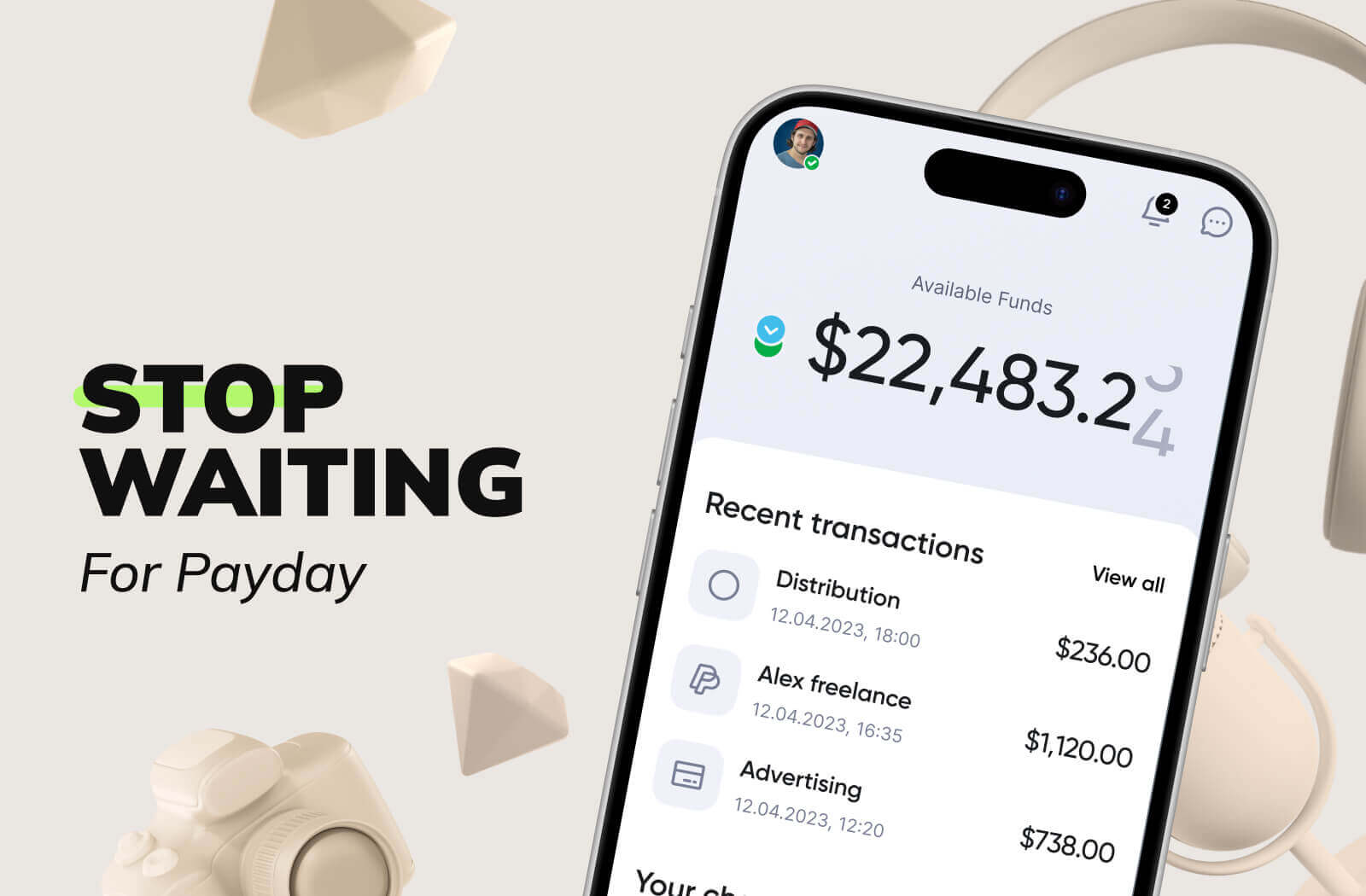
The hardest part of the YouTube payout system is the wait. MilX is a financial app built for creators that closes that gap.
With MilX Active Funds, you can access up to 6 months of your future YouTube revenue in one lump sum. No credit checks, no debt collectors. Repayment runs automatically at 5% per month from future income, with daily fees starting at 0.33%.
For today's bills, Advance Funds lets you cash out AdSense revenue you have already made, more than 50 days before YouTube's standard payday.
You also get control over how the money moves: 10+ payout methods including bank card, PayPal, Payoneer, and crypto, across 40+ currencies, with transfers in under 5 minutes. Pay your editor or designer with free P2P transfers between MilX users.
Over 5,000 creators already use MilX. It has processed $500M+ in creator revenue, is an Official YouTube Partner, is regulated by Canada's Fintrac, and holds a 4.6 on Trustpilot.
Whether you are scaling, bridging a seasonal dip, or just tired of waiting, MilX puts your cash flow on your terms.
👉 Start with MilX, your free banking app for creators.