

Behind every $5 million giveaway sits a creator economy business that runs on one principle: CASH FLOW. Big revenue is loud. Cash flow is what keeps the lights on.
This is the inside view of MrBeast's YouTube earnings structure, why his content reinvestment strategy looks insane until you do the math, and what creators of any size can copy from his playbook.
The Myth: Why More Views Don't Equal More Money
Ask a hundred creators what makes MrBeast (Jimmy Donaldson) tick, and most will say "views". But they are looking at the wrong column.
Beast Industries posted $473 million in revenue in 2024 (from both its Content and Commerce divisions), up from $221 million the year before. That's the headline.
The part nobody quotes is that the content side of his business booked roughly $224 million in 2024 against around $344 million in production costs. The content engine ran at a loss of as much as $120 million.
It's hard to believe, but yes, a YouTube channel with over 483 million subscribers, hundreds of videos each pulling half a billion views, and a whole ecosystem of media projects attached to it can still run at a loss on its own. Because the cost of production can outpace the revenue from views.
At the same time, it’s driving revenue through those surrounding projects, sponsorships, merch, and so on.
So, how does this creator economy business stand up? Through cash flow, not view counts.
MrBeast doesn't make money from videos in the simple sense most channels do. He uses videos as the engine that makes everything else possible. Plus, he reinvests his money into projects like Feastables.
“Each video does a couple million in ad revenue, a couple million in brand deals,” said Jimmy Donaldson.
If you only chase views, you're chasing the smallest part of how MrBeast makes money.
Inside MrBeast's Revenue Engine
The MrBeast income map has four legs:
- AdSense and YouTube Premium revenue from his channels (significant income, but not the main source).
- Brand sponsorships are baked into videos.
- Feastables, his chocolate and snack brand.
- Live productions and licensing, including Beast Games on Amazon Prime.
Here are some numbers. In 2024, Feastables alone did about $250 million in sales and $20 million in profit. The brand grew from $33 million in 2022 to $96 million in 2023 to $251 million in 2024. Side hustle is the wrong word. That is the part of the empire printing real cash.
Feastables now makes more profit than his YouTube channel. The videos run as a marketing arm. The candy bar runs as the cash machine.
That structure matters.
AdSense pays once a month. Brand deals can take 30 to 90 days to settle.
A consumer product business takes cash off the shelf the day it sells. Stack them together, and the YouTube earnings structure becomes a portfolio, not a single line of income.
Why MrBeast Reinvests Almost Everything
MrBeast has said it in interviews more than once:
“I personally have very little money because I reinvest everything (I think this year we’ll spend around a quarter of a billion on content).”
That sentence is the core of his content reinvestment strategy, not a humblebrag.
His video productions cost serious money: at $2.1 million to $3.5 million each.
Larger productions like Beast Games crossed $100 million on the budget side.
“I’ve reinvested everything to the point of - you could claim - stupidity, just believing that we would succeed. And it’s worked out,” said Jimmy Donaldson.
Why pour it all back in? Because…
- Every dollar reinvested grows the audience ➡️
- which grows AdSense ➡️
- which grows brand deal value ➡️
- which grows Feastables sales ➡️ which grows the war chest for the next round 🏆.
He treats YouTube revenue scaling the way a venture-backed startup treats growth:
Spend now, compound later.
The math is brutal but logical.
A safe channel running tight margins might net 20 to 30 %. A channel that reinvests can sit on thin or negative profit for years and still come out ahead, because the asset, the audience, gets bigger every cycle. And this same audience is involved in other projects and initiatives.
“I reinvest everything,” said Jimmy Donaldson.
The Real Bottleneck: Cash Flow, Not Revenue
In a 2026 interview with The Wall Street Journal, MrBeast told reporters he was in a "negative cash" position.
“It’s funny talking about my personal finances because no one ever believes anything I say, because they’re like, ‘You’re a billionaire,' I’m like, that’s net worth. I actually… I have negative money right now. I’m borrowing money. That’s how little money I have. Technically, everyone watching this video has more money than me in their bank account if you subtract the equity value of my company, which doesn’t buy me McDonald’s in the morning, or whatever.”
How can a creator with hundreds of millions in revenue be cash poor? Because revenue and cash flow are not the same thing.
- Revenue is what your business books on paper.
- Cash flow is what's available to spend today.
AdSense lands roughly 30 to 60 days after the views happen. Brand deals settle on net-30, net-60, or net-90 terms.
A factory shipping Feastables expects payment up front. The mismatch creates a constant gap between money owed and money in hand.
When people search for how MrBeast makes money, they almost always stop at the revenue figure. The interesting layer is the one underneath. YouTube cash flow, not revenue, is the real KPI for any creator running content as a business.
Are You Earning on YouTube?
You can withdraw your funds before payday - and get up to 6 months of revenue in advance to reinvest in your channel. Transfer in any currency you want via 10 payment methods and plan your finances with less guesswork. Download the free MilX app.
How MrBeast Funds Expensive Videos
When a single video costs up to $3,5 million, you can't just film and hope. You plan like a producer.
A few of the methods MrBeast and his team use:
- Brand integrations are locked in before filming begins, often paying upfront or on signing.
- Sponsorship deals tied to view milestones with performance bonuses on top.
- Equity capital from outside investors. Tom Lee's Fundstrat-linked vehicle reportedly placed about $200 million into Beast assets, which smooths long production cycles.
- Cross-funding from Feastables profit, which throws off predictable cash that can be redeployed into content.
Add operational discipline on top. He runs production like a small film studio with weekly check-ins, cost tracking, and pre-bought inventory for big set pieces.
Most creators run video production like a hobby. He runs it like a balance sheet.
YouTube Content As a Financial System
This is where most creators miss the trick. A MrBeast video works as a financial instrument, not a piece of media.
Each video does four jobs at once:
- It generates ad revenue (a yield).
- It carries a sponsorship slot (a contract).
- It pushes Feastables sales (consumer demand).
- It builds the audience (asset value).
That's why his team will spend $3.5+ million to film something that may book less than $3 million in direct YouTube revenue. The other returns make up the difference and then some. Every video is engineered to hit several P&L (Profit and Loss Statement) lines at once.
If you start thinking of your videos this way, your decision-making changes. You stop asking "will this video go viral?" and start asking "what does this video pay back, across how many channels, over how long?"
Cash Flow Beats Wait Time
Big channels and small ones live by the same rule: the money you have today funds the next video, the next hire, the next leap. Cash out your AdSense earlier, in 40+ currencies, on more than 10 payout methods. MilX is the financial toolkit that creators run their channel on.
Why Most Creators Get Stuck on Reinvesting
Reinvestment looks easy when you watch MrBeast do it. It feels impossible when you try it on a 50,000-subscriber channel.
A few reasons creators stall:
- Tight personal expenses. Rent and groceries don't wait for the next AdSense deposit.
- No cushion. One bad month, and the next video gets canceled.
- Slow money. AdSense pays around the 21st to 26th of the next month. Brand deals take longer.
- High variability. A single demonetization can flip a green month into a red one.
These pressures push creators toward the safe move. Withdraw what you can. Save the rest. Make less expensive videos.
The trouble is that smaller videos rarely break out, which keeps the channel small, which keeps the cash small. The flywheel never spins up.
The way around it is better cash flow management, not more luck.

What Smaller Creators Can Copy From MrBeast
You don't need a $3.5 million budget to use the MrBeast business model. You need a clear structure. The accounting habits scale down. The discipline scales down. The cash-flow logic scales down. What changes is the size of the numbers, not the system behind them.
1. Treat Your Channel As a Business: Build a P&L
Open a spreadsheet today.
Two tabs: one for revenue, one for costs.
List every video with its release date, total production spend, and money earned so far.
Add a column for "days to break even." If a video costs you $400 and pulls in $150 a month, it pays back in roughly three months. Now you know which formats earn out and which don't.
Here is an example:
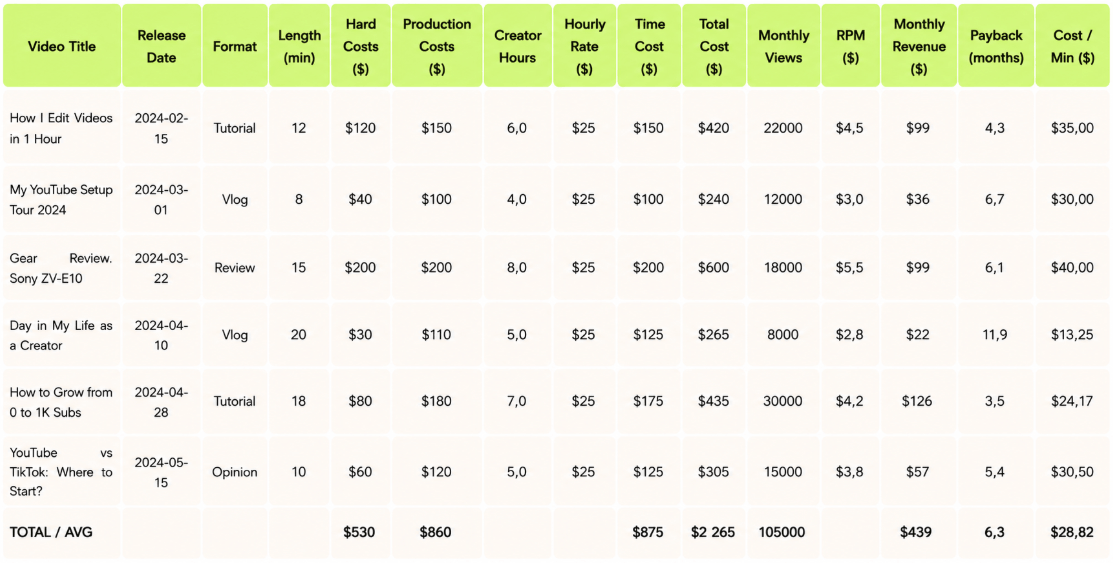
Most creators have no idea what their videos cost because they treat their own time as free. Don't. Pick an hourly rate for yourself, even a low one, and book it against each video.
The number will look ugly at first. Good. That's the whole point. You can't fix a leak you don't measure.
Track cost per video, payback per video, and cost per finished minute. That is your operating dashboard.
2. Build a Second Revenue Line Outside AdSense
AdSense pays on a 60-day delay and varies wildly with the season. November pays well. February doesn't. A creator with one revenue source is one algorithm change away from a cash crisis.
A second line buys you stability. Options that work at any size: a digital product (templates, a Notion build, an ebook), a paid course on whatever your channel is about, a paid newsletter, a small print-on-demand merch test, or affiliate links to gear you already use.
Pick one and ship a v1 in a month. Don't try to build the perfect product. Build something that proves a buyer exists.
The goal is to book revenue before YouTube pays you. A $25 product that sells 40 copies a month is $1,000 of cash that arrives the same week, not 60 days later. That cash funds your next video.
👉 Check this out: Top 7 revenue streams for a full-time YouTube creator.
3. Reinvest a Fixed Share of Every Video's Profit
MrBeast pours back close to 100%. You don't have to. The rule is what matters. The exact ratio is your call.
Pick a number you can defend: 30, 40, 50 %. Write it on the spreadsheet. When a video earns out, you take that percentage and put it back into the next one. New lavalier mic. A freelance editor for two hours. A paid thumbnail artist. A small ad spend to test a video against a cold audience.
The compounding is real. A creator who reinvests 40 % of profit for two years has a meaningfully larger production budget than a creator who took the same money home. Same revenue, different outcome.
The discipline is the part most people skip. They reinvest when they feel like it, which means they reinvest when the bank account looks fat and panic-cut when it looks thin. A fixed rule removes the emotion.
4. Pre-Sell When You Can
Cash timing matters more than total cash. A $3,000 sponsorship paid 90 days after delivery is worse than a $2,000 sponsorship paid up front. The earlier the money lands, the more videos it funds.
Practical moves: negotiate 50 % of brand deals up front and the rest on delivery (most agencies will agree if you ask), take deposits on custom sponsorships, sell a product as a pre-order with a four-week lead time and ship after you have the cash, run paid community memberships that bill monthly in advance, offer a discounted annual rate on a newsletter to pull a year of revenue forward.
Every move on that list flips one transaction from "I'll get paid eventually" to "I have the money now."
Stack a few of them, and your cash cycle changes character. You stop chasing receivables and start running on a float.
5. Tighten Cost Discipline
Know your cost per minute of finished video. If a 12-minute video costs $600 to make, that is $50 per finished minute.
Now look at every line item and ask whether it moved retention or revenue. The drone shot that took two hours to get? Check the audience retention graph at the timestamp it appears. If retention dropped there, it costs you money twice: once to shoot, once in lost watch time.
Cuts that often pay off: the second location nobody asked for, the prop that looked great on the moodboard and added 40 seconds of B-roll, the editing software subscription you forgot you had, the freelancer who delivers slow, the thumbnail revisions past round three.
Cuts that usually backfire: better audio, faster editing, a real thumbnail. Those line items move retention and click-through rate. Spend more there, not less.
The MrBeast team is famous for spending unreasonably on the things that move the metrics and being brutal on the things that don't. That is the muscle worth copying.
6. Plan Three Videos Ahead, Not One
Single-video planning is fragile. You finish a video, post it, then start the next one cold.
If that video underperforms or the next one stalls in editing, you have nothing in the pipeline. Revenue gaps and content gaps arrive together.
MrBeast's team is shooting today's video, editing yesterday's, and pre-buying props for next month. The overlap is the point. A delay on one video doesn't break the schedule because the next one is already in motion.
Same system, smaller version. Always have one video in the can ready to publish, one in editing, and one in scripting or pre-production. That is three videos at three stages.
When something breaks, and something always breaks, you ship the buffered one and absorb the hit. The audience never sees the delay. The cash flow never stops.
You don't have to match his scale to copy his accounting habit.
7. The Role of Early Access to Earnings
Now we get to the unglamorous engine room of every successful YouTube channel: speed of money.
A 30 to 60-day wait between view and payout is fine if you are sitting on cash. It is a wall if you are trying to fund the next shoot.
MrBeast solves this with capital partnerships, brand pre-payments, and the cash from Feastables. Most creators can't pull those levers on day one. They need a faster source of money against the revenue they have already made.
This is why early access to earnings matters more for small and mid-size channels than for the top of the curve. Without it, the flywheel never spins. With it, the gap between video and bigger video shrinks from 60 days to 5 minutes.
MilX brings that same speed to creators who don't have a $200 million investor on speed dial.
A few specifics worth knowing:
- Active Funds gives you up to 6 months of future YouTube income upfront, with no credit checks and no hit to your credit score. Repayment is automatic, 5% monthly from future revenue. Daily fees start at 0.33%.
- Advance Funds lets you cash out AdSense revenue up to 50 plus days before YouTube's standard payout, drawn from up to 2 months of money already booked but not yet paid.
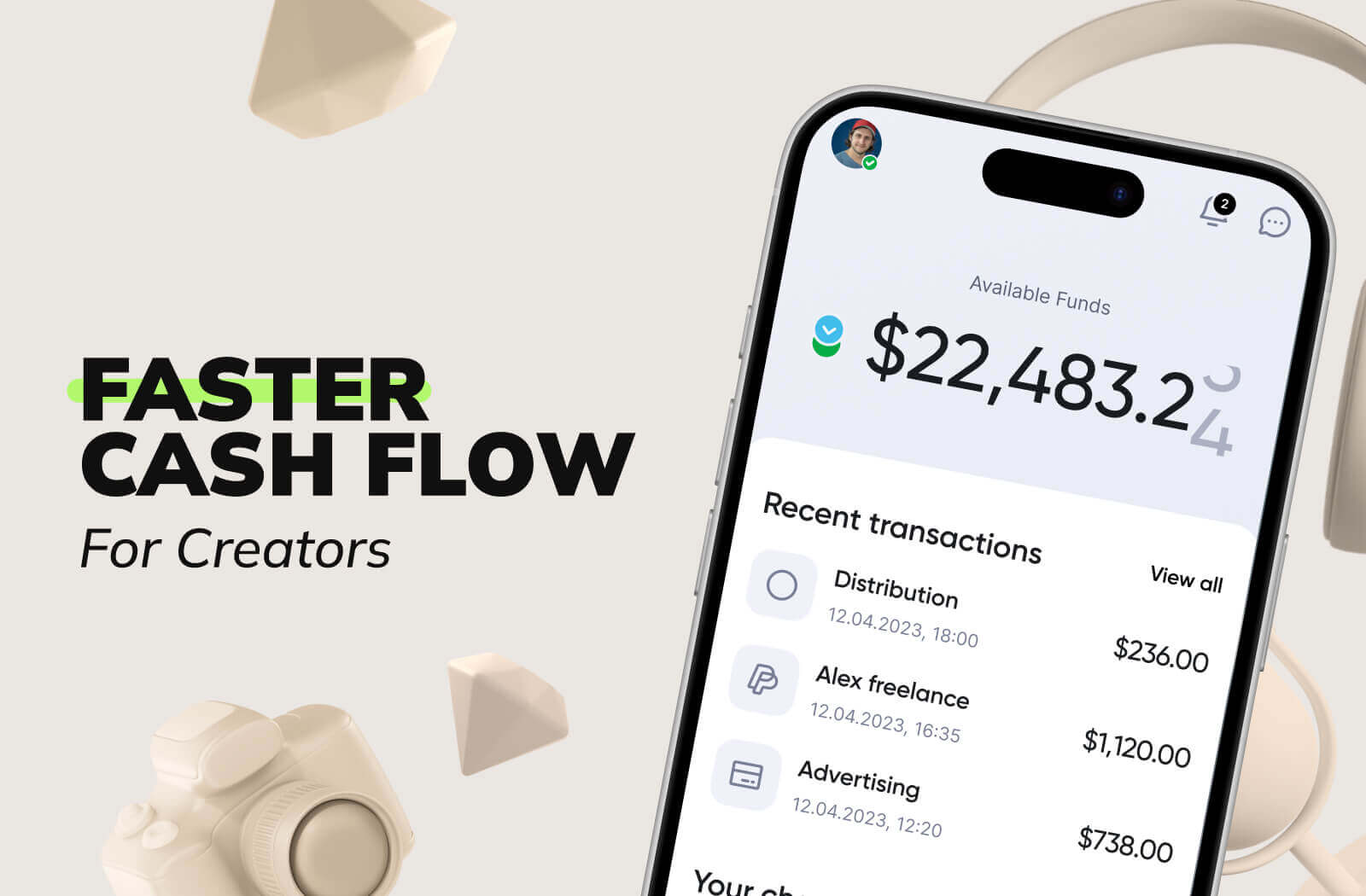
How MilX Helps You Run Your Channel Like a Business
Running a channel stops feeling like chaos when your cash flow finally matches your creative pace. MilX gives creators the tools to move money faster, pay teams easier, and scale content without waiting months for payouts.
- Cash out in 40+ currencies, including Bitcoin, USDT, and USDC.
- Choose from 10+ payout methods: bank card, bank transfer, PayPal, Payoneer, crypto, PIX, Zelle, GIM.
- P2P transfers between MilX users are $0 and land in under 5 minutes. Pay editors, designers, and crew without the wire fees.
Over 5,000+ creators already use MilX. The platform has processed more than $500 million in creator revenue. Trustpilot rating sits at 4.6.
👉 Learn more about why creators love MilX.
If MrBeast turned YouTube cash flow into a science, MilX hands you the lab kit. Whether you are filming a one-camera video at home or staging your first big production, the loop is the same: faster money in, smarter money out, more money on the next video.
👉 Try MilX free and see if your channel qualifies for Active Funds.