

The richest YouTubers have their own strategy, and we analyzed many of them.
MrBeast didn't become a hundred-millionaire by chasing views. Neither did Ryan Kaji, Marques Brownlee, or any of the richest YouTube creators pull seven and eight figures a year. They cracked something most channels never figure out: YouTube income is about how much each view is worth and what you do with the money once it lands.
To understand what that looks like in practice, we analyzed the richest YouTube creators operating today.
They share more in common than most people realize.
The Top YouTube Earners
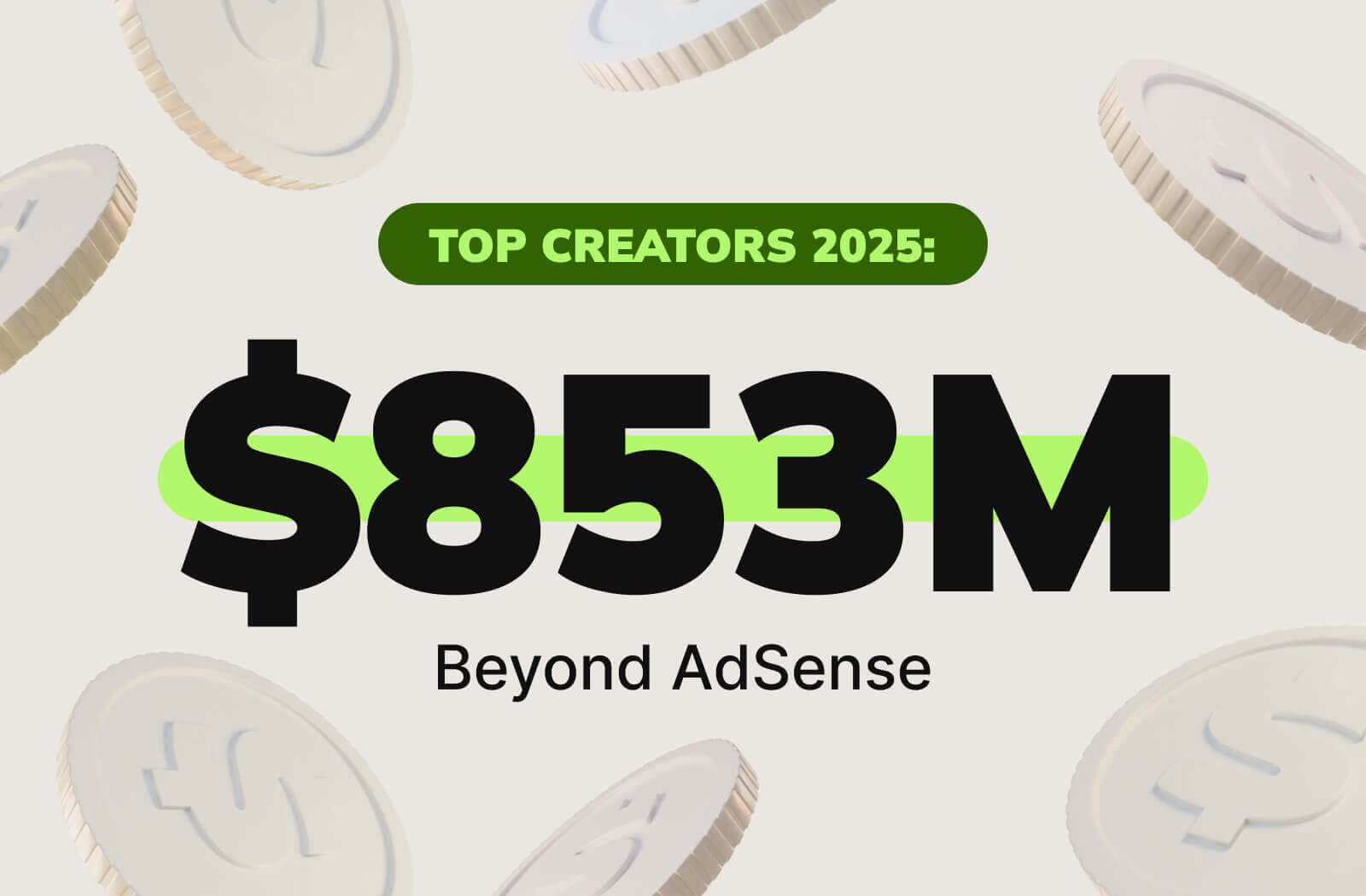
According to Forbes' Top Creators 2025 list, the top 50 creators earned a combined $853 million between April 2024 and April 2025 - an 18% jump from the prior year, with Goldman Sachs projecting influencer marketing will reach $50 billion annually.
These YouTube earnings numbers reflect the full stack of what top creators build, not just the ad revenue that appears in their dashboards.
Here's who sits at the top, and what the numbers actually say:
- MrBeast (Jimmy Donaldson): ~$85M/year. Forbes ranked him #1 for the fourth year running. Independant reseraches evaluate his income around 80-120M/year, while Donald says to the Wall Street Journal: “I’m borrowing money. That’s how little money I have”. Fortune reports that his company, Beast Industries, carries a $5 billion valuation. Time named him one of the world's 100 most influential people. Only a fraction of his income is from AdSense. The rest flows from Feastables, MrBeast Burger, and a reported nine-figure Amazon deal for Beast Games.
- Dhar Mann: ~$56M/year #2 on Forbes' 2025 list with $56M in earnings and 137 million followers. His studio now operates at Hollywood scale, with brand partnerships including Meta and Universal.
- Jake Paul: ~$50M/year #3 on Forbes' 2025 list. His blockbuster fight with Mike Tyson, streamed on Netflix, was a primary earnings driver.
- Matt Rife: ~$50M/year Forbes reported that Rife leveraged social media virality to sell more than a hundred thousand seats to live shows. A textbook example of turning YouTube reach into offline revenue.
- Rhett & Link: ~$36M/year #4 on Forbes' 2025 list with $36M, built on a daily show format turned full media company: podcasts, touring, product lines, and the Mythical Entertainment brand.
- Ryan Kaji (Ryan's World): ~$35M/year. Time's editorial team specifically spotlighted Ryan Kaji as a benchmark for YouTube-to-licensing success. Forbes estimated his 2025 earnings at approximately $35M, driven by Walmart toy licensing, Nickelodeon, Netflix, and mobile games - not ad revenue.
- Mark Rober: ~$25M/year. TIME included Rober on its inaugural TIME100 Creators list in 2025. Forbes put his earnings at $25M, fueled primarily by CrunchLabs, his STEM subscription box company, which he discussed on CNBC's Squawk Box.
- Marques Brownlee (MKBHD): ~$10M/year Forbes ranked MKBHD at #17 on its 2025 creators list with $10M in earnings. TechCrunch noted his reviews now carry enough weight to move markets for the companies he covers - a form of influence that commands premium brand deal rates.
- Dude Perfect: $50M+ revenue, $100M+ institutional investment. There was a lot of buzz around their $100M+ raise from Highmount Capital, with annual revenue estimated to exceed $50 million, spanning YouTube, mobile games, merchandise, touring, and TV.
- Emma Chamberlain: ~$9M/year Forbes placed her at #18 on the 2025 list with $9M in revenue. Her primary asset isn't her channel. It's Chamberlain Coffee and luxury ambassador relationships with Louis Vuitton and Lancôme.
- Logan Paul: ~$10M/year (creator activities) Forbes ranked Logan Paul at #15 with $10M in earnings. His far larger wealth driver is Prime Hydration, the beverage brand he co-founded with KSI that crossed $1 billion in retail sales.
What stands out is the structure. Top earners derive only 20–40% of their income from YouTube AdSense. The majority comes from brand deals, merchandise, external businesses, and licensing agreements that exist entirely beyond the YouTube Partner Program. AdSense is just the entry point. The real money is built on top of it.
This YouTube payout structure is the foundation of real YouTube revenue diversification, where AdSense is only one layer in a much wider stack.
👉 Learn more about how popular YouTubers earn.
9 Monetization Secrets from The Richest YouTubers
None of these creators woke up at $85M. MrBeast spent six years making videos that almost nobody watched. Ryan Kaji's parents filmed toy unboxings in a living room. Rhett & Link built their daily show format for years before Mythical Entertainment was a company.
If you've been asking how to earn on YouTube beyond the ad stream, the YouTube monetization strategies below are exactly what separates a channel from a full creator business.
At every stage, there are specific monetization strategies to leverage. We've mapped them all out, so you can change how you earn on YouTube.
Secret #1: Reinvest Your First Dollars Before You Spend Them
The move that separates MrBeast from almost everyone else is what he did with his first revenue. In a deep interview with Colin and Samir, Jimmy Donaldson walked through the progression: "My first brand deal helped me buy a microphone. Then a camera. Then a better camera. And basically the entire time - for the last eight or nine years - every dollar I've made, I just spent it the next month on content."
That pattern started when he was earning almost nothing. TIME's profile of Donaldson quotes him directly:
"Each video does a couple of million in ad revenue, a couple of million in brand deals. I've reinvested everything to the point of - you could claim - stupidity, just believing that we would succeed."
His manager, Reed Duchscher, framed it memorably:
"A lot of people work really hard to get the Ferrari. Jimmy works really hard so we can give the Ferrari away and then later own the car dealership."
You don't need to reinvest millions. You need to decide, the moment your first AdSense check arrives, that some fixed percentage - 20%, 30%, whatever you can sustain - goes back into the channel before you see it as income.
Secret #2: Study the Platform Obsessively
MrBeast's early years were spent studying YouTube. He spent 18 hours a day on Skype with other aspiring creators, dissecting why videos performed and why they didn't. His TubeBuddy interview captures the core principle:
"Anytime you say the word 'algorithm,' replace it with 'audience.'"
He didn't study the algorithm. He studied what made people click and stay.
This translated into concrete tactics:
- testing 2–3 thumbnail variants per video,
- writing titles under 50 characters,
- spending the first 5 seconds of every video delivering on the promise of the thumbnail.
These were the output of the systematic analysis he'd done before he had a single million views.
Ali Kaplan from Jason Vlogs confirmed the same. As he told AIR Media-Tech, “I wasn’t satisfied with any video fast”. They’re obsessed over every little detail.
What could you do?
Open your YouTube Analytics right now and pull two numbers:
- CTR (click-through rate) by video, and average view duration by video.
- Sort both.
- Find your top five in each.
- The videos where CTR and retention are both high are telling you what your audience actually wants.
- Make more of those. Not what you want to make, but what the data says they respond to.
MrBeast did this on every video for six years before his channel broke through.
Get Paid Before YouTube Pays You
Access up to 6 months of future YouTube revenue today with MilX Active Funds. No credit checks. No debt. Just your money, faster. Try MilX free and unlock your cash flow on your terms.
Secret #3: Consistency As A Business Model
Rhett & Link turned consistency itself into a structural advantage. They've hosted Good Mythical Morning daily - daily - since 2012. As they explained to The Tilt, they initially thought YouTube was a stepping stone to Hollywood. They kept waiting for someone to let them in. Eventually, they stopped asking permission and doubled down on what they were already building.
The lesson was about predictability. When Rhett & Link joined ad platform Agentio as advisors, their pitch to brands was simple: daily programming, 19 million subscribers, audiences that show up like clockwork.
That regularity is what turns a channel into a sellable media property, and what made Mythical Entertainment a 100+ employee studio bootstrapped entirely from YouTube revenue.
Consistency is more than a posting schedule; it's the operating backbone of a sustainable creator business model.
You don't need to go daily. You need a publishing cadence that's predictable enough that brands can plan around it. A channel that publishes twice a week reliably for 18 months is worth more to a sponsor than one that uploads 8 videos in a burst and then goes quiet. Consistency is your first pitch deck.
Secret #4: Quality Beats Quantity
MrBeast's insight on quality is often misunderstood as "spend more." The original version, as documented by TubeBuddy, is more nuanced:
"Putting 20% more effort into a video can triple the outcome."
The 44 hours he spent filming himself counting to 100,000 were an extreme commitment to a concept. The viral moment wasn't visual. It was the audacity of the premise.
Mark Rober makes the same point from a different angle. He described reducing 200 hours of footage to a 10-minute video as "exhausting, rewarding, and critical" to his success. His channel took 6 years to reach 300,000 subscribers.
He also told interviewers that he says no to almost everything that doesn't end up in a video - no speaking gigs, no books, no podcasts - because focus is what produces quality.
Higher-quality videos also compound into a stronger YouTube RPM strategy, because better retention and engagement directly lift the value of every single view.
Before you plan your next video, ask one question: What would make this concept completely impossible to ignore?
Not better lighting. Not a better intro. What would make the idea so strong that people feel compelled to click just from the title? That's where quality lives at every budget level.

Strategy #5: Turn Your Channel Into A Format
Rhett & Link's genius was inventing a format that could run every day and still be watchable.
Good Mythical Morning's "Will It?" segments, food challenges, and rotating game structures gave the audience a reason to return on a schedule rather than waiting to stumble across a viral video.
As The Tilt reported, this format-first approach is what enabled Mythical Entertainment to scale: once the format was proven, they could hire writers, producers, and editors because the creative brief was already defined.
Dude Perfect did the same thing. Their "Stereotypes" series, "Overtime" format, and trick shot templates are all repeatable structures. As their Fast Company CEO interview noted, the catalog has enduring value precisely because a trick shot video doesn't get old.
Identify whether your most-viewed videos share a structural pattern. If they do, that's your format. Name it, repeat it with variation, and build a series identity around it. Series are easier to pitch to brands, easier for audiences to subscribe for, and easier to produce efficiently than one-off concepts. One strong format that runs 20 times is worth more than 20 different experiments.
Your Revenue, Your Rules
Cash out YouTube revenue on your terms - anytime, in 40+ currencies. Send your YouTube revenue to a bank, card, e-wallet, or crypto. With MilX, it's free to start and fully in your control.
Secret #6: Be Selective About Brand Deals From Day One
Dude Perfect turned down an alcohol brand early on when they were still college kids with almost no income.
"It was adult money at the time, especially to college kids. But we were unified quickly on, 'Hey, this is just not the direction we're going to take this.' Initially, it started because of our faith. But over the years, we've seen that that has become a strong business move as well - because brands are looking for partners that are safe for them to advertise against."
That selective positioning is what made Dude Perfect worth $100M+ to investors.
MKBHD made the same bet on credibility in a different context. Brownlee turned down one of the largest sponsorship offers he'd ever received - a crypto deal - because it conflicted with his editorial standards. His channel's premium value with tech brands is inseparable from that reputation.
Every deal you take teaches your audience what your channel is. A sponsored video for a product you wouldn't use yourself costs you more than the fee pays. At 100K subscribers, your credibility with a specific audience is worth more than a $2,000 check from a misaligned brand. The creators who command $20K–$50K per integration didn't get there by saying yes to everything early. They got there by being known for something.
Secret #7: Build Your Audience Before You Build Your Product
Ryan Kaji's parents didn't launch a toy line and then create a channel to sell it. They built the audience first and only moved toward licensing once the demand made it obvious.
As Shion Kaji told Fast Company:
"Our intention was to share Ryan's daily life with our extended families. Four months after we launched our channel, the views exploded. That's when I felt creators had the power of influence that could go beyond the YouTube platform."
The licensing deal with Pocket.watch that put Ryan's World toys on Walmart shelves came years after the channel existed. The audience was the proof of concept. The Kajis' breakthrough insight was that the brand could expand beyond toy reviews, but only after they understood what their audience actually wanted from them. They rebranded from "Ryan's Toy Review" to "Ryan's World" specifically because the audience had signaled they wanted more than unboxing.
If you're thinking about launching a product, a course, or a service, the channel's job right now isn't to sell it. It's to prove that a specific audience trusts you enough to buy something from you. That trust is measurable: reply rates, comment quality, and direct messages. When that trust is visible, licensing, merchandise, or digital products become easy conversations because you can show a potential partner or customer that you've already earned the room.

Strategy #8: Build the Team Before You Think You Can Afford It
This is the strategy nearly every creator in this list mentions, and nearly every early-stage creator delays.
Marques Brownlee said:
"Everyone in the studio does something that I was once doing myself."
He started solo, but he started delegating before he had a large team. Today, Brownlee runs a 17-person studio and multiple channels.
Dude Perfect made the same admission publicly after their $100M raise, they told:
"We've been bottlenecks in our own company."
Tasks that required all five founders in a room - merchandise decisions, live show planning - took hours. The business couldn't scale because the founders were doing everything.
Bringing on support early is the single biggest unlock for YouTube income scaling, since no creator can outgrow their own bandwidth alone.
The first hire is a leverage. An editor at $400–$1,200/month who saves you 15–20 hours per video is funding your next brand deal pitch, your next series concept, your next revenue layer. Calculate the hourly cost of your own time and ask whether that time is being spent on what only you can do. For most creators at the 100K–500K view range, the answer is no.
Strategy #9: Think About the Channel As IP
Ryan Kaji's parents had a specific frame very early.
"I felt creators had the power of influence that could go beyond the YouTube platform, even though at that time there was no other channel that became big and broke out from YouTube."
That belief shaped every decision they made about the brand. They built Ryan's World as a licensable IP from the beginning, not a channel that happened to generate licensing later.
The same logic drove Dude Perfect's Highmount deal.
As Highmount's co-founder, Jason Illian, told:
"Disney started somewhere by drawing a mouse, and I doubt Walt knew at that time that it would turn into cruises, theme parks, and movies."
The reason Dude Perfect was worth nine figures to investors wasn't the YouTube channel. It was 15 years of consistent trust-building with a specific audience that made the brand transferable to physical products, live events, and consumer goods.
Ask yourself whether your channel could exist off YouTube. Could your audience buy something you made? Would they come to an event? Would they pay for a community? If the answer is yes to any of those, you're already building IP; you just haven't named it yet. The creators who hit $1M+ annually almost always have a clear answer to: what is this channel, beyond the videos?
How the Richest Creators Manage Their Money
The gap between the richest YouTube creators and everyone else is about the financial machinery behind those views.
- MrBeast runs Beast Industries, complete with executives, operators, and financial planners guiding every decision.
- Dude Perfect closed a $100M+ institutional round from Highmount Capital and now operates as a structured media business with real capital management.
- Rhett & Link bootstrapped Mythical Entertainment into a 100+ person studio, reinvesting YouTube revenue through a full operating company.
At that scale, dedicated finance teams handle reinvestment choices, tax structuring, and cash flow planning so the creator can stay focused on the work.
Below the 1 Million-View Ceiling, The Reality is Very Different
Under that mark, you're the creator, the editor, the bookkeeper, and the business developer at the same time. Reinvesting into gear, ads, or a new content series while covering taxes and everyday expenses isn't a tidy spreadsheet exercise; it's a juggling act with real cash flow risk.
Deciding when to reinvest, how much to hold in reserve, and how to smooth out YouTube's 30–60 day payout delays becomes one of the hardest problems at this stage, and it's not one you can easily solve without support.
Cash Out Smarter with MilX
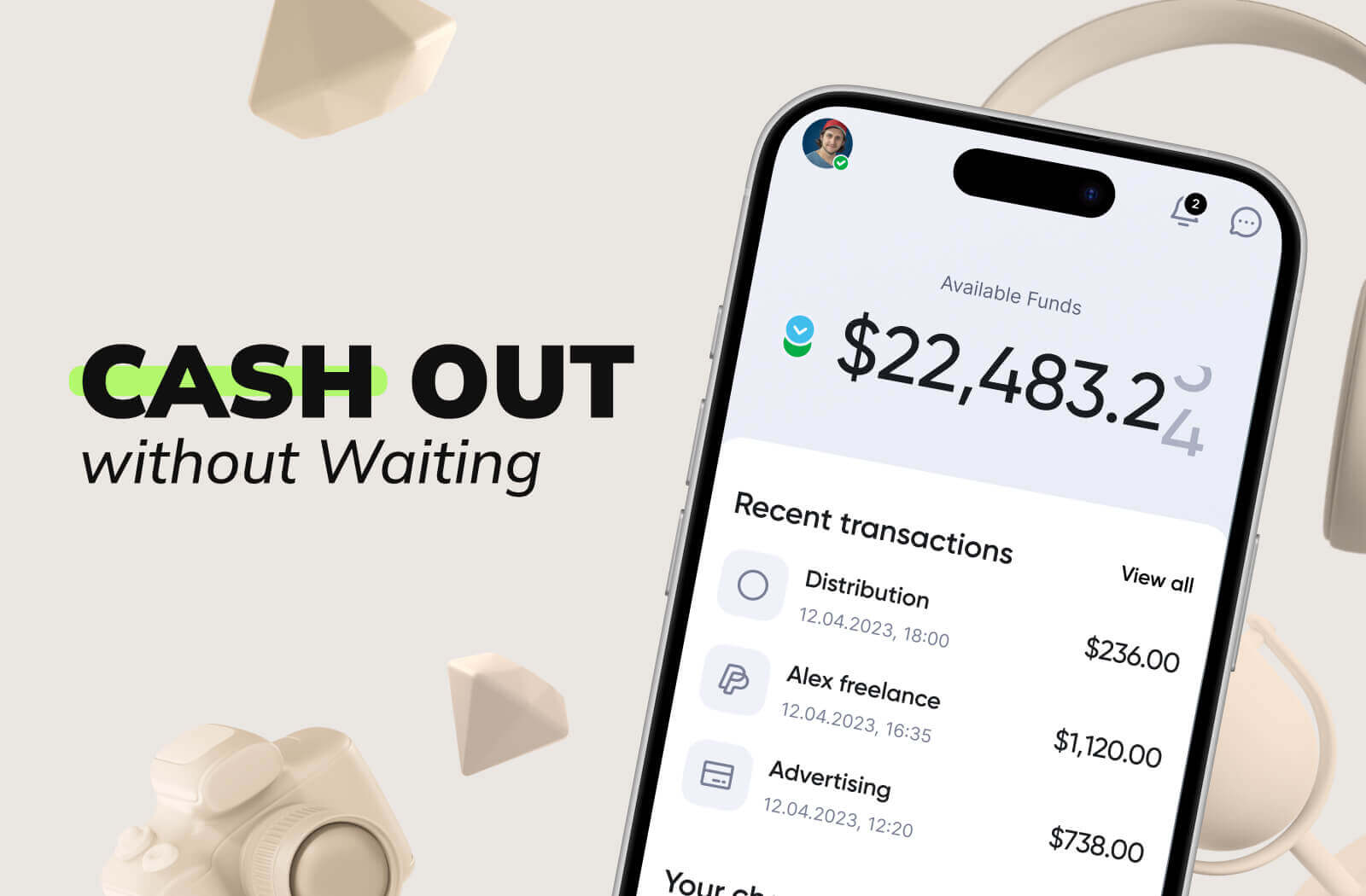
MilX is a banking app built specifically for creators. It helps you get flexible with payouts and funding your channel.
No monthly subscriptions or credit checks. Just your money, moved the way you want it.
Here's what that looks like:
- Active Funds - access up to 6 months of future YouTube revenue upfront. Need to invest in gear, ads, or a new content series? Don't wait for payment cycles. Get the capital now and repay automatically at 5% per month from future income. No tracking headaches, no debt collectors.
- Advance Payments - cash out your already-earned AdSense revenue 50+ days before YouTube's standard payout. The money is yours. Why should it sit in limbo?
- 10+ payout methods - bank card, bank transfer, PayPal, Payoneer, crypto (BTC, USDT, USDC), PIX, Zelle, and more. Cash out in 40+ currencies. Under 5 minutes.
- Free P2P transfers - pay your editor, designer, or collaborator instantly. Zero fees between MilX users.
👉 Check out these top reasons to partner with MilX.
Over 5,000+ creators already use MilX to stay ahead.
- $500M+ in revenue processed.
- Official YouTube Partner.
- Regulated by Canada's Fintrac. 4.6 on Trustpilot.
Whether you're scaling your channel, bridging a seasonal revenue dip, or just tired of waiting on slow payouts - MilX gives you the financial tools to move at the speed of your ambition.
Start with MilX - your free banking app built for creators.