

Short answer first: yes, Premium usually pays you more per view than a traditional ad revenue, but rarely on a steady schedule, and not without trade-offs.
Most creators check their ad numbers and stop there. The YouTube Premium revenue line sits a little lower in the dashboard, gets ignored, and keeps growing in the background. It is real money. It behaves nothing like ad money. And the way it gets handed out moves cash from some channels to others, without anyone noticing.
This blog breaks down how YouTube Premium pays creators, why it runs on watch time instead of ads, who comes out ahead, who gets shortchanged, and how to put that silent income to work for your own channel.
How YouTube Premium Pays Creators
When someone pays for YouTube Premium, they stop seeing ads. That sounds like bad news for you. It is the opposite.
YouTube takes the subscription fee, keeps 45%, and splits the remaining 55% among creators. Same cut as ad revenue. The difference is where the money comes from. Instead of an advertiser paying for an impression, the viewer pays a flat monthly fee, and YouTube divides it based on what that person watched.
Picture a US member paying $15.99 a month. Around $8.79 of that (the 55% creator share) flows into the pool tied to their viewing. If that member spent most of the month on three channels, those channels split the bulk of the $8.69. Watch more of someone’s content, and a bigger slice goes their way.
And the pool keeps getting bigger. YouTube reported 125 million Premium and Music subscribers in early 2025, up from 100 million a year earlier. More members paying in means a larger pot to split, so this stream matters more each year, not less.
Here is the part that matters for small channels: a Premium viewer who would have skipped or blocked every ad still pays you. The view that brings in nothing under the ad model brings in something under Premium. That alone makes this revenue stream worth reading.
👉 For a deeper look at whether Premium hurts or helps your ad income, see our breakdown: Is YouTube Premium killing your ad revenue, or secretly helping it?.
⚡ Quick tip: Open YouTube Studio, go to Analytics, then Revenue. You will find a YouTube Premium line, separate from Watch Page ads. Check what share of your total it already is before you change anything.
Watch Time, Not Ads: The Engine Behind Premium
Ad money rewards the ad. Premium money rewards you the minute.
With ads, your income depends on advertiser demand, your niche CPM, how many ads run, and whether viewers sit through them.
With Premium, none of that applies. YouTube looks at how much Premium watch time your videos pull, compares it to everyone else, and pays you a matching share of the subscription pool. This is YouTube watch time revenue in its clearest form.
👉 You can read YouTube’s own explainer on how Premium revenue reaches creators.
A 14-minute video that holds a Premium viewer to the end can out-pay a 5-minute video with a higher ad CPM, because it banked more Premium minutes. The model does not care how flashy your thumbnail is. It cares about how long people stayed.
That shifts the math on retention. Every extra minute a Premium member watches is a direct claim on the pool. Not an ad slot that might or might not fill. A minute booked, counted, and paid.
⚡ Quick tip: Sort your videos by average view duration, not just by views. The ones with long watch times are your real Premium engines, even when their view count looks modest.
How Much Premium Really Adds to Your Income
For most channels, Premium revenue ranges from 5% to 18% of total YouTube income.
The spread is wide for a reason. A channel with a young, global, mobile audience that lives on Shorts might see 3% to 10%. A channel with long videos and an older, US- or UK-heavy audience can push toward the top of that range, sometimes past it.
In RPM terms, a US-skewed channel often sees an extra $1 to $3 per thousand views from Premium, stacked on top of ad RPM. For long-watch formats such as 8 to 12 minute videos, live streams, or music sets, the effective pay per Premium minute can match or beat an ad-supported minute. That is the upside of creator earnings from YouTube Premium that most people overlook.
Quick math to make it real. Say you pull 500,000 long-form views a month from a mostly US audience at an $8 ad RPM. That is roughly $4,000 from ads. Add a $2 Premium RPM, and you bank about $1,000 more, close to 20% on top of your ad income, for views you already had.
A different audience gives a different result. The principle holds: Premium pays for the attention you already captured.
The catch is consistency. Premium revenue rides on which Premium members happened to watch you that month and for how long. It moves. One month it is 12% of your income, the next it is 7%, with nothing different on your end. That is the trade: more total money, less predictability.
⚡ Quick tip: Track Premium as a rolling three-month average, not month to month. The average tells the truth. A single month lies.
Who Wins From Premium
The Premium pool rewards a specific kind of channel, even if it never announces it.
- Long-watch formats. Tutorials, documentaries, podcasts, video essays, live streams. The more minutes you hold, the larger your slice of the pool.
- Music and leave-it-playing content. Lo-fi, mixes, full albums, sleep, and study tracks. Premium members run these for hours.
- Older and Tier-1 audiences. Premium adoption is higher in the US, UK, Canada, and Australia, and among viewers who can afford a subscription and dislike ads.
- Rewatchable libraries. Back-catalog videos that members return to keep banking watch time long after upload.
Example: A 40-minute history documentary with a US and UK audience can bank more Premium revenue than a viral 60-second Short with ten times the views. The Short grabs attention. The documentary holds it, and Premium pays for the holding.
⚡ Quick tip: If you make one long flagship video a month, give it your best retention work. It is your strongest Premium asset.
Who Gets the Short End
Same pool, opposite result for some.
- Shorts-first channels. Shorts route Premium money through a separate Creator Pool, split by share of views per country, and music licensing skims part of it. Per view, it is thin.
- Sub-three-minute content. Short videos bank a few Premium minutes, so they claim little of the pool, no matter how many clicks they pull.
- Low-Premium markets. If most of your audience sits in regions with low Premium adoption, fewer subscription dollars flow toward you.
- Volume-over-duration strategies. Posting daily 90-second clips can win the algorithm and still leave YouTube subscription revenue on the table.
The music math makes it sharper. On a Short with one licensed track, half of that clip’s pooled revenue goes to cover music, not to you. Add a second track, and two-thirds go to licensing. A catchy song can shrink your cut before you ever see a cent.
None of this means Shorts are worthless. They build reach, subscribers, and discovery. The point is narrower: Shorts and ultra-short videos are weak at capturing subscription money specifically. Know which job each format is doing for you.
⚡ Quick tip: If you are Shorts-heavy, treat Premium as a bonus, not a base. Build at least one long-form series to claim a real slice of the pool.
Your Money, Your Way
Get your YouTube money out on your terms, anytime, in 40+ currencies. Send it to a bank, card, e-wallet, or crypto. With MilX, it is free to start and fully in your hands. Try the MilX app.
Premium vs Ads: Two Different Economies Under One Roof
It helps to stop thinking of Premium as extra ad money. YouTube Premium vs ads revenue is closer to two separate economies sharing one channel. These are the two halves of the YouTube monetization model most creators run at once.
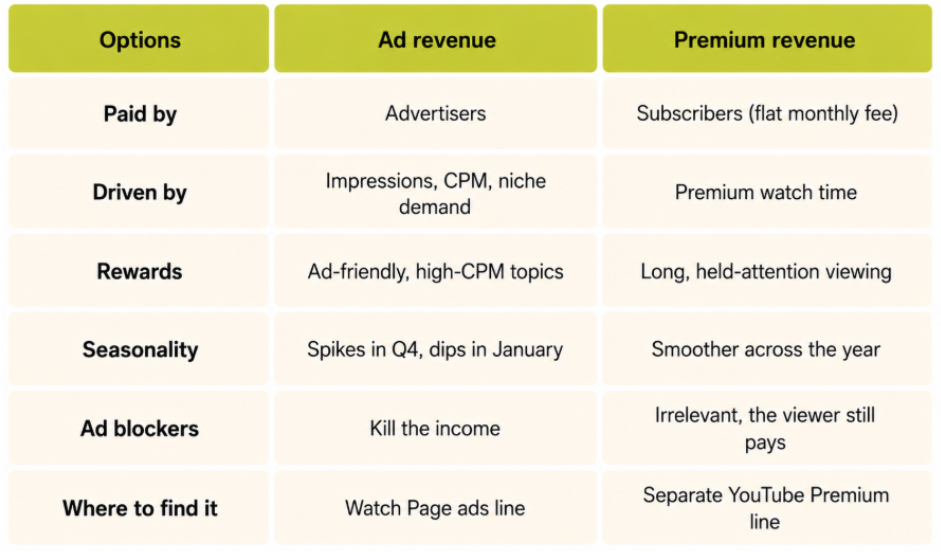
Read the table, and the lesson is plain. Your two main YouTube revenue streams reward different behavior. A channel built purely for ad CPM can underperform on Premium, and a channel built for watch time can lag on ads while cleaning up on subscriptions. Most healthy channels want both.
⚡ Quick tip: Before chasing a high-CPM niche pivot, check how much of your income already comes from Premium. You might be more watch-time rich than you think.
The Revenue Stream Most Creators Never Check
Here is why this money stays invisible. It is silent by design.
It has no notification. No, you-got-a-Premium-view ping. It does not spike with your viral moments the way ad money does. It sits on its own line in Studio that most people scroll past on the way to the ad number. Plenty of creators run for years without once reading it.
That silence costs you. If you never look, you never learn which videos are your Premium engines, you never tune your format mix, and you treat a steady chunk of YouTube Premium revenue as background noise. The number is already in your account. You only have to read it. YouTube’s partner earnings overview shows exactly where each source lands.
Step-by-step: Where to find your YouTube Premium revenue in Studio:
- Step 1. Open YouTube Studio. Go to studio.youtube.com or click your avatar on YouTube → "YouTube Studio".
- Step 2. Go to the Analytics section. In the left sidebar, find Analytics (the chart icon) and click it.
- Step 3. Open the "Revenue" tab. At the top of the Analytics page, you'll see four tabs: Overview, Content, Audience, and Revenue. Click Revenue.
- Step 4. Find the YouTube Premium line. The Revenue page shows a breakdown of your income sources. Most creators land here, glance at the "Ad revenue" line, and leave. Scroll down slightly or look at the full source breakdown; you'll see a separate row labeled "YouTube Premium" (sometimes shown as "YouTube Premium revenue").
- Step 5. Adjust the date range. In the top right corner, change the period to Last 28 days, Last 90 days, or a specific month. A single-day snapshot won't tell you much; you need the trend.
- Step 6. Check the per-video breakdown. Below the main chart, there's a video table. It shows which specific videos generated your Premium revenue. These are your Premium engines, videos that Premium subscribers watch longer and come back to.
👉 Official source: Google Support → Partner earnings overview, covers every revenue source and exactly where it appears in Studio.
⚡ Quick tip: Add the Premium line to your monthly review. One glance: what percentage of the total it is, and which videos drove it. Two minutes, real signal.
How Premium Reshapes Content Strategy
Once you see Premium clearly, your content choices shift.
Retention stops being a soft metric and turns into a direct paycheck. Watch time becomes a line straight into the pool. A few moves follow naturally.
- Stretch strong topics into longer, well-paced videos instead of cutting them to fit a trend.
- Build series and playlists that keep Premium members in one session, video after video.
- Protect your back catalog. Old long videos that still pull watch time still pull Premium money.
- Mix formats on purpose: Shorts for reach, long-form for Premium and depth.
Example: A cooking channel moving from 5-minute recipes to 18-minute cook-along videos holds Premium viewers far longer per session. Same recipes, more banked minutes, more Premium revenue, without chasing extra views.
The goal is simple. Make your best ideas long enough to hold the people who pay by the minute. You do not need to stretch everything.
⚡ Quick tip: Pick your strongest two topics and test a longer cut of each. Then watch the Premium line over the next quarter.
Your Premium Playbook: A Step-by-Step Guide
Everything above turned into steps you can run this week.
- Find your Premium line. YouTube Studio, Analytics, Revenue, then look for the YouTube Premium entry under your revenue sources. Note the number.
- Calculate your Premium share. Divide Premium revenue by total revenue. Under 8% and you are likely Shorts-heavy or in a low-Premium market. Over 15%, and watch time is already paying you well.
- Rank videos by watch time, not views. Your longest-held videos are your Premium engines. They deserve more of your effort.
- Find your Premium audience. Check your top countries. The US, UK, Canada, and Australia carry higher Premium adoption, so content for those viewers tends to pull more subscription revenue.
- Lengthen your best ideas. Take your two strongest topics and build longer, well-paced cuts. Hold attention, and you claim more of the pool.
- Protect the back catalog. Do not delete or hide old long videos that still bank watch time. They keep paying through Premium.
- Read it monthly. Add the Premium line to your monthly check, and track the rolling three-month average so one odd month does not fool you.
- Fix the timing gap. Premium is steadier than ads but still slow to arrive. If cash flow is tight, line up upfront access so you are not financing your channel out of pocket while YouTube holds your money.
Do these eight things, and Premium stops being background noise. It becomes a number you manage on purpose.
YouTube Premium revenue is the income most creators forget they have: more money than they realize, paid for the minutes they hold, and rarely steady enough to plan around. So read that line. Grow it where you can. And do not leave your money parked at YouTube while your bills come due.
Get Paid Before the Views Land
Tap up to 6 months of your future YouTube revenue today with MilX Active Funds. Start free and put your money to work on your schedule, not YouTube’s. Try MilX now.
Premium, Cash Flow, and Income Stability
Premium has one underrated quality: it is steadier than ads across the calendar.
Ad money swings hard. It floods in during Q4 holiday spending and drops off a cliff in January. Premium does not lurch like that. Subscribers pay every month, in summer and in slow weeks, so the Premium line smooths some of the bumps that ads create.
Steadier is not the same as fast. Premium money still rides YouTube’s payout calendar. You wait through the month, wait for it to finalize, then wait for the 21st-to-26th payout window, then wait for the bank. By the time the money lands, you have already paid your editor, bought the gear, and shot three more videos. The income is more stable in size and still slow to arrive.
That gap between the money exists, and the money is in my hands, is where many small creators get stuck. Your revenue, ad, and Premium alike, sit at YouTube for weeks while your bills are due now.
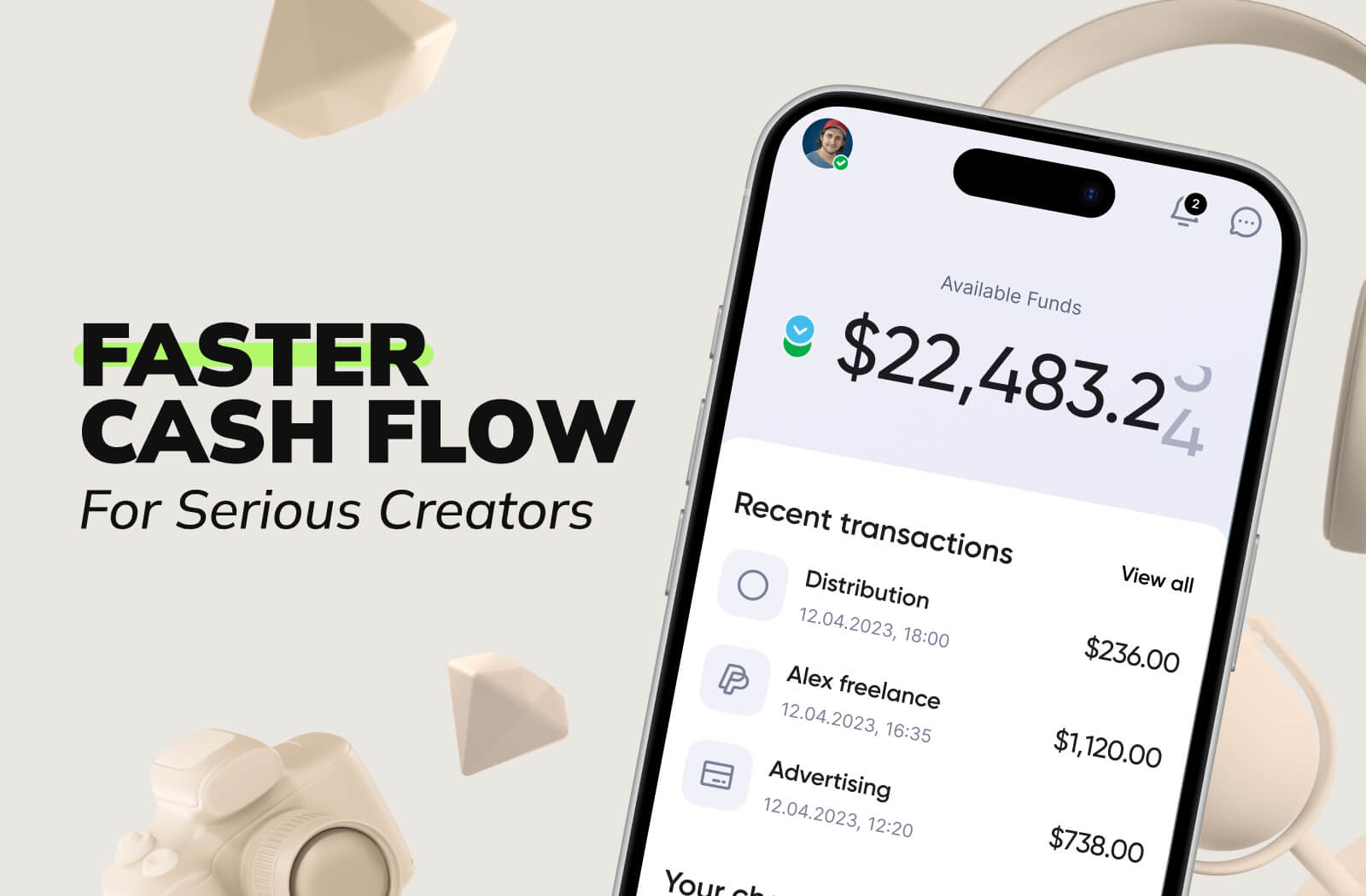
Take Control of Your YouTube Money with MilX
Premium proves a simple truth about creator income from YouTube monetization: the money is real, it builds month after month, and it shows up later than you need it. MilX closes that gap.
There is a better way to handle slow payouts: Active Funds by MilX. Instead of waiting on YouTube’s calendar, you can pull up to 6 months of your future YouTube revenue upfront and put it straight into your next shoot, gear, or ad spend. No waiting for the pool to finalize. And you stay in control.
- Automatic repayment: 5% a month from future income, no manual tracking.
- Low daily commission, starting around 0.33% per day.
- No credit checks and no score required.
- Cash out in 40+ currencies, including crypto.
- 10+ payout methods: bank, card, e-wallet, or crypto.
- Free P2P transfers to editors, designers, and collaborators in under 5 minutes.
MilX is an Official YouTube Partner, with $500M+ in creator revenue already processed and 5,000+ creators on board. Whether you are scaling a series or covering next month’s shoot, you move fast without watching the calendar.
👉 Want the full picture of how it fits together? Explore MilX for creators.